
Private LTE Versus Wi-Fi for Industrial Sites
Compare private LTE versus Wi-Fi for industrial and mobile operations. See where coverage, mobility, security, and backhaul drive the right design choice.

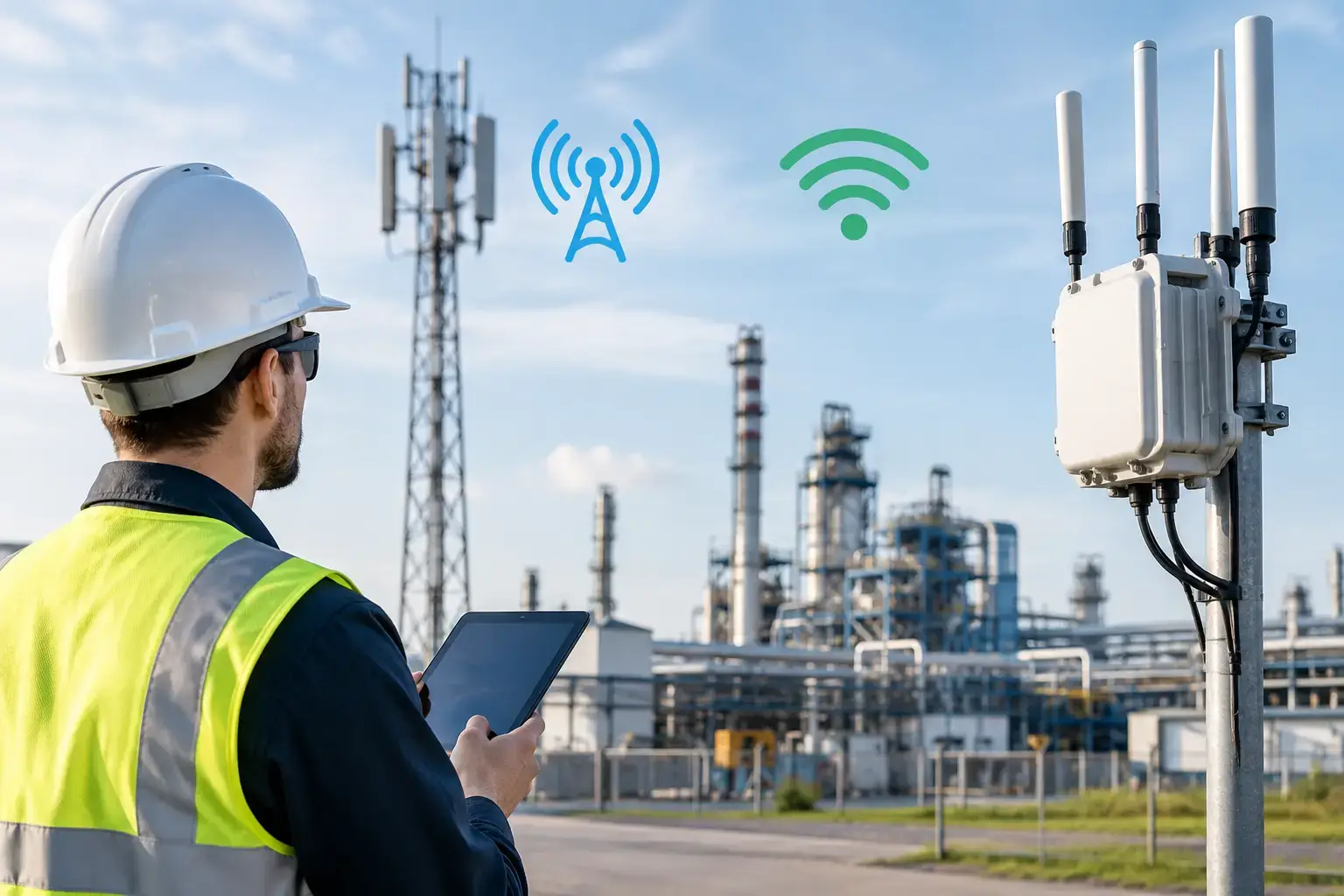
A network that works well in a warehouse can fail quickly across a mine, port, offshore vessel, construction project, or emergency response area. The decision between private LTE versus Wi-Fi is not a matter of choosing the newer technology. It is an engineering decision shaped by coverage area, asset movement, application criticality, spectrum, backhaul, and the operational cost of a dropped connection.
For many field deployments, the right answer is not LTE or Wi-Fi alone. It is a purpose-built architecture that assigns each technology to the work it handles best.
Private LTE Versus Wi-Fi: The Core Difference
Wi-Fi is a local-area networking technology designed for high throughput over relatively short distances. It operates in unlicensed spectrum, uses access points that are generally straightforward to deploy, and supports a broad ecosystem of laptops, tablets, cameras, sensors, and handheld devices. In the right environment, it is economical and highly capable.
Private LTE uses cellular technology under enterprise control. It can operate in licensed, shared, or locally available spectrum, depending on the deployment model and regulatory requirements. Devices authenticate to the network through SIM or eSIM credentials, and the network is designed to manage mobility across larger coverage areas. Rather than building coverage from many closely spaced access points, private LTE can serve a broad outdoor or mixed indoor-outdoor footprint from fewer radio sites.
That distinction has direct operational consequences. Wi-Fi is usually strongest where users are concentrated and the physical environment is predictable. Private LTE is often better suited to wide-area coverage, moving assets, difficult terrain, and applications that cannot tolerate repeated handoff failures or coverage gaps.
Coverage Is More Than a Distance Specification
Published range figures do not tell the full story. RF performance depends on frequency band, antenna height, transmit power, terrain, obstructions, interference, vessel motion, building materials, and the desired level of service at the edge of coverage.
A Wi-Fi network can cover a large facility, but broad coverage often requires a dense access point design. That may be appropriate for office areas, crew quarters, control rooms, terminals, and enclosed industrial spaces. It becomes more difficult when the service area includes open yards, rail corridors, elevated structures, process equipment, or assets operating beyond the facility perimeter.
Private LTE is typically more efficient for those wide-area conditions. Its cellular air interface, spectrum options, and lower-frequency deployment possibilities can support meaningful coverage across outdoor industrial sites with fewer radios. The benefit is not simply fewer towers or poles. It is a network design that can preserve usable service as a vehicle, worker, or vessel moves through the coverage footprint.
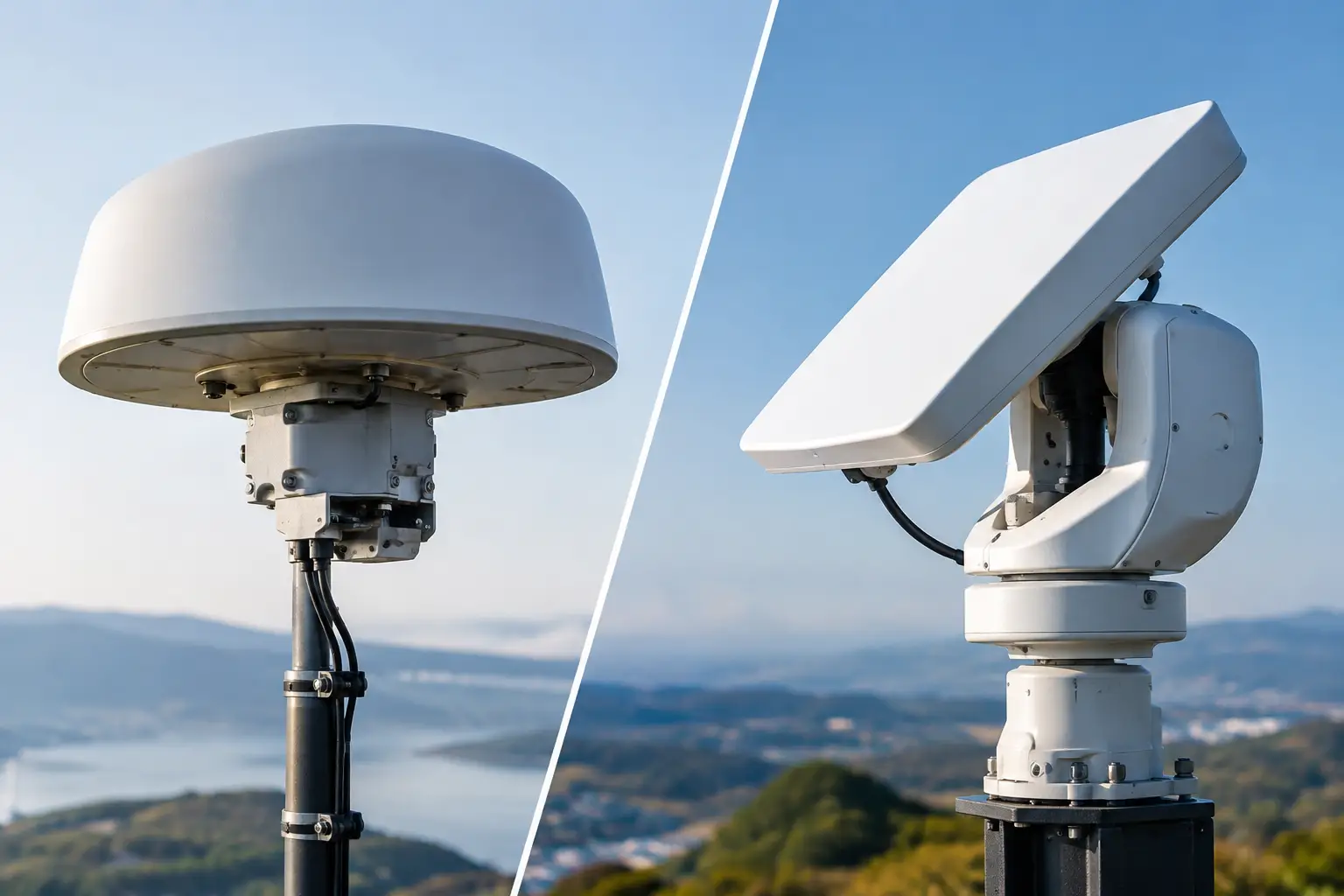
Long-distance connectivity still requires a complete RF design. A private LTE radio cannot overcome poor antenna placement, blocked Fresnel zones, unstable mounting, or an undersized backhaul path. In maritime, mobile command, and remote-field applications, stabilized and auto-aiming microwave systems may be just as important as the LTE access layer. The access network can only perform as well as the transport network supporting it.
Mobility Is Where Private LTE Often Pulls Ahead
Wi-Fi clients can roam between access points, but roaming behavior is heavily influenced by the device, client driver, access point configuration, signal thresholds, and application behavior. A laptop in an office usually handles this well. A vehicle-mounted camera, industrial tablet, autonomous platform, or communications kit traveling at speed through a large site creates a tougher requirement.
Private LTE was built around managed mobility. The network coordinates handoffs between cells, while SIM-based identity gives each device a persistent and controlled connection profile. This is valuable for mobile workforces, fleet operations, port equipment, ground-to-air communications, mobile command centers, and offshore assets that must maintain service while their RF environment changes.
That does not mean every moving device needs LTE. A forklift operating in a compact warehouse may perform well on an engineered Wi-Fi design. The question is whether a brief interruption is merely inconvenient or whether it affects safety, production, situational awareness, command-and-control, or revenue-producing operations.
Capacity Depends on the Traffic Pattern
Wi-Fi can deliver very high throughput in dense, localized areas, particularly when modern access points are properly planned and the RF environment is controlled. It is often an efficient choice for staff connectivity, fixed workstations, local video access, and high-density indoor use.
Private LTE generally trades some peak local throughput for controlled mobility, coverage consistency, and predictable quality of service. Its capacity is shared across the sector, so planners must account for the number of active devices, uplink demand, available spectrum bandwidth, application priority, and busy-hour behavior.
Uplink planning deserves particular attention in industrial deployments. Video surveillance, body-worn cameras, inspection drones, teleoperation, and machine telemetry can create sustained upstream demand. A network built around downlink-heavy assumptions may look acceptable during commissioning and become constrained once operational video and data flows are active.
Neither technology is automatically better for capacity. High-density worker areas may favor Wi-Fi. Broad yards with mobile cameras, vehicles, and sensors may favor private LTE. Many operations benefit from both: Wi-Fi indoors and at high-density fixed locations, LTE across the larger operational area.
Security and Device Control Change the Risk Profile
Both Wi-Fi and private LTE can be secured effectively when they are designed, configured, monitored, and maintained by qualified teams. The difference is in the operating model.
Wi-Fi security commonly relies on enterprise authentication, certificates, segmentation, and carefully managed access policies. It is familiar to most IT teams, but it also serves a diverse client population with varying configuration quality. Guest access, personal devices, and legacy equipment can add administrative complexity.
Private LTE uses cellular-grade identity management through SIM or eSIM credentials. This provides a strong foundation for controlling which devices may attach to the network and for applying service policies to specific device groups. A utility sensor, a crew tablet, a vehicle gateway, and a security camera can be assigned different network treatment without placing them on the same flat network.
Security architecture should still extend beyond radio access. Segmentation, firewall policy, encryption, identity management, logging, and secure backhaul remain necessary. Private LTE is not a substitute for cybersecurity discipline. It gives network operators a useful control layer for managed enterprise devices.
Deployment Cost Must Include Operations
Wi-Fi often has a lower initial barrier because equipment is widely available and implementation is familiar. For contained environments, that can make it the cost-saving solution. But initial hardware cost is only one line item.
A large outdoor Wi-Fi design may require many access points, mounting locations, power runs, fiber or wireless distribution links, weather protection, and ongoing RF tuning. In harsh locations, each field visit has a cost. On vessels, remote energy sites, and temporary deployments, physically reaching the equipment can be more expensive than the equipment itself.
Private LTE can require greater upfront planning. Spectrum access, core network design, SIM management, radio selection, and specialized integration must be addressed early. Yet for a large or mobile footprint, fewer well-positioned radio sites and stronger mobility behavior can reduce complexity over the system life.
The proper comparison is total operational cost: design, installation, spectrum, backhaul, maintenance, device onboarding, support workload, expansion, and the cost of downtime. A low-cost network that repeatedly loses communications at the edge of a work area is not low-cost in practice.
When Wi-Fi Is the Better Fit
Wi-Fi is often the practical choice for offices, fixed indoor facilities, control rooms, warehouses, crew accommodations, and high-density areas where devices remain relatively stationary. It also works well as a complementary network for employee access and local high-bandwidth applications.
Choose Wi-Fi when the coverage area is contained, AP placement is practical, client density is high, and temporary roaming interruptions do not create operational risk. It is especially effective where the organization already has strong enterprise Wi-Fi management capabilities and the environment does not impose extreme RF or maintenance constraints.
When Private LTE Is the Better Fit
Private LTE is usually worth serious consideration when coverage must extend over large outdoor areas, between buildings, along roads, across a port, through a processing site, or across terrain where cable infrastructure is expensive or impractical. It is also well suited to fleets, mobile teams, fixed and mobile video, industrial sensors, and applications requiring controlled mobility.
For remote and mission-critical deployments, BATS Wireless approaches private connectivity as part of a complete system. LTE or 5G access, antenna placement, long-range backhaul, tracking capability, radio compatibility, and field support need to work as one operational design. A cellular network installed without dependable transport and properly engineered RF paths will not deliver the continuity the mission requires.
Build for the Operating Environment
The best design starts with the work being performed, not a preference for a technology label. Map where people, vehicles, sensors, cameras, and command systems operate. Identify the applications that must remain connected, their uplink and downlink needs, acceptable latency, and the consequence of interruption. Then evaluate terrain, structures, interference, spectrum availability, mounting constraints, power, backhaul, and future expansion.
In many cases, the answer will be a hybrid network. Wi-Fi serves localized and high-density areas. Private LTE extends managed coverage across the field. Stabilized microwave, point-to-point links, fiber, satellite, or other transport methods carry traffic back to the core. Each layer has a defined role.
A useful next step is to test the network decision against a real operating day: a vehicle crossing the farthest yard, a crew boarding a vessel, a camera streaming at peak activity, and a backhaul path operating in poor weather. The architecture that holds up under those conditions is the one worth deploying.
November 25, 2026

November 25, 2026
November 25, 2026

November 25, 2026
