
Private 4G vs WiFi: Which Fits the Site?
Private 4G vs WiFi for industrial and mission-critical sites: compare coverage, mobility, security, latency, cost, and deployment trade-offs.

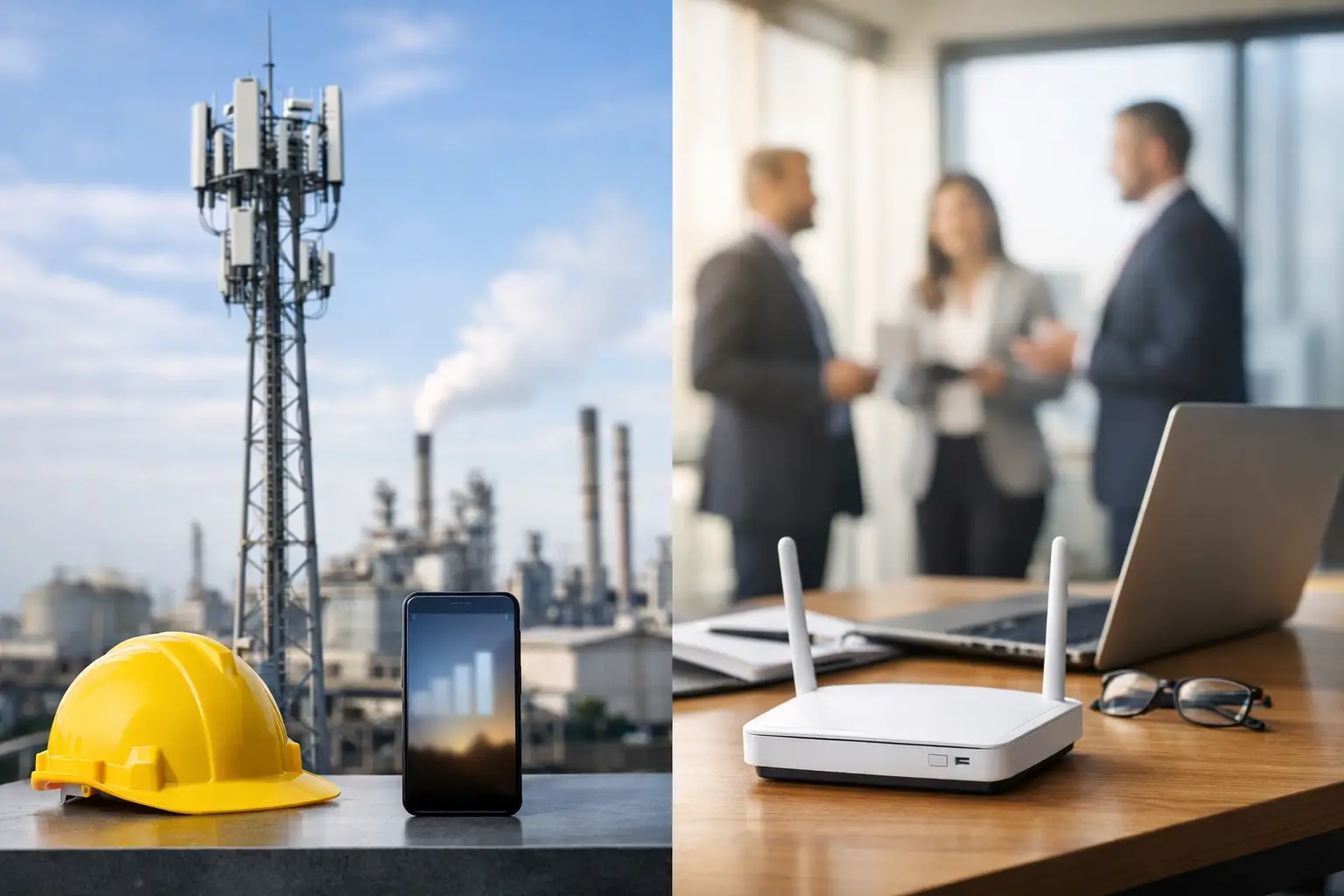
A warehouse with dense steel racks, a port with moving cranes, a wind farm spread across miles, and a temporary disaster response base all have the same problem: standard connectivity assumptions break down fast. That is where the private 4G vs WiFi decision becomes operational, not academic. The right choice affects coverage, handoff performance, device behavior, security policy, and how much engineering effort it takes to keep the network usable under field conditions.
For many organizations, this is not an either-or question in the abstract. It is a design choice tied to geography, mobility, interference, traffic type, and service continuity requirements. If the environment includes moving assets, large outdoor coverage areas, or hard-to-reach zones where public networks are inconsistent, private 4G often changes the economics and the reliability profile. If the site is smaller, mostly indoor, and built around high-throughput local access for laptops, scanners, and tablets, WiFi may still be the more efficient fit.
Private 4G vs WiFi at a practical level
The simplest difference is architectural. WiFi is a local area networking technology designed for relatively short-range access, usually with high capacity in contained spaces. Private 4G is a licensed or shared-spectrum cellular system built for managed mobility, broader-area coverage, and more deterministic device behavior across a larger footprint.
That distinction matters because operational environments rarely fail on peak speed alone. They fail at the edges – when vehicles move between coverage zones, when interference rises, when metal structures absorb signal, or when temporary infrastructure has to go live quickly. In those conditions, private 4G often provides better control over coverage planning, user prioritization, and mobility handling.
WiFi remains valuable because it is familiar, cost-effective, and widely supported. It can deliver very high throughput over short distances and works well in offices, control rooms, terminals, and indoor production zones. But WiFi performance depends heavily on careful access point placement, RF tuning, and client behavior. In industrial and outdoor deployments, those variables can become a liability.
Coverage and mobility are usually the deciding factors
If a site spans a campus, yard, port, mine, rail corridor, or offshore platform, private 4G has a structural advantage. A cellular network can cover larger areas with fewer radios than a WiFi design, especially outdoors. That reduces the amount of edge infrastructure required and simplifies mobility across the site.
Handoffs are another critical distinction. WiFi roaming has improved, but it still depends on client device behavior and vendor interoperability. In practice, that means one device may transition cleanly while another holds onto a weak signal too long or disconnects during movement. For autonomous vehicles, field tablets in moving trucks, body-worn systems, or onboard connectivity, that inconsistency is a problem.
Private 4G handles mobility as a core function. Devices are designed to remain attached while moving between cells, and the network manages that transition in a more controlled way. In field operations where continuity matters more than burst speed, that difference is often the reason buyers move toward private cellular.
Capacity and throughput are more nuanced than they seem
Many teams default to WiFi because they associate it with higher speed. In a contained indoor environment, that can be true. WiFi is well suited for high-throughput access in offices, logistics facilities, and production areas where users are relatively stationary and access points can be densely deployed.
Private 4G is not usually chosen because it wins a headline speed test. It is chosen because it delivers usable performance over a much larger area with better control over who gets resources and when. That makes it more predictable for telemetry, voice, video, operational apps, and connected equipment.
The trade-off is straightforward. If the requirement is very high local bandwidth in a confined space, WiFi may be the better primary layer. If the requirement is sustained coverage and mobility across a large or complex environment, private 4G often produces a better operational result even if raw peak throughput is lower.
Security and control in private 4G vs WiFi
Both technologies can be secured well when designed properly. The real question is how much control the organization needs over authentication, segmentation, SIM-based identity, traffic policy, and RF access.
Private 4G brings a cellular security model that many industrial and government users prefer for controlled access environments. SIM or eSIM credentials create a more tightly managed endpoint identity model, and the network can apply policy in a structured way across user groups, devices, and applications. That is especially useful when supporting mixed fleets of sensors, handhelds, vehicles, cameras, and specialist equipment.
WiFi security has advanced significantly, but endpoint onboarding and credential management can become difficult at scale, particularly with shared devices, contractor access, and industrial IoT. A well-run WiFi network can absolutely meet enterprise requirements. The issue is often operational overhead and consistency, not theoretical capability.
Deployment complexity depends on the environment
WiFi is often faster to deploy for straightforward indoor sites. The equipment ecosystem is broad, local IT teams understand it, and the design process is familiar. If the use case is office coverage, a control center, or a small industrial building, WiFi can be the right answer with less initial complexity.
Private 4G requires more planning. Spectrum strategy, radio design, core architecture, device compatibility, and integration with backhaul all need to be addressed. That can look heavier at the start, but in large outdoor or mobile environments, the result is often a cleaner long-term architecture with fewer coverage gaps and less maintenance burden.
This is where engineered deployment matters. A private cellular network is not just radios on poles. It is coverage design, path planning, antenna placement, backhaul resilience, and device validation. In sectors such as maritime, defense, construction, public safety, and oil and gas, those details determine whether the network performs under operating conditions or only in a site survey.
Where WiFi still makes the most sense
WiFi remains the practical choice when users are concentrated indoors, device movement is limited, and the main objective is low-cost local access. Offices, maintenance buildings, temporary admin spaces, and high-density indoor work areas are common examples.
It also works well as part of a layered architecture. Many sites use WiFi indoors for staff access and high-throughput local connectivity while relying on private 4G outdoors for vehicles, field devices, and broad-area operations. That hybrid model is often more effective than forcing one technology to cover every use case.
The mistake is assuming WiFi can simply be extended outward indefinitely. As the area grows, as mobility increases, and as interference sources multiply, the design becomes harder to stabilize. What starts as a low-cost option can turn into an ongoing troubleshooting exercise.
Where private 4G delivers the strongest value
Private 4G is especially effective in environments with large footprints, moving assets, sparse infrastructure, or mission-critical traffic. Ports, utility sites, energy facilities, rail operations, airfields, remote industrial campuses, and temporary field deployments are strong candidates.
It also fits sites where continuity matters more than convenience. If the cost of a dropped session includes lost visibility, delayed operations, or safety risk, private cellular deserves serious consideration. The value is not only signal reach. It is the ability to engineer a controlled wireless layer around the actual operation.
For organizations with mixed indoor and outdoor demands, private 4G can also reduce the number of access points and network touchpoints needed across the wider site. That can simplify operations and improve coverage consistency, particularly when paired with engineered backhaul and sector-specific antenna systems.
How to make the right call
The best decision starts with the operating model, not the technology label. Ask how far the network needs to reach, whether devices are stationary or moving, what applications must stay connected, and how much downtime or inconsistency the operation can tolerate.
If the site is mostly indoor, user density is high, and roaming is not mission-critical, WiFi is often sufficient and cost-effective. If the site is spread out, outdoor-heavy, mobile, or exposed to harsh RF conditions, private 4G usually offers better control and reliability. If both conditions exist, a hybrid design is often the right architecture.
That is the practical reality of private 4G vs WiFi. One is not universally better than the other. The better system is the one that matches the terrain, the traffic, the devices, and the consequences of failure. For high-stakes environments, that usually means treating wireless as engineered infrastructure rather than a commodity IT service.
When the network has to keep working beyond the office walls, the smartest path is to design around the operation first and let the radio layer follow.
September 20, 2026

September 20, 2026

September 20, 2026
September 20, 2026
