
Microwave Backhaul vs Fiber: Which Fits?
Microwave backhaul vs fiber comes down to terrain, uptime, speed, and cost. See which backhaul model fits remote and mission-critical networks.


When a site is waiting on connectivity, the real question is rarely bandwidth alone. The decision around microwave backhaul vs fiber usually comes down to deployment speed, terrain, uptime risk, and how much control you need over the network once it is live. For industrial operators, public safety agencies, maritime programs, and private LTE or 5G teams, that decision can shape both performance and operational continuity for years.
This is not a simple case of one technology replacing the other. Fiber is often treated as the default gold standard, while microwave is framed as the workaround. In the field, that assumption breaks down quickly. If your network must reach a wind farm, a temporary command post, an offshore platform, a remote industrial site, or a moving asset, the best answer depends on what the environment allows and what the mission can tolerate.
Microwave backhaul vs fiber in real deployments
Fiber delivers high capacity, low latency, and long-term scalability when the route is available and the build is practical. In dense metro corridors or fixed campuses with existing conduit and favorable permitting, it is often the right strategic investment. Once installed properly, fiber can support substantial throughput growth without changing the physical path.
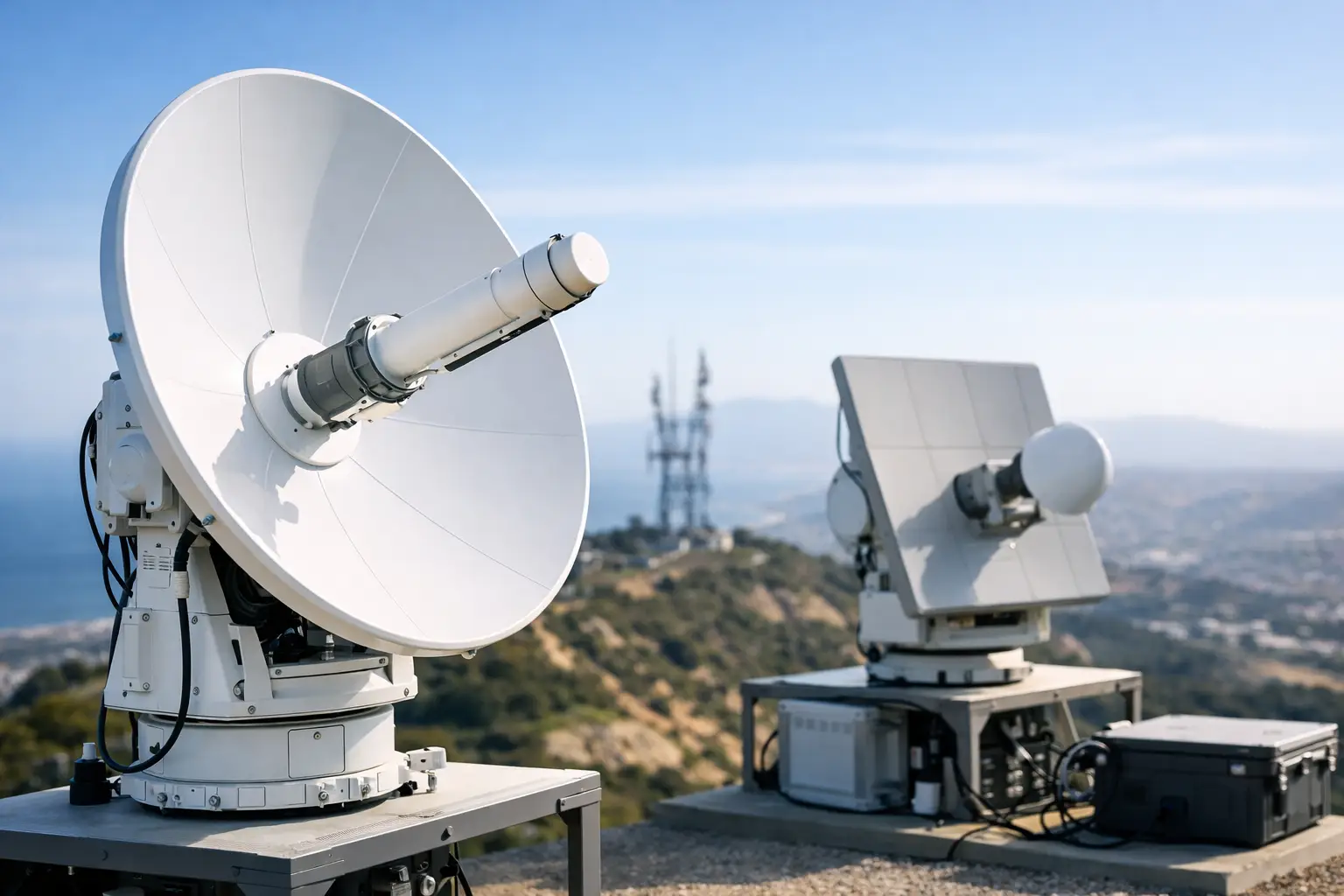
Microwave backhaul solves a different set of problems. It is built for situations where trenching is expensive, delayed, restricted, or simply impossible. A well-engineered microwave link can deliver strong throughput, predictable performance, and rapid time to service across terrain that would make fiber deployment slow and costly. That matters in sectors where communications are tied directly to safety, logistics, production, or mobile operations.
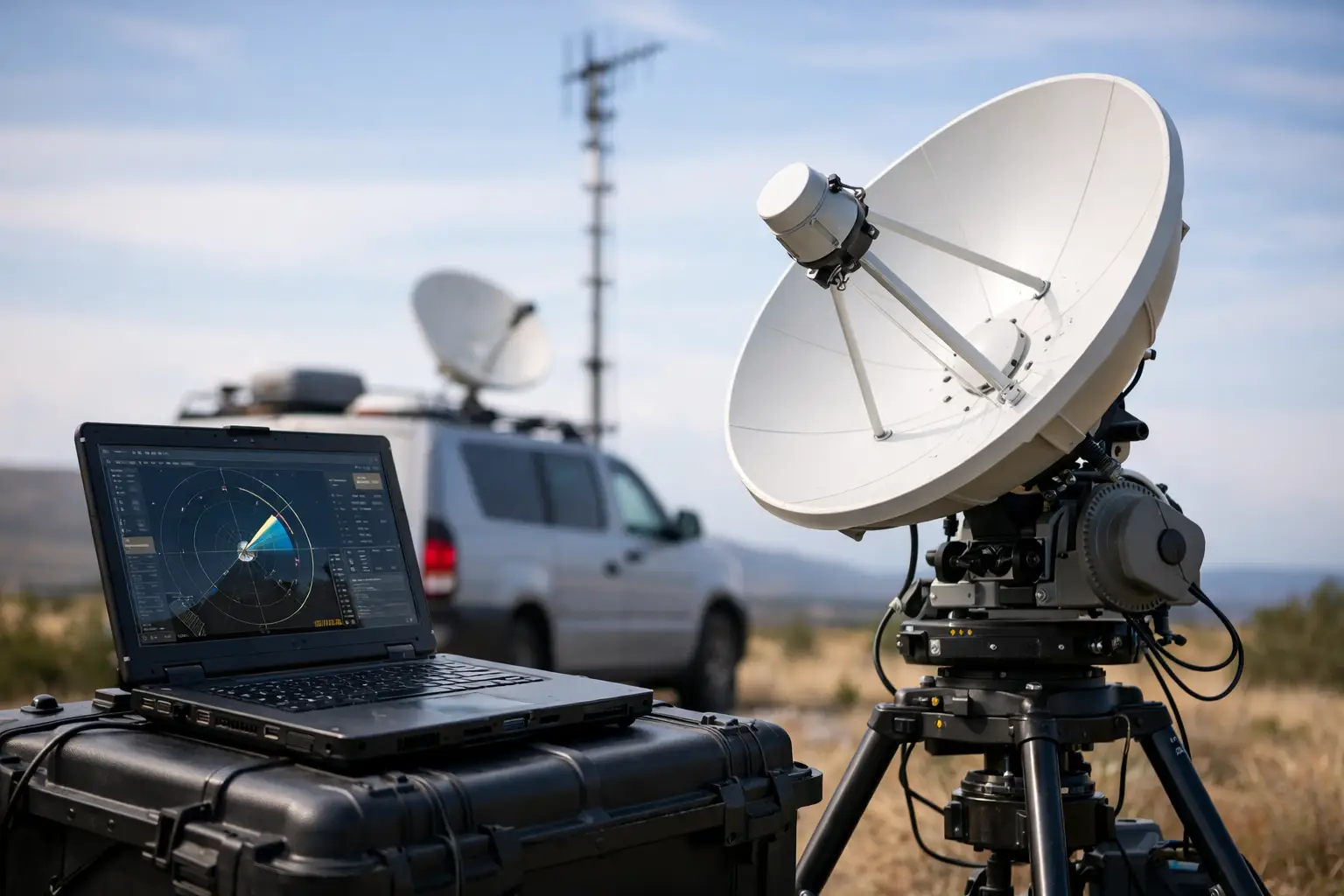
The comparison gets more nuanced when the network is not static. Fiber is fixed infrastructure. Microwave can be fixed, rapidly redeployed, or integrated into stabilized and auto-aiming systems where mobility is part of the mission. That flexibility changes the economics and the risk profile.
Capacity and latency are only part of the story
Fiber still leads on absolute capacity. If you need extremely high aggregate throughput over the long term and have a viable route, fiber gives you headroom that is hard to match. It also delivers very low latency, which can matter for certain edge workloads, data center interconnects, and highly synchronized applications.
But many backhaul decisions are not made at the theoretical limit. They are made around the actual service level the operation needs. Private wireless networks, video surveillance, SCADA traffic, voice, IoT telemetry, mobile command systems, and segmented enterprise traffic often perform well on properly designed microwave links. Modern microwave systems can support substantial throughput with carrier-grade reliability when path engineering, spectrum planning, and antenna selection are done correctly.
Latency is also more contextual than many buying discussions suggest. In many field deployments, the latency difference between microwave and fiber is not the primary constraint. The bigger issue is whether the site can be connected at all within the required timeline and budget. A delayed fiber build that arrives nine months late is not more useful than a microwave link that is operational this quarter.
Deployment timelines change the business case
This is where microwave often has a decisive advantage. Fiber construction introduces dependencies that network teams do not fully control: right-of-way approvals, utility coordination, environmental review, civil works, contractor availability, and route remediation. Even when fiber is the long-term target architecture, those variables can push service activation far beyond the original plan.
Microwave can reduce that delay significantly. If line of sight is available, and the system is engineered to the path, deployment can move much faster. That can be a cost-saving solution even before you compare construction expense. Faster turn-up means earlier production, earlier site readiness, better continuity during expansion, and fewer temporary workarounds.
For temporary sites, emergency response operations, construction projects, and staged infrastructure rollouts, speed is not a convenience. It is part of the requirement. In those environments, microwave is often the more operationally sound option.
Terrain, geography, and mobility often decide the answer
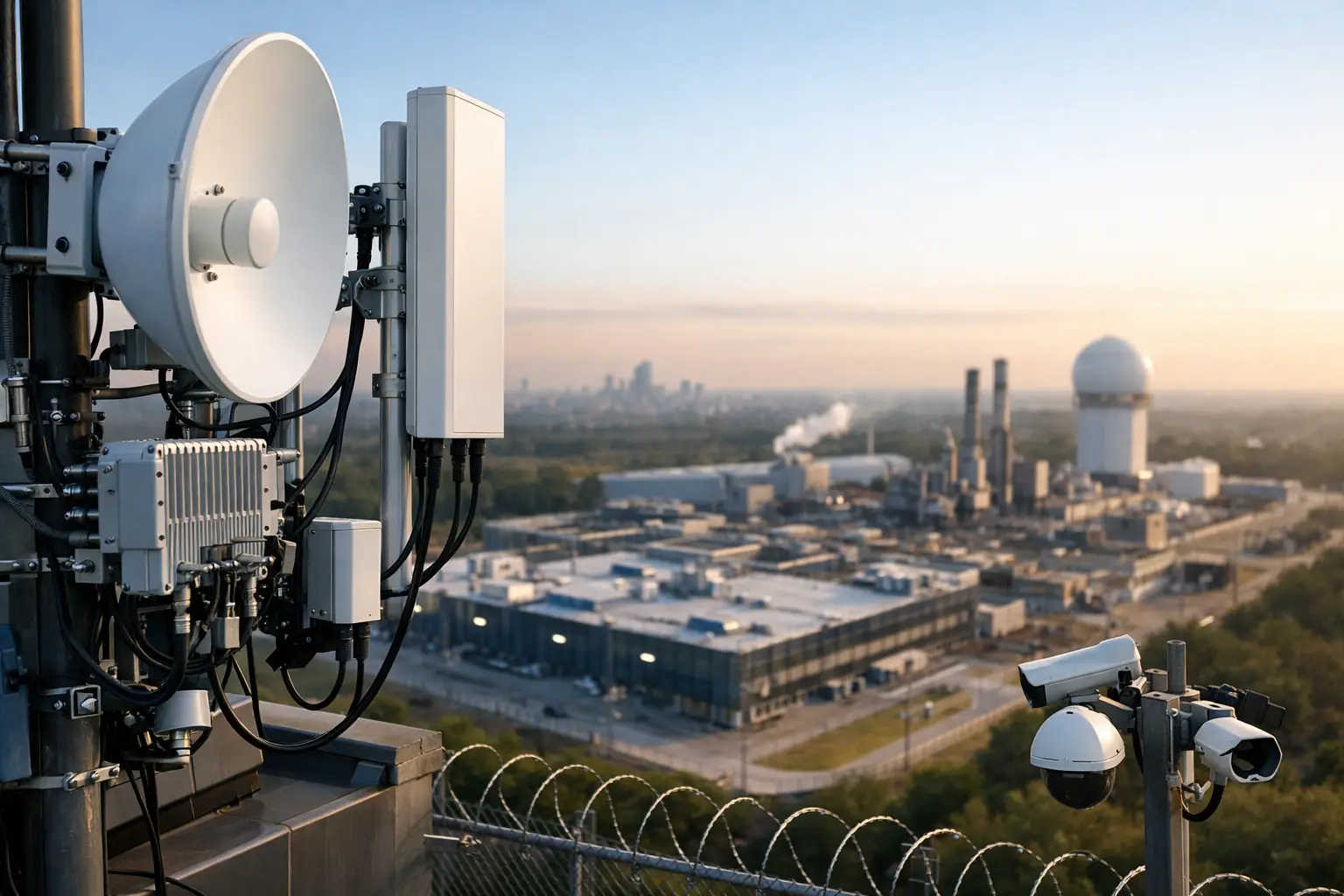
The farther you move from urban utility corridors, the less useful generic fiber assumptions become. Rocky terrain, wetlands, protected areas, port facilities, offshore routes, mountain paths, and dispersed industrial assets can make trenching costly or heavily constrained. In those conditions, microwave is not a second-choice technology. It is frequently the most practical design path.
Mobility adds another layer. Fiber cannot follow a vessel, support an onboard network directly, or adapt to a moving command platform. Stabilized microwave systems and auto-aiming antenna platforms are designed for these exact conditions, maintaining directional performance where conventional fixed links would fail. That matters in maritime operations, defense, and mobile field deployments where the network edge is constantly shifting.
For organizations operating across mixed environments, the answer is often hybrid. Fiber may serve as a core transport layer into a regional hub, while microwave extends that connectivity to remote, temporary, elevated, offshore, or mobile endpoints. That architecture gives operators both capacity and reach without forcing every site into the same infrastructure model.
Reliability depends on engineering, not marketing claims
Fiber is often described as inherently more reliable, but that shorthand leaves out real failure modes. Buried fiber can be cut during construction, damaged by environmental events, or disrupted by third-party utility work. Repair times can be long, especially in remote areas or complex rights-of-way. If a route lacks physical diversity, fiber can become a single point of failure.
Microwave has its own design considerations, including rain fade, path obstruction, interference risk, and alignment quality. Those are real factors, not footnotes. But they are manageable with proper frequency selection, fade margin design, antenna sizing, path calculation, and system integration. In mission-critical environments, the difference between a stable link and a problematic one usually comes down to engineering discipline.
This is where buyers should be skeptical of broad claims from either side. The meaningful question is not whether fiber or microwave is more reliable in the abstract. It is how the proposed network will perform in your specific geography, spectrum environment, weather profile, and maintenance model.
Cost needs to be measured over the full project
A superficial cost comparison can be misleading. Fiber may appear attractive on a per-bit basis once it is installed, but installation is often the largest variable. Civil works, permits, route preparation, restoration, and timeline overruns can push total project cost far beyond the original estimate. That is especially true in difficult terrain or low-density service areas.
Microwave typically avoids much of that construction burden. It can lower upfront deployment cost, reduce time-to-service, and make remote sites economically viable. It also gives organizations more flexibility when network footprints shift. If a temporary industrial site closes or an operational layout changes, a microwave asset can often be repurposed. Fiber in the ground cannot.
That does not make microwave automatically cheaper over every horizon. If you have a permanent high-capacity site with straightforward access to existing fiber infrastructure, fiber may be the more efficient long-term investment. But if the project includes uncertainty, mobility, terrain constraints, or a tight activation schedule, microwave often provides better overall economics.
Security and control matter in private networks
For government, defense, utilities, and industrial operators, backhaul is not just a transport issue. It is part of the security model. Both fiber and microwave can be secured effectively, but each has different exposure points and operational controls.
Private fiber offers strong physical isolation when routes are owned or tightly controlled, but route access and third-party dependence still matter. Microwave introduces an over-the-air segment, which means encryption, authentication, radio hardening, and network architecture must be handled properly. In return, operators often gain more flexibility in where and how they establish communications, particularly in fast-moving or austere environments.
For private LTE and 5G, that flexibility is often a major advantage. Backhaul has to align with the radio access design, the site topology, and the service priorities. An engineered wireless backhaul layer can support that architecture without forcing the project to wait for civil infrastructure.
So which one fits?
If the site is permanent, high-capacity demand is growing fast, and fiber can be delivered without major route, cost, or schedule risk, fiber is often the right call. If the site is remote, temporary, mobile, difficult to trench, or under pressure to go live quickly, microwave is frequently the more effective option.
Many of the strongest networks use both. They treat fiber as a core asset where it makes sense and microwave as a high-performance extension layer for the places fiber cannot reach efficiently. That is often the architecture that best matches real operating conditions, especially in sectors where uptime and adaptability matter more than textbook assumptions.
At BATS Wireless, that is the practical lens that matters most: not which technology wins the debate, but which backhaul design keeps the mission connected when the environment stops being simple.
August 31, 2026
August 31, 2026

August 31, 2026
August 31, 2026
