
Why Use Private 4G Connectivity in the Field?
Why use private 4G connectivity? Learn how enterprises gain controlled coverage, security, mobility, and dependable uptime in remote, demanding operations.

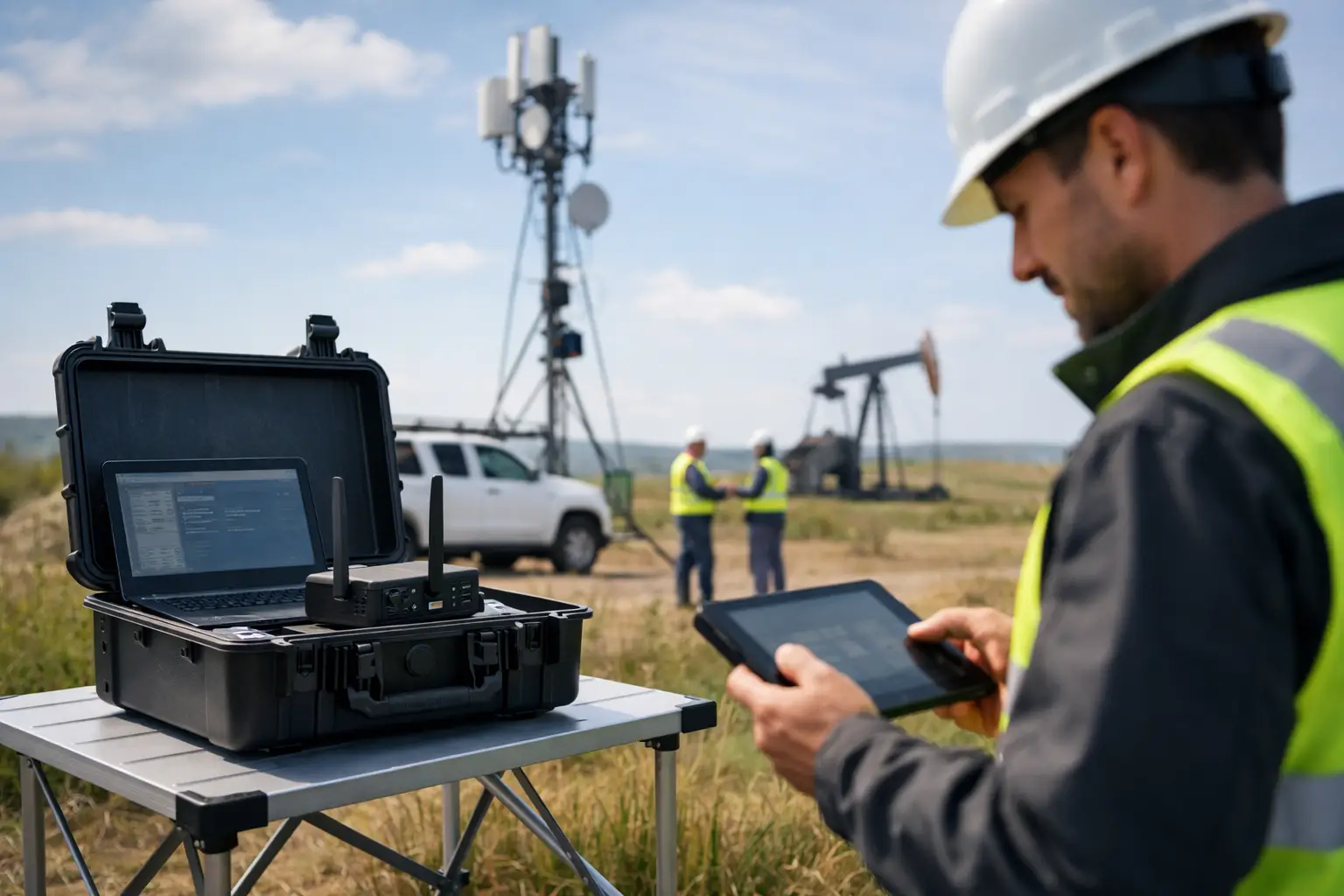
A drilling crew loses public cellular service 40 miles from the nearest town. A patrol boat moves beyond marina Wi-Fi. A construction site expands faster than the local carrier can add capacity. These are not edge cases for industrial operators. They are common reasons to ask: why use private 4G connectivity when existing wireless options appear to be available?
The answer is operational control. Private 4G gives an organization a dedicated cellular network designed around its assets, geography, traffic priorities, and security requirements. Instead of depending entirely on public carrier coverage or trying to stretch Wi-Fi across a dynamic work area, operators can build a managed LTE environment that supports people, vehicles, sensors, cameras, and critical applications under one network architecture.
Why Use Private 4G Connectivity for Critical Operations?
Private 4G is LTE deployed for the use of a specific organization, site, or operational group. It can use licensed spectrum, shared spectrum such as CBRS in the United States, or other authorized spectrum arrangements. The network typically includes radios, antennas, a cellular core, subscriber devices or SIMs, backhaul, and a management layer.
Its central advantage is not simply higher speeds. It is the ability to engineer connectivity for the work being done.
A public network is designed to serve a broad population. Its coverage footprint, capacity planning, upgrade schedule, and traffic policies belong to the carrier. That model works well for ordinary business mobility, but it may not fit a mine, port, refinery, wind farm, disaster area, offshore vessel, military training range, or large temporary project site.
With private 4G, the organization decides where coverage is needed, which applications receive priority, who can connect, and how the network integrates with existing systems. A field team can maintain cellular connectivity across a defined operational area without relying on the availability or congestion level of the nearest commercial tower.
Coverage Built Around the Work Area
Cellular coverage is often treated as a fixed utility. In demanding environments, it is an engineering problem. Terrain, steel structures, water, moving equipment, elevation changes, RF interference, and distance all affect performance.
Private LTE allows coverage to be designed around those realities. A network can use sector antennas for a broad yard, directional antennas for a corridor or point-to-point extension, and specialized antenna systems where a platform or vehicle is in motion. The objective is not generic signal bars. It is usable, predictable service where operators need to communicate, collect data, monitor video, and coordinate assets.
This approach is especially valuable when operations move. Construction projects change shape. Emergency response perimeters shift. Maritime vessels travel through areas with inconsistent shore coverage. Private 4G can be deployed as a fixed system, a temporary field network, or part of a mobile communications architecture with engineered backhaul.
Mobility That Wi-Fi Was Not Designed to Deliver
Wi-Fi remains useful for offices, warehouses, and localized access areas. It is often cost-effective, familiar, and capable of high throughput at short range. But a large industrial campus or outdoor operation exposes its limitations.
A device moving between Wi-Fi access points may experience handoff interruptions, inconsistent roaming behavior, or coverage gaps. Extending Wi-Fi across wide outdoor areas can require a dense access-point layout and careful channel planning. That can become difficult around heavy machinery, large vehicles, metal infrastructure, and uneven terrain.
Private 4G was designed for mobility. LTE manages handoffs between cells, supports a broad ecosystem of purpose-built devices, and can cover considerably larger areas per radio site than Wi-Fi in many deployment scenarios. For connected vehicles, tablets, body-worn devices, inspection tools, drones, cameras, and machine telemetry, that mobility model can reduce operational friction.
It does not mean LTE replaces Wi-Fi everywhere. Many organizations use both. Wi-Fi can serve indoor high-density areas, while private 4G provides wide-area mobility, outdoor coverage, and continuity between operational zones.
Security and Traffic Control at the Network Layer
For critical infrastructure and government operations, connectivity is not only a coverage question. It is also a security and policy question.
Private 4G uses SIM-based authentication, allowing administrators to control which devices are permitted on the network. Devices can be provisioned, managed, revoked, and segmented by role. A camera system can be placed in a different policy group from employee tablets. Operational technology traffic can be separated from guest or contractor access. Priority rules can protect command communications and safety applications when bandwidth demand rises.
This is a meaningful distinction from open or lightly managed wireless networks. A private cellular network gives the operator more direct control over identity, traffic treatment, and access boundaries. It can also be integrated with enterprise security tools, private data centers, cloud applications, and existing IP networks.
Security still depends on the design and operating discipline behind the network. SIM controls, encryption, firewall policy, core-network configuration, device management, and physical infrastructure protection all matter. Private 4G improves control, but it does not eliminate the need for a defined cybersecurity and lifecycle-management plan.
Predictable Performance for Video, Voice, and Data
Not every packet carries the same operational value. A high-definition inspection camera, push-to-talk voice session, SCADA alarm, equipment telemetry feed, and employee web session should not necessarily compete on equal terms.
Private LTE enables quality-of-service policies that can prioritize traffic according to mission needs. This helps organizations protect latency-sensitive or safety-related communications when the network is busy. It also supports a more deliberate capacity model than best-effort connectivity alone.
For example, a port operator may need reliable connectivity for crane telemetry, terminal operating systems, mobile work orders, and security video. An oil and gas field may need remote monitoring data alongside crew communications. A public safety agency may need incident command traffic to take precedence over routine applications. Network policy can reflect those priorities.
Performance expectations should remain realistic. Private 4G is not a substitute for adequate backhaul, proper RF design, or capacity planning. Video-heavy applications can consume significant bandwidth. Long distances, poor antenna placement, and obstructed paths can reduce service quality. The benefit comes from designing the complete system rather than assuming a cellular radio alone solves the problem.
Private 4G Can Be a Practical Step Before 5G
Many buyers assume a new private wireless deployment must begin with 5G. In some cases, 5G is the right choice, particularly where very high device density, advanced edge applications, or specific 5G capabilities justify the investment.
But private 4G remains a practical and proven option for many field deployments. LTE devices are widely available, the technology is mature, and its performance is sufficient for a broad range of industrial applications. Cameras, fleet communications, IoT sensors, mobile workforce tools, voice services, and remote monitoring often do not require 5G to deliver operational value.
A well-designed private 4G network can also provide a migration path. Infrastructure decisions should consider future spectrum strategy, radio compatibility, core-network evolution, backhaul capacity, and the ability to introduce 5G where it produces a clear benefit. The right question is not whether 4G or 5G is newer. It is which architecture meets the mission, budget, timeline, and device requirements.
The Deployment Decisions That Determine Results
Private 4G is most effective when it is treated as an engineered communications system, not an equipment purchase. The first decision is the operational objective: extend coverage, connect moving assets, replace weak Wi-Fi, support temporary operations, improve security, or provide a backup communications path.
From there, network planners need to evaluate spectrum availability, coverage area, terrain, user count, application traffic, device compatibility, power, mounting locations, and backhaul. Remote systems may require microwave links, satellite integration, fiber extension, or a combination of transport methods. On moving platforms, antenna stabilization and tracking can be as important as the LTE radio itself.
Organizations should also decide how the network will be operated. Some need a fully managed model with monitoring and technical support. Others need local control with integration into existing network operations. Both approaches can work, provided ownership boundaries and response expectations are clear.
The trade-off is upfront planning and capital commitment. Public cellular is simple to consume because the carrier has already built the network. Private 4G requires design, deployment, spectrum coordination, and ongoing management. For a small site with good carrier service and modest requirements, that investment may not be justified. For a mission-critical or poorly served operation, the cost of downtime, lost visibility, delayed work, or unsafe communications can make a private network the more economical decision.
Where Private LTE Produces Measurable Value
Private 4G is particularly effective where a defined operational footprint has demanding communications needs. Common applications include remote industrial sites, maritime and port operations, oil and gas facilities, utilities, defense environments, public safety incidents, logistics yards, mines, aquaculture operations, wind farms, and major construction projects.
In each case, the value is tied to continuity. Connected crews can coordinate work. Supervisors can see equipment status. Video can support safety and security. Field data can reach enterprise systems without waiting for manual collection. Mobile assets can stay connected beyond the edges of a building network.
BATS Wireless approaches these deployments as complete field communications systems, combining private LTE architecture with long-range backhaul, integrated radios, auto-aiming capability, and specialized antenna engineering where the environment requires it.
The most productive next step is to map the operation, not the product catalog. Identify where coverage fails, which assets move, what traffic is critical, and what a communications interruption costs. That assessment will show whether private 4G is simply another wireless option or the foundation for more dependable field operations.
September 15, 2026
September 15, 2026

September 15, 2026
September 15, 2026
