
How to Build Maritime Onboard Connectivity
Learn how to build maritime onboard connectivity with stabilized links, private LTE/5G, and network design for vessels operating beyond shore reliably.

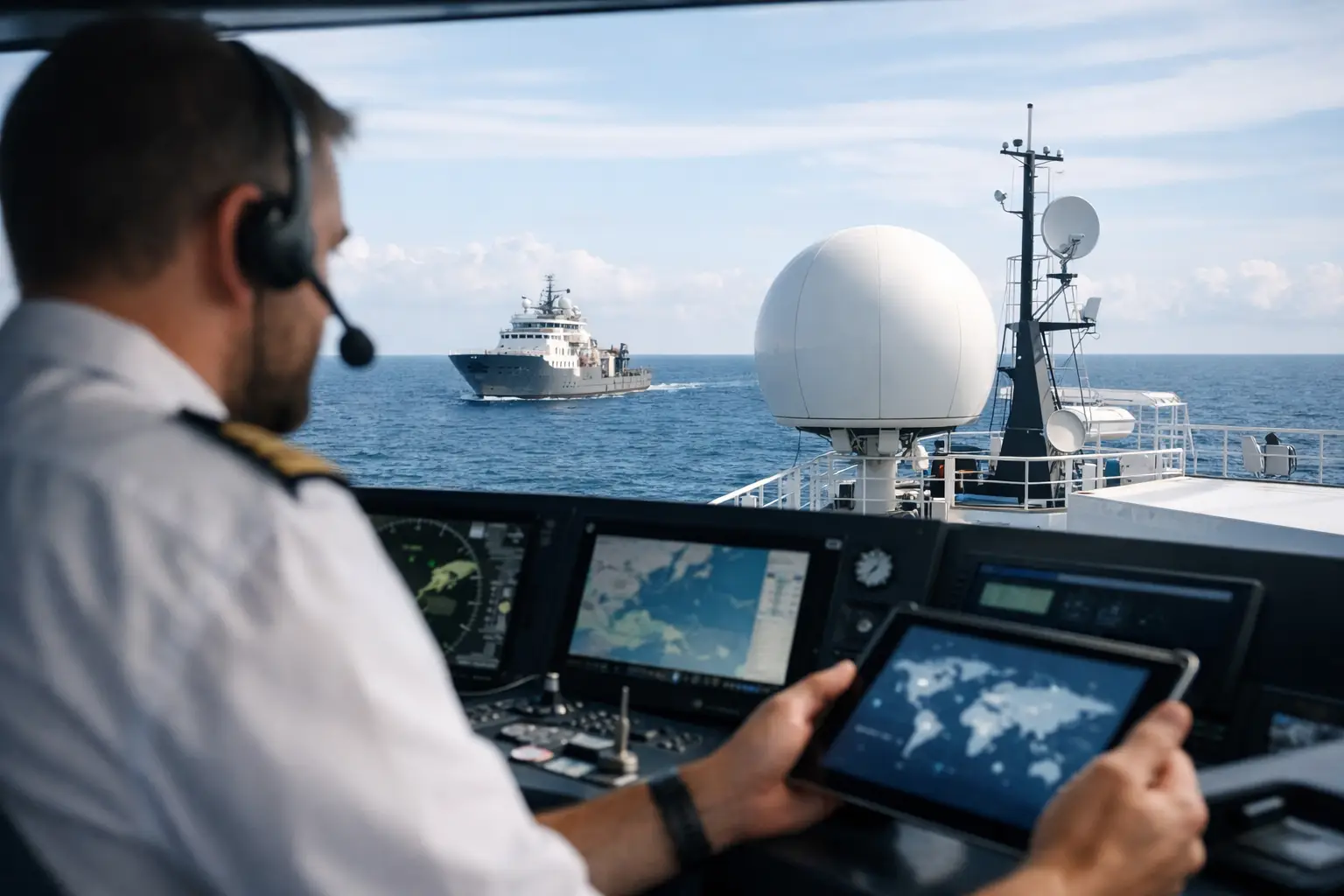
A vessel can have a clear horizon and still operate in a communications blind spot. For operators that need crew welfare access, operational telemetry, video, voice, remote support, and command traffic on the same platform, the decision to build maritime onboard connectivity is an infrastructure project, not a satellite subscription purchase. The network must keep working while the vessel moves, rolls, changes heading, enters congested RF environments, and transitions between nearshore and offshore coverage.
The right design starts with mission requirements and works outward to the antenna, radio, backhaul, onboard LAN, and security controls. A system that performs well at the dock may fail at sea if its RF path, stabilization, switching logic, power design, or traffic priorities were treated as secondary considerations.
Build Maritime Onboard Connectivity From Mission Requirements
Maritime connectivity requirements differ substantially among tugboats, offshore support vessels, ferries, commercial fishing fleets, research vessels, patrol craft, and wind farm service operations. The first engineering question is not which radio to install. It is which communications services must continue when the primary path degrades or disappears.
Separate traffic by operational consequence. Navigation and safety systems, dispatch, voice, alarm reporting, and control traffic need predictable availability and low contention. Video streams, maintenance data, cloud applications, crew internet use, and software updates can consume substantial bandwidth, but they should not be allowed to impair safety-critical services.
A practical requirements review should establish expected operating routes, distance from shore, vessel speed, mast height, target data rates, coverage zones, uptime objectives, and the applications that require low latency. It should also identify the consequences of an outage. A vessel that can tolerate delayed email has a different design target than one transmitting surveillance video, supporting offshore work crews, or maintaining a private operational network across multiple assets.
This assessment also exposes a common mistake: designing for average demand. Wireless systems are typically stressed during peak activity, weather events, port operations, emergency coordination, and maintenance periods. Capacity and failover behavior should be engineered around these conditions, not normal idle-state traffic.
Start With a Layered Maritime Network Architecture
A dependable onboard design uses multiple layers, each with a defined role. The backhaul layer reaches shore, another vessel, an offshore platform, or a satellite network. The vessel LAN distributes that connection to onboard systems. A private LTE or 5G layer can extend managed coverage across decks, work areas, cabins, and connected equipment where Wi-Fi alone is not the best fit.
Near shore, point-to-point or point-to-multipoint microwave can provide high-capacity connectivity at a lower recurring cost than satellite service. Beyond the practical range of shore infrastructure, satellite can become the primary transport path or the resilience layer. Cellular coverage may add another path around ports, coastal waterways, and established offshore service areas.
The architecture should be built around path diversity, not merely a collection of modems. If the primary microwave link is obstructed, a secondary cellular or satellite path must be able to carry the necessary priority traffic without manual intervention. That requires WAN edge equipment capable of monitoring link health, selecting traffic paths, applying quality-of-service policies, and preserving active applications where possible.
The best mix depends on the mission. A vessel operating on repeat coastal routes may justify shore-based microwave infrastructure and auto-aiming equipment. A deep-water vessel may need a satellite-led design with cellular and microwave used when available. Offshore energy, aquaculture, and wind farm operations may benefit from a dedicated private LTE/5G network that connects vessels, platforms, sensors, and shore facilities under one managed architecture.
Stabilized Antennas Protect the RF Path
The RF path is often the limiting factor in maritime deployments. A high-gain directional antenna can provide substantial range and throughput, but only if it remains aimed at the intended access point. Vessel pitch, roll, yaw, vibration, and changing headings create constant alignment challenges that fixed antennas cannot solve consistently.
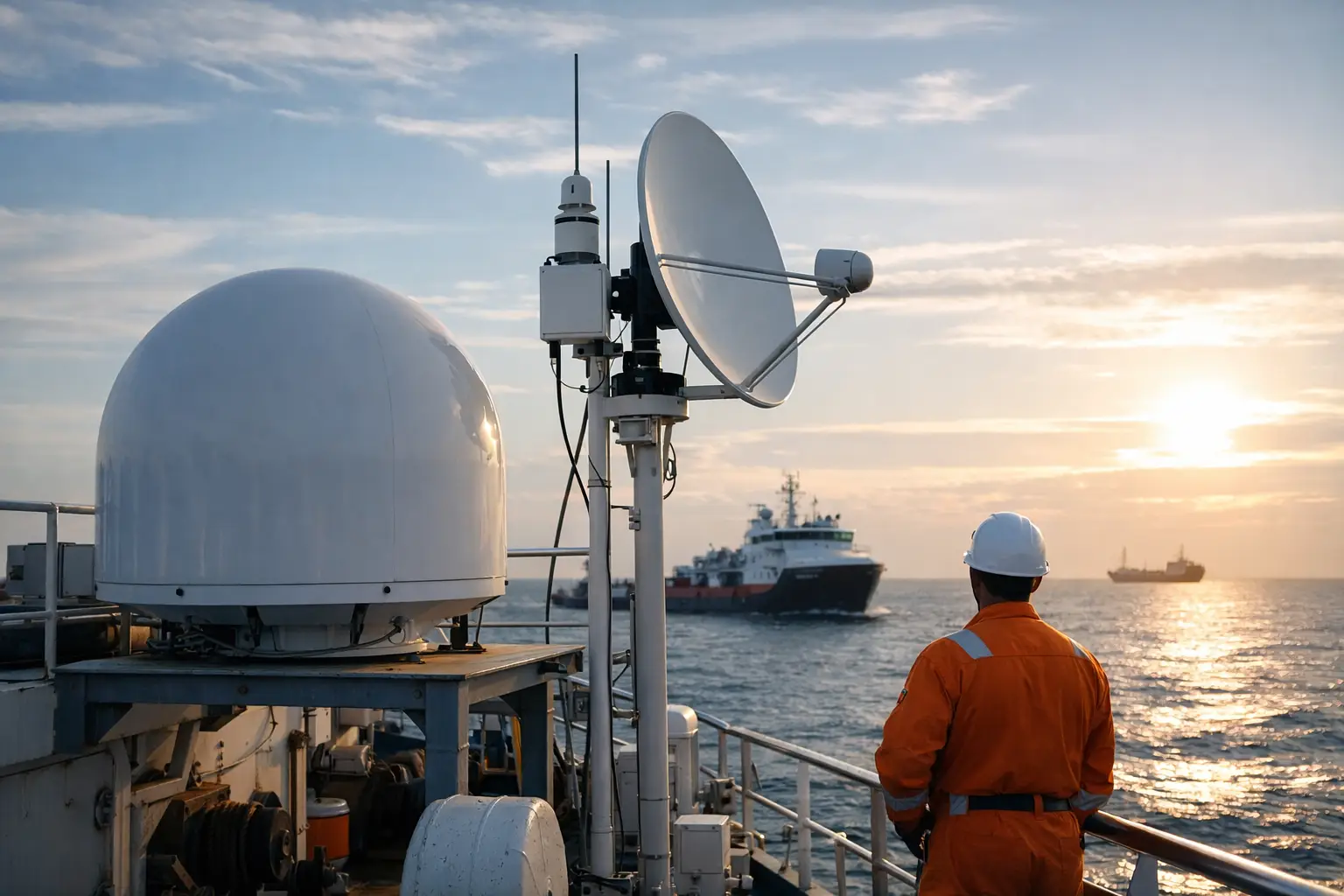
Auto-aiming, stabilized microwave systems address this problem by continuously maintaining antenna alignment as the vessel moves. The system must account for the vessel’s position, motion, target location, and antenna orientation. Path calculation and tracking performance matter because a narrow beamwidth delivers gain but reduces tolerance for pointing error.
Antenna selection is a trade-off. Higher gain generally supports longer paths and better link budgets, yet it can require more precise tracking and may be more exposed to installation constraints. Lower-frequency bands can offer better propagation in certain conditions but may have limited available spectrum or larger antenna requirements. Higher-frequency systems can support significant capacity, but rain fade, obstruction, and path geometry become more consequential.
Installation details matter as much as hardware specifications. The antenna needs a location with clear line of sight across the expected operating envelope. Crane booms, exhaust stacks, containers, radar equipment, and changing deck loads can create intermittent blockage. Cable routing, grounding, corrosion protection, enclosure ratings, vibration tolerance, and access for field service should be considered before installation rather than corrected after commissioning.
Design the Onboard Network for Traffic Control and Growth
Once connectivity reaches the vessel, it needs disciplined distribution. A flat onboard network makes troubleshooting harder and allows nonessential traffic to interfere with operational systems. Network segmentation separates vessel operations, industrial devices, administrative users, guest access, surveillance, and maintenance functions.
VLANs, firewall policies, and role-based access controls provide the foundation. Private LTE/5G can add managed mobility for personnel, vehicles, cameras, sensors, and handheld devices across the vessel or between nearby operational assets. It is particularly valuable where Wi-Fi roaming, coverage consistency, device scale, or security policy requires more control than a conventional access-point deployment provides.
Traffic policies should reflect actual operational priorities. For example, voice, dispatch, control, and alarm traffic may receive guaranteed treatment; video may be rate-limited or sent across a preferred high-capacity path; crew access can be shaped by time, quota, or application category. These decisions are not only technical. They protect expensive backhaul capacity and preserve communications when the network is under pressure.
Cybersecurity belongs in the original design. Maritime networks increasingly connect operational technology, vendor support tools, crew devices, and cloud services. That creates a larger attack surface than a simple shipboard Wi-Fi network. Use separate security zones, encrypted management access, current firewall rules, device inventory controls, logging, and a defined process for remote support. If a third party needs access to a system, it should be time-bound, authenticated, and limited to the required assets.
Engineer for Degradation, Not Just Availability
No wireless path is perfect at sea. Weather, obstruction, distance, interference, beam movement, provider congestion, and equipment faults can reduce capacity or interrupt service. The objective is not to claim that every link will remain available under every condition. The objective is to ensure the vessel degrades in a controlled way.
That means defining what happens when a path loses throughput, latency rises, or the link drops altogether. Priority services should move to a viable backup path. Lower-priority traffic may pause, throttle, or wait for restoration. Local systems should retain enough capability to operate safely without a cloud connection. Critical data should queue and forward when service returns.
Power resilience is part of this plan. Communications cabinets, edge routers, switches, radios, and tracking systems need protected power, appropriate surge protection, and enough ride-through capability to avoid unnecessary resets during vessel power events. Monitoring should show not only whether a device is online, but also RF signal quality, antenna tracking status, bandwidth consumption, packet loss, latency, temperature, and failover events.
Validate the System in Operating Conditions
A dockside speed test is not acceptance testing. Commissioning should include underway validation across expected headings, speeds, distances, and operational zones. Test primary and secondary paths independently, then test automatic failover under live application load. Confirm that critical traffic receives its intended priority and that noncritical demand cannot consume the entire available connection.
Field validation should also examine antenna reacquisition after maneuvers, obstruction recovery, network behavior after a power cycle, radio interoperability, and remote management access. Capture baseline performance data so that later degradation can be identified quickly. This is where an engineered system delivers value: the installation is measured against mission outcomes, not just a list of installed components.
BATS Wireless approaches these deployments as integrated communications systems, combining stabilized antenna tracking, compatible radios, onboard network design, and technical services around the operating environment. That approach is especially relevant when the vessel is one element of a larger shore-to-vessel, vessel-to-platform, or private LTE/5G deployment.
The most useful final question is simple: when the preferred link is gone and the vessel is still moving, which services must continue, at what performance level, and through which path? Build the network to answer that question before the vessel leaves the dock.
September 15, 2026

September 15, 2026
September 15, 2026
September 15, 2026
