
Emerging Private LTE Applications That Deliver
Emerging private LTE applications are extending secure broadband to vessels, job sites, utilities, and response teams operating beyond public coverage.


A wind turbine technician is 20 miles offshore. A command vehicle has moved beyond the nearest fiber handoff. A drilling crew is operating where public carrier coverage fades at the edge of the lease. In each case, emerging private LTE applications are solving a practical communications problem: how to deliver controlled, dependable broadband where conventional networks were never designed to perform.
Private LTE is not simply a way to place cellular radios on private property. It is an engineered communications layer that can carry operational data, voice, video, telemetry, and workforce connectivity across a defined area or mobile operating environment. For organizations working in remote, harsh, or mission-critical conditions, the value comes from ownership of coverage, traffic policy, security posture, and network priorities.
Why Emerging Private LTE Applications Matter
Public cellular networks remain useful, but they are built around broad consumer coverage and carrier-managed capacity. An industrial operator may need a different outcome: predictable coverage over a port, a mine, a construction corridor, or a moving vessel; priority for control traffic; and a backhaul design that remains available when the nearest terrestrial connection is far away.
Private LTE fills that gap with mature cellular technology. LTE devices are widely available, the radio behavior is well understood, and network teams can define which users and systems are permitted on the network. It also provides a practical migration path. Many organizations can solve an immediate connectivity problem with private 4G while designing their spectrum, core, radio, and backhaul architecture to support 5G as requirements justify it.
The technology is particularly relevant where Wi-Fi alone becomes difficult to manage. Wi-Fi can perform well inside buildings, camps, and tightly bounded work areas. It generally requires more access points, more careful roaming design, and more frequent intervention as coverage distances grow or assets begin moving. Private LTE offers broader-area mobility, controlled handoffs, and a cellular ecosystem suited to field devices and vehicle-mounted equipment.
That does not make LTE the answer to every wireless requirement. The correct design depends on geography, spectrum availability, device mix, throughput expectations, latency tolerance, and the consequences of an outage. The strongest deployments treat the access network, backhaul, antenna system, and operational support plan as one system.
Maritime and Offshore Operations
Maritime connectivity is among the most demanding private LTE use cases because the coverage area moves, the radio path changes constantly, and saltwater, vibration, weather, and vessel motion affect equipment performance. A private LTE network can provide onboard and nearshore coverage for crew communications, maintenance data, video, safety systems, and connected operational equipment.
The challenge is not limited to installing an LTE small cell or vessel router. Broadband must reach the vessel in the first place. Depending on route and distance from shore, the architecture may combine shore-based LTE, point-to-point microwave, satellite, or a hybrid backhaul approach. Directional antennas must hold the path as the vessel rolls, pitches, and changes heading.
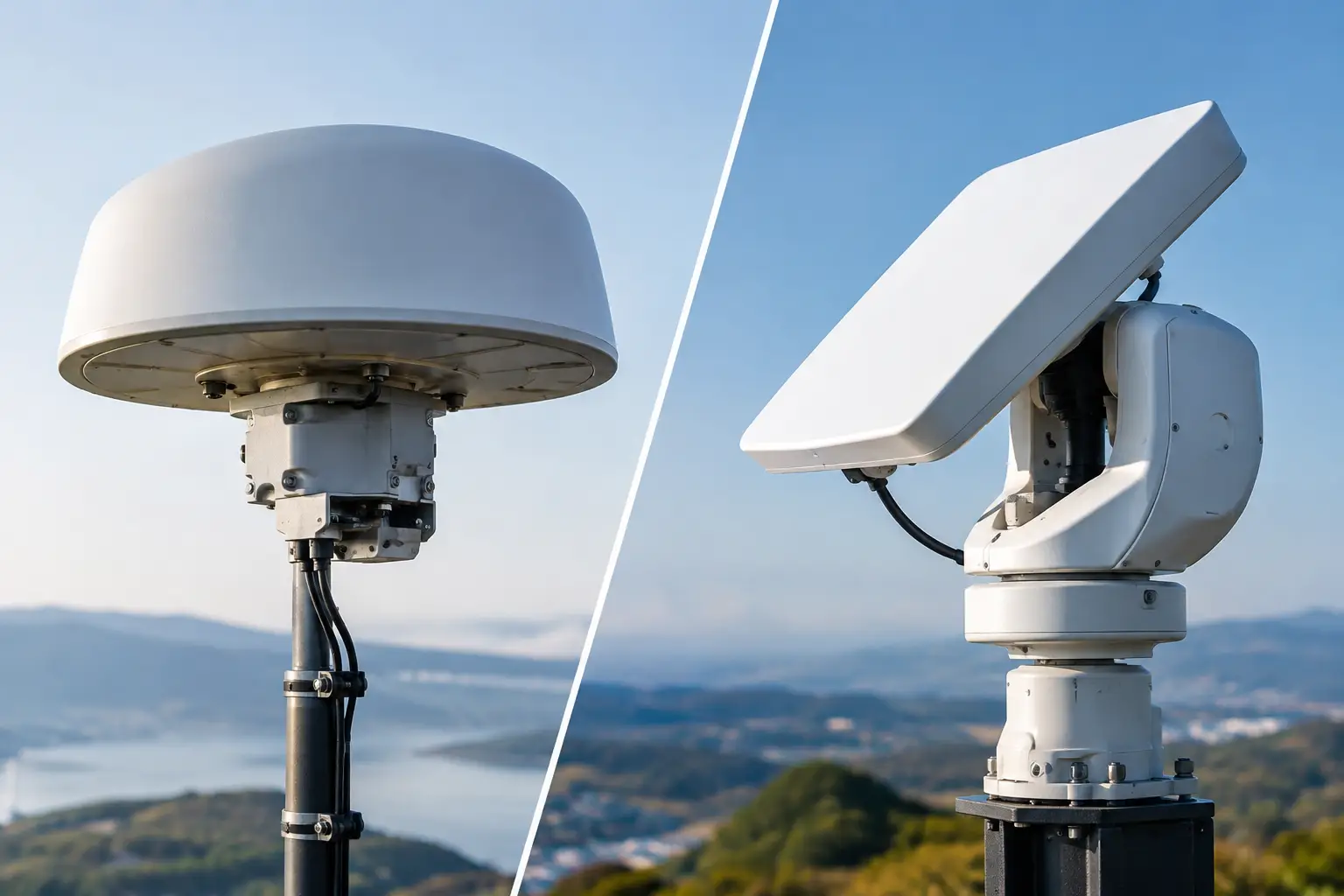
This is where stabilized, auto-aiming antenna systems become operational infrastructure rather than an accessory. By continuously maintaining a high-quality radio link, they help support the private LTE service carried across that link. For fleets, aquaculture operations, offshore wind support vessels, and port operators, the design target is continuity during movement, not merely connectivity while stationary.
Private LTE for Construction and Temporary Sites
Large construction projects often begin before permanent communications infrastructure exists. Crews need access to drawings, inspection records, progress imagery, safety systems, dispatch tools, and collaboration platforms long before the finished building or facility has a carrier-grade connection.
Private LTE can establish a controlled broadband zone across a construction site, supporting fixed offices, mobile crews, cameras, equipment telemetry, and connected tablets. Unlike a patchwork of temporary hotspots, it can provide broader coverage with centrally managed subscriber access. As the site footprint changes, radios and antennas can be repositioned without rebuilding the entire communications environment.
Temporary does not mean low consequence. A poor network design can leave a tower crane, an excavation area, or a remote staging yard without usable coverage at the moment crews depend on it. The backhaul must be assessed early. Microwave may be a cost-saving solution where line of sight exists, while satellite can extend service into locations with no practical terrestrial path. In many projects, a combination provides the needed availability.
For contractors, private LTE also creates separation between operational traffic and guest access. That distinction matters when the network carries camera feeds, digital work orders, asset tracking, and safety communications alongside normal office use.
Utility, Energy, and Industrial Field Networks
Utilities and energy operators are extending digital control and monitoring deeper into field operations. Substations, pump stations, well pads, pipelines, wind farms, and distributed generation sites all produce data that has greater value when it can be accessed reliably and acted on quickly.
Emerging private LTE applications in these environments include mobile workforce communications, condition monitoring, remote video, connected sensors, and field access to maintenance and engineering systems. LTE can also support coverage across large facilities where licensed or shared spectrum offers better interference control than unlicensed alternatives.
The operational requirement is often coverage continuity across miles of terrain, not peak indoor speed. A network may need to serve a technician truck moving between sites, a fixed sensor on a remote asset, and a maintenance crew working inside a steel-heavy industrial facility. Radio planning must account for topography, vegetation, building materials, clutter, antenna height, and available spectrum.
Backhaul resilience deserves equal attention. A private LTE access layer cannot compensate for a single fragile transport path. Network architects should evaluate diverse routes where the business impact warrants it, including microwave links, fiber where available, and satellite as a protected or primary path. The appropriate redundancy level depends on whether lost connectivity delays paperwork or affects safety, production, or critical control visibility.
Public Safety and Disaster Response
During a disaster, the first communications problem is frequently not capacity but access. Commercial networks may be congested, damaged, or unavailable in the exact area where responders need data, voice, mapping, and video. A rapidly deployable private LTE system gives incident commanders a controlled local network for teams, vehicles, cameras, drones, and field applications.
Deployable systems can be staged in command vehicles, trailers, portable cases, or temporary towers. Their effectiveness depends on speed of setup and on a realistic plan for upstream connectivity. A microwave path to a surviving network point can provide high-capacity backhaul when line of sight is available. Satellite provides reach when terrestrial infrastructure is compromised. Multiple transport options create operational flexibility rather than dependence on one damaged route.
Priority and segmentation are central to this application. Incident traffic should not compete equally with guest devices, media activity, or nonessential user traffic. A properly configured private LTE network can enforce access policies and allocate capacity according to mission needs.
Mobility Changes the Network Design
The most consequential private LTE deployments are increasingly mobile. They support vessels, rail corridors, mobile command assets, field vehicles, temporary industrial facilities, and aircraft-adjacent operations. Mobility introduces a separate set of engineering questions: How fast will assets move? How often will the radio path be obstructed? Where must handoffs occur? What happens when a primary backhaul link drops?
Fixed wireless assumptions can fail quickly in these environments. An antenna that performs well at a static test location may lose its path after a vehicle turns, a vessel changes course, or a temporary structure blocks line of sight. Tracking antennas, path calculation, stabilized platforms, and integrated radios are part of the network design because they determine whether the LTE service has a viable transport connection.
BATS Wireless approaches these projects as complete field communications systems, combining private 4G/5G connectivity with the antenna tracking, stabilized microwave, and technical services needed to keep long-range links operating in real conditions.
Design Decisions That Determine Results
Before selecting radios or subscriber devices, operators should define the service outcome. Is the objective broad workforce coverage, high-quality video transport, low-rate telemetry, vehicle mobility, or an emergency network that can be deployed in hours? Those goals affect spectrum planning, cell placement, antenna selection, core-network design, and backhaul capacity.
Device compatibility also matters. LTE delivers value partly because of its broad device ecosystem, but not every modem supports every band, power class, or network feature. Procurement teams should confirm support for the intended spectrum, carrier aggregation needs, SIM or eSIM approach, environmental rating, and management capabilities before standardizing field equipment.
Security should be designed into the architecture rather than added after commissioning. That includes subscriber authentication, role-based access, network segmentation, traffic monitoring, remote device management, and clear procedures for lost or compromised equipment. Private ownership improves control, but it does not remove the need for disciplined network operations.
The best emerging private LTE applications are not defined by the word LTE. They are defined by the work that can continue when crews move beyond public coverage, infrastructure is incomplete, and the operating environment refuses to stay still. Start with that operational reality, then engineer the radio, antenna, and backhaul system around it.

November 25, 2026

November 25, 2026
November 25, 2026

November 25, 2026
