
Microwave Radios vs Satellites: Which Fits?
Microwave radios vs satellites: compare capacity, latency, resilience, cost, and mobility needs when selecting backhaul for remote operations at scale.


A remote site can have power, local Wi-Fi, private LTE, and capable field teams yet still fail operationally when its backhaul is undersized or unavailable. The real question in microwave radios vs satellites is not which technology is universally better. It is which transport layer can meet the required throughput, availability, latency, mobility, and lifecycle cost for the specific mission.
For fixed industrial sites with a clear path to a connected hub, microwave is often the higher-capacity, lower-latency, cost-saving solution. For isolated operations, dispersed assets, or routes where terrestrial paths cannot be built, satellite may be the practical answer. In many mission-critical designs, the strongest architecture uses both.
Microwave Radios vs Satellites: The Core Difference
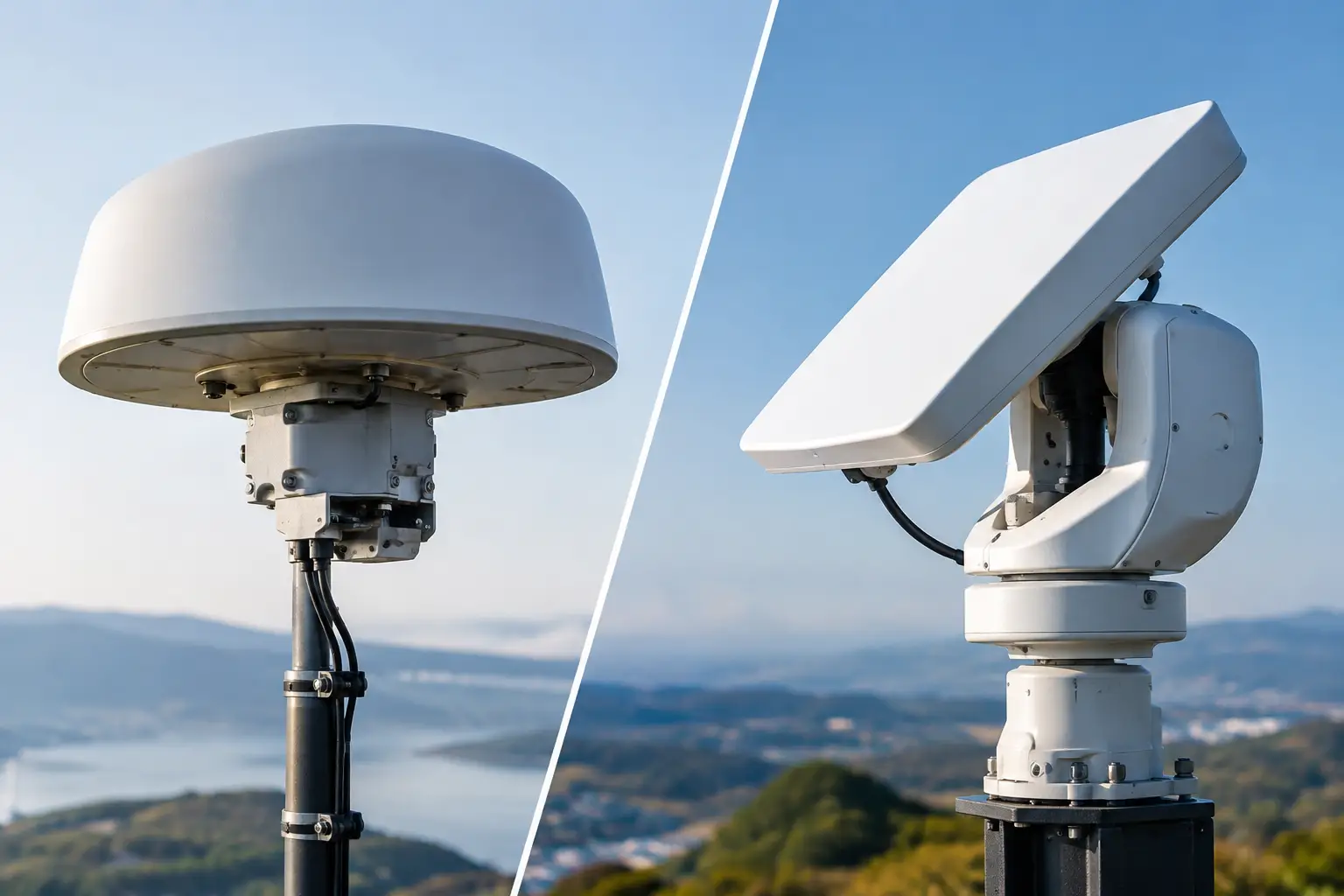
Microwave radio systems send data over a point-to-point or point-to-multipoint terrestrial radio path. They require compatible radios, correctly engineered antennas, adequate path clearance, and a reliable mounting environment. The payoff is substantial: a properly designed licensed or unlicensed microwave link can deliver high throughput with predictable latency and without a per-gigabyte service model.
Satellite systems move traffic between an earth station and an orbiting satellite, then back to a gateway or another terminal. Their primary advantage is reach. A satellite terminal can connect an offshore vessel, an emergency command post, a remote drilling location, or a temporary worksite without first constructing a terrestrial relay chain.
That distinction drives nearly every design decision. Microwave depends on an available terrestrial path. Satellite depends on an acceptable view of the sky, service coverage, and the capacity available from the selected network. Neither requirement is minor in the field.
When Microwave Is the Better Backhaul Choice
Microwave is generally the preferred option when an organization controls, or can access, endpoints with line of sight between them. A wind farm connecting to a shore facility, a mine linking its pit and processing plant, or a public safety network extending from an established tower may have the geometry needed for an engineered microwave path.
Capacity and latency favor microwave
A modern microwave system can support substantial traffic for video surveillance, dispatch, voice, operational technology, private 4G/5G backhaul, and crew connectivity. Latency is typically very low because traffic travels directly across a terrestrial path rather than making a trip to orbit and back. That matters for interactive applications, real-time monitoring, control functions, and networks carrying a high volume of concurrent users.
Capacity is not unlimited. It is affected by spectrum, channel bandwidth, modulation, antenna size, distance, and weather margin. Still, where the path is viable, microwave commonly provides more predictable high-bandwidth performance than satellite service at a comparable ongoing operating cost.
Operating costs can be more controllable
After equipment, tower work, spectrum coordination, and installation are complete, a microwave link usually has limited recurring transport expense. That model is attractive for permanent or long-duration sites with consistently high data demand.
The upfront work must not be underestimated. A path survey may identify terrain blockage, tree growth, Fresnel-zone intrusion, or reflection issues that make an apparent link unusable. Construction, permitting, power, grounding, and tower access can also dominate the project budget. Microwave saves money when the path is practical, not merely when the radio hardware price looks favorable.
Mobility requires specialized tracking
Conventional fixed microwave links are not designed for a moving endpoint. A vessel, vehicle, aircraft, or mobile command platform changes position, heading, pitch, roll, and elevation relative to the far-end antenna. Maintaining a narrow-beam link under those conditions requires stabilized, auto-aiming antenna systems, accurate position data, path calculation, and compatible integrated radios.
This is where engineered systems matter more than individual components. BATS Wireless designs stabilized microwave solutions that maintain directional connectivity across demanding mobile and maritime operating conditions. The antenna, tracking controller, radio, mounting arrangement, and network design must perform as one operational system.
When Satellite Is the Better Choice
Satellite becomes the leading option when there is no viable terrestrial path, no nearby connected tower, or no time to build fixed infrastructure. It is often the fastest way to bring broadband to a site that is geographically isolated or temporarily deployed.
Reach outweighs terrestrial constraints
Offshore operations, disaster response zones, remote survey teams, and construction projects beyond existing coverage may have no realistic line-of-sight path to a fiber point of presence. Satellite removes the requirement for a terrestrial relay network. A terminal with a clear view of the required orbital coverage can establish service far beyond the reach of microwave infrastructure.
This reach is especially valuable for continuity planning. A satellite terminal can serve as an independent path when local fiber is cut, a microwave tower is damaged, or a wildfire, storm, or security event disrupts terrestrial access.
Not all satellite services behave the same way
The term satellite covers different network architectures. Geostationary services typically introduce materially higher latency due to orbital distance. They can work well for file transfer, general internet access, telemetry, voice applications designed for delay, and many backup use cases, but high delay can affect interactive control and user experience.
Low Earth orbit services can reduce latency significantly and may provide attractive capacity for mobile and remote deployments. Their performance still depends on terminal selection, network congestion, geographic availability, service plan, and how well the terminal maintains a view of the moving constellation. Procurement teams should evaluate measured performance at the operating location rather than relying on headline claims.
Service economics need careful review
Satellite can minimize initial infrastructure construction, but recurring charges may be substantial. Usage allowances, priority tiers, contention, and data policies can change the effective cost of video-heavy or high-volume operations. A site with continuous camera feeds and private cellular traffic may quickly exceed the economics of a satellite-only design.
For short-term sites or low-to-moderate traffic loads, that trade-off can be entirely reasonable. For a permanent operation carrying terabytes of data, a terrestrial microwave path may justify its higher initial capital cost.
Availability Depends on Engineering, Not a Label
Neither microwave nor satellite is automatically more reliable. Each has distinct failure modes that must be designed around.
Microwave performance can be affected by heavy rain at higher frequency bands, antenna misalignment, obstruction growth, tower movement, interference, and inadequate fade margin. Long paths and high-capacity links require disciplined path engineering, antenna alignment, spectrum planning, grounding, and monitoring.
Satellite performance can be affected by rain fade, terminal obstruction, beam handoffs, satellite network congestion, physical damage, and power loss at the terminal. On moving platforms, the terminal must also track the service effectively through vessel motion or vehicle movement.
For critical operations, availability is usually created through diversity. A primary microwave link can carry routine high-capacity traffic, while satellite provides geographically independent failover. Conversely, satellite may serve as the primary path at an isolated site, with microwave added later when a nearby hub becomes available. Network policy should prioritize operational technology, voice, command traffic, and essential applications during a degraded state rather than treating all traffic equally.
A Practical Selection Framework
Start with geography. Can the endpoints support a clear and maintainable microwave path, including required Fresnel clearance? If not, satellite may be the only immediate transport option. If the path exists, assess whether the site is fixed or mobile. Fixed sites simplify microwave deployment; moving assets require stabilized tracking and a full motion-aware design.
Next, quantify traffic instead of estimating it broadly. Include camera streams, private LTE or 5G backhaul, cloud applications, voice, telemetry, software updates, crew welfare traffic, and future expansion. Then define acceptable latency, uptime targets, recovery objectives, and the duration of the deployment.
Finally, compare total cost over the expected operating life. Include civil work, towers, spectrum, installation, maintenance access, managed service fees, satellite data plans, spare equipment, and the cost of downtime. The least expensive terminal is rarely the least expensive communications system.
The Better Answer May Be a Hybrid Network
The choice between microwave radios and satellites often becomes less binary once operational requirements are mapped. Microwave can deliver the primary capacity and low latency needed for a fixed industrial network. Satellite can provide coverage beyond the terrestrial edge and preserve communications during a primary-path outage. A managed hybrid architecture can also route traffic intelligently, reserving higher-cost satellite capacity for essential services when conditions require it.
The right backhaul is the one that keeps crews, systems, and decisions connected under real operating conditions. Design from the mission outward, test the path assumptions early, and treat the transport network as critical infrastructure rather than an afterthought.
November 20, 2026

November 20, 2026

November 20, 2026

November 20, 2026
