
How Do Antenna Tracking Systems Work?
How does antenna tracking system work? Learn how auto-aiming, sensors, GPS, and control software keep mobile links aligned in harsh conditions.

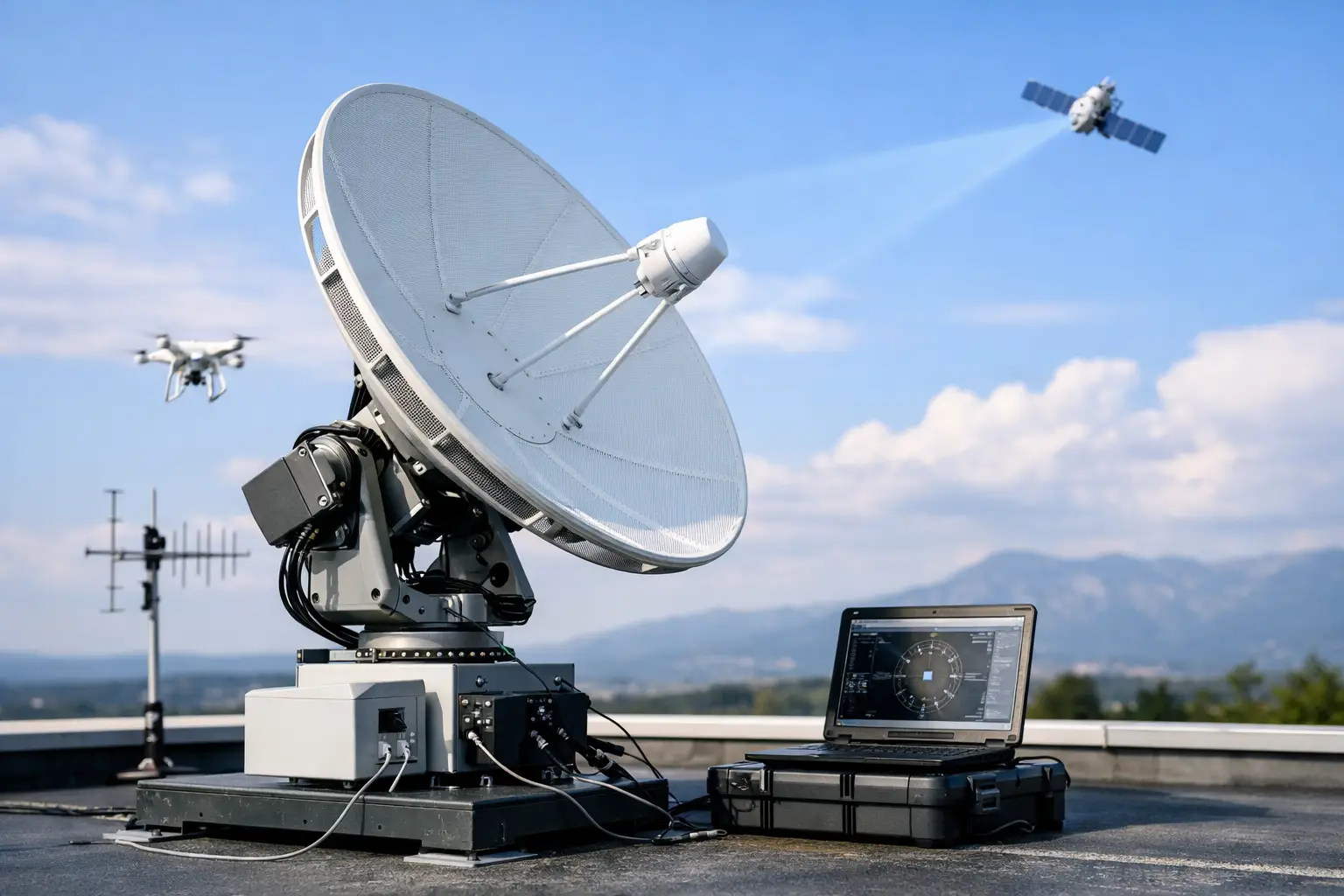
A fixed antenna is easy. Point it once, confirm the link budget, and you are done. The problem starts when the endpoint moves, the platform rolls, the mast sways, or the path itself changes fast enough to break alignment. That is where the real question matters: how does antenna tracking system work when connectivity has to stay up in motion, in weather, and across long-range paths where even small pointing errors can cost throughput or drop the link entirely?
At its core, an antenna tracking system keeps a directional antenna aimed at a target as conditions change. The target might be another vehicle, an aircraft, a vessel, a remote base station, or a fixed hub seen from a moving platform. The tracking system continuously determines where the antenna should point, compares that with where it is actually pointing, and then commands motors or actuators to correct the difference.
That sounds straightforward, but the engineering is not. In high-gain microwave, LTE, and private 5G deployments, beamwidth can be narrow enough that minor heading shifts, pitch and roll motion, GPS drift, or mechanical backlash all matter. A practical tracking system has to combine positioning data, orientation sensing, control logic, and RF feedback in a way that works outside the lab.
How do antenna tracking systems work in practice?
Most systems are built around four functional layers: position awareness, attitude awareness, pointing calculation, and physical antenna movement. Those layers operate as a closed loop.
Position awareness usually comes from GPS or GNSS data. The system needs to know where the local platform is and where the target is, either from stored coordinates, a remote feed, or a networked update from the far end. If both points are known, the controller can calculate azimuth and elevation to the target.
Attitude awareness is just as important. On a vessel, vehicle, or airborne platform, the antenna may be mounted on something that is constantly changing orientation. In that case, the system uses heading, pitch, and roll data from sensors such as compasses, gyros, inertial measurement units, or stabilized reference systems. Without that correction, the antenna may be aimed correctly in theory but wrong in the real world because the platform itself is tilted or turning.
The controller then runs a pointing algorithm. It takes the target coordinates, the current platform position, and the platform attitude, and converts that into a command for the pan and tilt axes, or the equivalent axes in a stabilized pedestal. Once the motors move the antenna, the system checks whether the resulting position matches the expected aim point. If not, it makes another correction. This repeats continuously, often many times per second.
In stronger systems, that calculation is not based on one data source alone. It blends navigation data with live RF behavior. If received signal strength, signal quality, or error rate suggests the antenna is slightly off-axis, the controller can fine-tune the pointing beyond what GPS and compass inputs alone would achieve.
The main components of an antenna tracking system
An antenna tracking system is not a single device. It is an integrated assembly of mechanical, electrical, and software elements designed to operate as one.
The antenna itself is usually directional because tracking only matters when beam focus matters. Omnidirectional antennas do not require pointing, but they also do not deliver the same gain, range, or interference control as a directional system. In long-range backhaul or mobile broadband extension, the antenna is often a panel, dish, or sector-style directional unit matched to the radio and coverage objective.
The mount or pedestal provides controlled movement. In a simple land-based setup, that may be a pan-tilt unit. In maritime or other high-motion environments, the mount may be stabilized so the antenna can remain locked on target even while the platform moves underneath it. Mechanical quality matters here. A control algorithm cannot fully compensate for poor repeatability, loose gearing, or slow drive response.
The sensors supply the awareness layer. GPS establishes location. Compass heading establishes direction. Gyros and IMUs help track rapid movement and correct for pitch and roll. Some systems also use encoders on the motor axes to confirm actual antenna position rather than relying only on commanded movement.
The controller is the decision engine. It receives data from sensors, performs geometric calculations, filters noisy inputs, applies motion control logic, and issues commands to the motors. It may also interface directly with the radio to monitor RF metrics and refine alignment based on actual link performance.
Finally, the radio and network layer provide the operational outcome. Tracking is not the goal by itself. The goal is to preserve throughput, latency, availability, and service continuity for the application riding on the link.
Open-loop and closed-loop tracking
One of the most useful distinctions is the difference between open-loop and closed-loop tracking.
Open-loop tracking points the antenna based on known position and motion data. If the system knows where the local platform is, where the far end is, and how the platform is oriented, it can compute where to aim without directly using RF feedback. This approach can work well when navigation data is accurate and the geometry is predictable.
Closed-loop tracking adds real signal feedback. The system measures signal strength, quality, or related RF indicators and uses them to fine-tune the antenna position. This matters when GPS accuracy is limited, the platform is vibrating, the target path is partially obstructed, or the mechanical system has small errors that accumulate over time.
In demanding deployments, the best answer is usually a hybrid approach. Geolocation gets the antenna close quickly, and RF feedback keeps it optimized. That combination is especially valuable in mobile and long-range environments where the link margin may be tight.
Why tracking performance depends on the environment
If you are asking how does antenna tracking system work, the more useful follow-up is this: how well does it work in the environment you actually operate in?
A land vehicle crossing uneven terrain introduces shock, vibration, and changing line of sight. A maritime vessel adds constant pitch, roll, yaw, salt exposure, and horizon movement. Air-to-ground applications compress all of that into faster dynamics and stricter latency for control decisions. Industrial sites may look stable but still create multipath, partial blockage, and mounting challenges from towers, cranes, or temporary structures.
That is why a tracking system should be evaluated as part of a complete link architecture, not as an isolated piece of hardware. Antenna gain, beamwidth, radio sensitivity, path distance, Fresnel clearance, update rates, mount rigidity, and stabilization method all shape the final result. A system with excellent tracking software can still underperform if the antenna is undersized or the mounting structure flexes under load.
Where antenna tracking systems deliver the most value
Tracking systems make the biggest difference when standard fixed wireless methods cannot maintain continuity. Ground-to-air communications are a clear example. As the aircraft moves relative to the ground station, the antenna has to follow continuously to preserve a high-capacity link.
Maritime broadband is another common use case. A directional antenna on a vessel can support stronger long-range connectivity than an omni approach, but only if it can stay aligned while the vessel changes heading and the sea state shifts the platform constantly.
The same applies to public safety and disaster response, where temporary mobile assets need dependable backhaul without time-consuming manual aiming. Oil and gas, construction, aquaculture, and remote industrial operations also benefit when assets move or when the operating base needs to maintain a targeted link over variable terrain and long distances.
This is where solution design matters. Companies such as BATS Wireless focus on auto-aiming and adaptive systems because field performance depends on more than antenna motion alone. Compatibility with integrated radios, path calculation, sector-specific deployment methods, and technical support all affect whether the system delivers operational continuity or just looks good on a spec sheet.
Common limits and trade-offs
No tracking system is magic. Narrower beams deliver more gain but require tighter control. More sensors improve awareness but add integration complexity. Stabilized systems improve performance on moving platforms, but they cost more and require stronger mechanical engineering.
There is also a trade-off between responsiveness and stability. If the controller reacts too aggressively to every movement or noisy sensor input, it can create hunting and overshoot. If it reacts too slowly, the antenna lags behind the target and link quality drops. Good control design is about balance, not just speed.
Another practical issue is fail behavior. In mission-critical environments, it is not enough for a system to track well under normal conditions. Buyers should also ask what happens during GNSS loss, sensor drift, power interruption, or temporary RF blockage. Recovery behavior is part of system performance.
Antenna tracking works by combining location, motion sensing, pointing logic, and controlled antenna movement into a live correction loop that keeps a directional link aligned as conditions change. The value is not in the motion itself. The value is in maintaining broadband where fixed alignment would fail, and doing it with enough precision to support real operations when the environment stops being forgiving.
If you are evaluating one for a mobile, maritime, defense, or industrial network, the right question is less about whether tracking exists and more about how the whole system behaves when your platform, path, and uptime requirements are working against you.

September 20, 2026

September 20, 2026

September 20, 2026
September 20, 2026
