
Antenna Tracking System for Mobile Broadband
Learn how an antenna tracking system for mobile broadband improves uptime, range, and throughput for vehicles, vessels, and field operations.

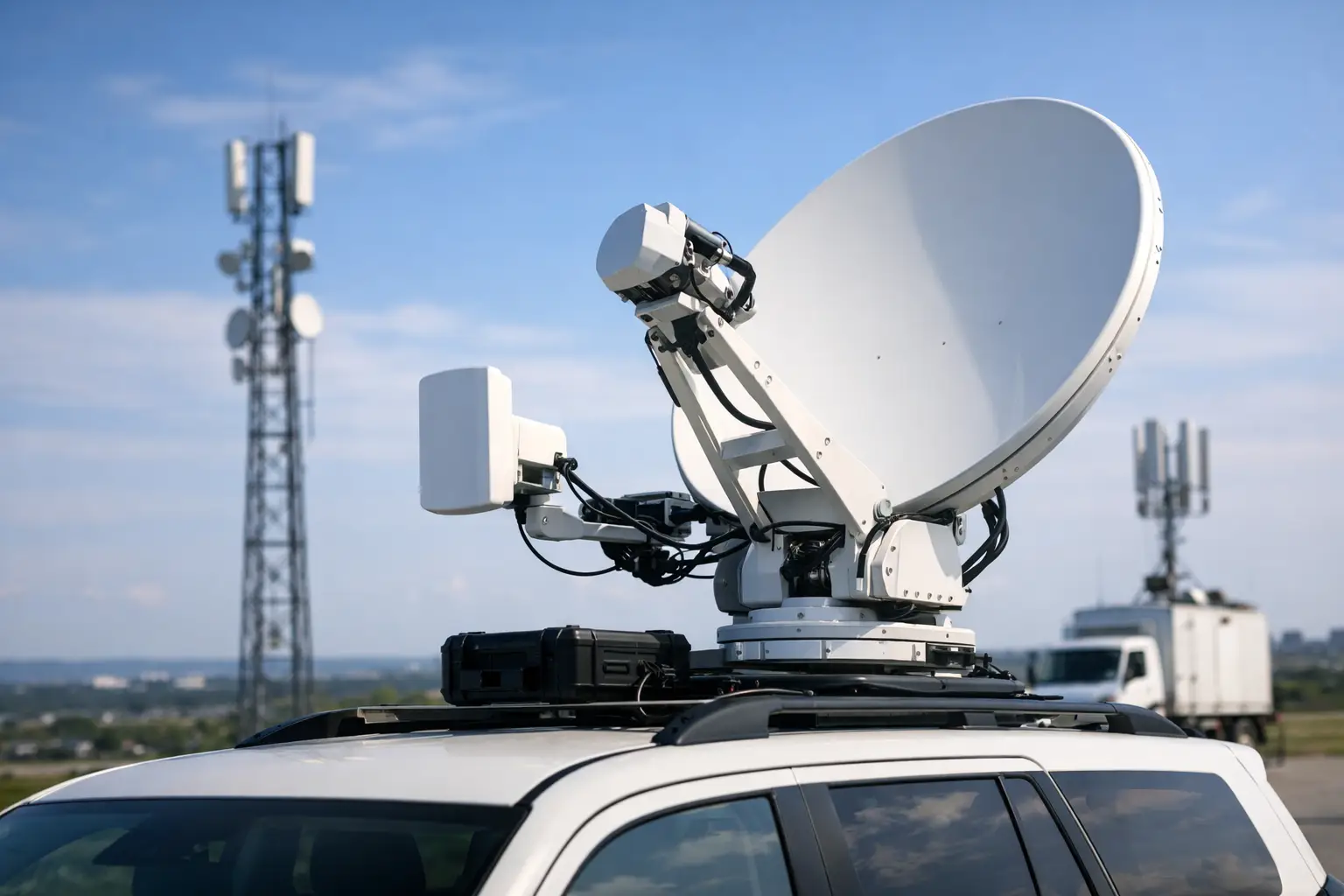
A patrol vessel changes heading in heavy chop. A command vehicle stops just long enough to push video upstream. A mining convoy moves beyond fixed coverage. In each case, the weak point is rarely the radio alone. It is the ability to keep the RF path aligned while the platform moves. That is where an antenna tracking system for mobile broadband becomes operationally decisive.
For organizations running broadband across moving assets, the problem is not simply signal availability. It is maintaining usable throughput, low packet loss, and predictable latency while the antenna platform is in motion, under vibration, and often exposed to wind, pitch, roll, obstructions, and changing terrain. Standard mobile broadband hardware can perform well in light-duty conditions, but it often falls short when the link budget is tight or the operational environment is unforgiving.
What an antenna tracking system for mobile broadband actually does
An antenna tracking system for mobile broadband continuously keeps a directional antenna aligned to the best available target or path while the host platform moves. Depending on the architecture, that target may be a shore site, a tower, a relay point, an airborne node, or another mobile asset. The system combines mechanical positioning, control software, sensor input, and radio integration to maintain the strongest practical link.
That sounds straightforward, but real-world tracking is more than pointing an antenna. The system has to account for GPS position, heading, pitch, roll, yaw, speed, and sometimes predictive path calculation. In higher-performance deployments, it also considers signal feedback from the radio layer so it can refine aim based on actual RF conditions rather than location data alone.
This is why engineered systems outperform improvised assemblies. A directional antenna with a simple mount may work on a static mast. Put that same antenna on a moving vessel or vehicle, and small alignment errors quickly translate into lower modulation rates, dropped sessions, and reduced coverage. Tracking closes that gap.
Why mobile broadband performance depends on pointing accuracy
Mobile broadband links are increasingly expected to support more than basic telemetry. Operations now rely on live video, SCADA traffic, VoIP, access to cloud applications, private LTE or 5G extensions, and backhaul for onboard networks. As data demands rise, tolerance for unstable links drops.
Directional antennas help because they concentrate energy, extend range, and reduce interference from unwanted directions. The trade-off is that narrower beamwidth requires more precise pointing. A broad-pattern antenna is easier to deploy, but it gives up gain and usually sacrifices range and capacity. A high-gain directional antenna can support a stronger, cleaner link over longer distances, but only if the tracking system can hold alignment under movement.
This trade-off matters in offshore, industrial, defense, and public safety environments where every dB counts. If the mobile platform is operating at the edge of coverage or through variable path conditions, poor tracking can erase the advantage of the antenna and radio design.
Core elements of a high-performance tracking system
A capable tracking platform is built as a system, not as a collection of loosely matched parts. The antenna matters, but so do the control mechanics, stabilization logic, and radio compatibility.
Stabilization and motion compensation
On moving assets, stabilization is essential. Vehicles introduce shock, vibration, and rapid heading changes. Marine platforms add roll and pitch that can be severe enough to break alignment repeatedly if the antenna is not actively compensated. Stabilized microwave systems and broadband trackers are designed to counter those disturbances in real time.
The level of stabilization required depends on the mission. A construction trailer may need basic auto-aiming and occasional correction. A fast patrol craft or offshore support vessel needs continuous compensation with a much tighter control response.
Auto-aiming and path calculation
Auto-aiming reduces dependence on manual setup and operator skill. In temporary deployments, that shortens commissioning time and lowers the risk of bad alignment. In continuously mobile operations, auto-aiming works with path calculation to keep the antenna pointed where it needs to be as the platform changes course or location.
Good path calculation is particularly valuable where line of sight can change quickly, such as coastal routes, mountainous corridors, windfarm transit paths, or mixed urban-industrial environments. The goal is not simply to react after degradation occurs. It is to anticipate the geometry of the link and maintain continuity.
Radio and network integration
Tracking performance cannot be separated from radio performance. The best results come from systems designed to work with integrated radios or with clearly validated third-party radio platforms. Compatibility affects everything from mounting and cabling to management visibility and signal feedback.
For enterprise and mission-critical buyers, this is often where generic products become expensive. A low-cost tracker that does not integrate cleanly into the network stack can create delays, field modifications, and avoidable service calls. A complete solution architecture usually delivers better long-term value than a piecemeal build.
Where an antenna tracking system delivers the most value
The strongest use case is any operation where mobility, range, and uptime matter at the same time. That covers more sectors than many buyers initially assume.
In maritime broadband, tracking supports vessel connectivity for crew welfare, operations data, CCTV, VoIP, and private onboard networks while maintaining alignment to shore or relay infrastructure. In oil and gas, it supports mobile and semi-mobile assets that need dependable backhaul beyond conventional service footprints. In public safety, it allows rapid-deployment vehicles and incident command assets to establish high-capacity links without relying entirely on congested commercial networks.
Defense and border applications are another natural fit. Mobile platforms often require broadband continuity for ISR, command traffic, sensor feeds, and situational awareness in locations where fixed infrastructure is limited or contested. In these cases, the system has to be rugged, fast to deploy, and able to hold performance in demanding motion profiles.
Commercial and industrial users also benefit. Construction sites, mining fleets, aquaculture operations, and remote field teams frequently need a cost-saving solution that extends broadband without trenching fiber or waiting for permanent carrier upgrades. If the asset moves, or if the link has to be repositioned frequently, antenna tracking can turn a marginal connection into a viable operational service.
What buyers should evaluate before specifying a system
The first question is not antenna size or peak gain. It is the operational requirement. How fast is the platform moving? How much pitch and roll should be expected? What throughput is needed, and what is the acceptable level of downtime? Those answers shape the tracking class, stabilization requirement, and radio design.
Environmental exposure comes next. Salt, dust, vibration, temperature swings, and mechanical shock all affect system life and maintenance planning. Buyers should also look at mounting constraints, power availability, network management requirements, and how the system will be serviced in the field.
Another practical issue is beamwidth versus tolerance. Higher gain can be attractive on paper, but if the motion profile is aggressive and the control system is underspecified, the link may perform worse than a lower-gain setup with more forgiving alignment characteristics. This is a classic it depends scenario. The right answer comes from the full link budget and the real motion environment, not from a single headline specification.
Why engineered deployment matters
A tracking system is only as effective as the deployment behind it. Site surveys, path analysis, enclosure design, cabling discipline, and network configuration all affect broadband continuity. This is especially true when the system is part of a larger private LTE or 5G architecture, a maritime LTE design, or a long-range microwave backhaul plan.
That is why experienced buyers tend to favor providers who understand complete operational environments rather than isolated hardware components. BATS Wireless operates in that space, where antenna engineering, tracking capability, integrated radios, and field deployment support are treated as one solution.
There is also a cost argument here. Engineered systems typically reduce truck rolls, shorten deployment time, improve uptime, and extend useful service life. In a mission-critical network, those outcomes matter more than the initial equipment delta.
The strategic role of tracking in modern broadband
Mobile broadband is moving toward higher expectations, not lower ones. More organizations want fiber-like performance in places where there is no fiber, and they want that performance on moving platforms, temporary sites, and remote assets. That shift puts pressure on every part of the RF chain.
An antenna tracking system is not an accessory to that problem. In many deployments, it is the mechanism that makes the broadband strategy workable at all. It preserves directional gain, protects link quality, and allows network planners to extend coverage into environments where standard omni-based mobility solutions lose effectiveness.
If your operation depends on broadband beyond fixed infrastructure, the right question is not whether tracking sounds advanced. It is whether your current architecture can maintain link quality when movement, distance, and environment start working against you. That is usually where the value becomes obvious.
September 20, 2026

September 20, 2026

September 20, 2026
September 20, 2026
