
Stabilized Microwave System for Vehicles
A stabilized microwave system for vehicles keeps broadband links aligned in motion, delivering reliable backhaul for defense, public safety, and industry.

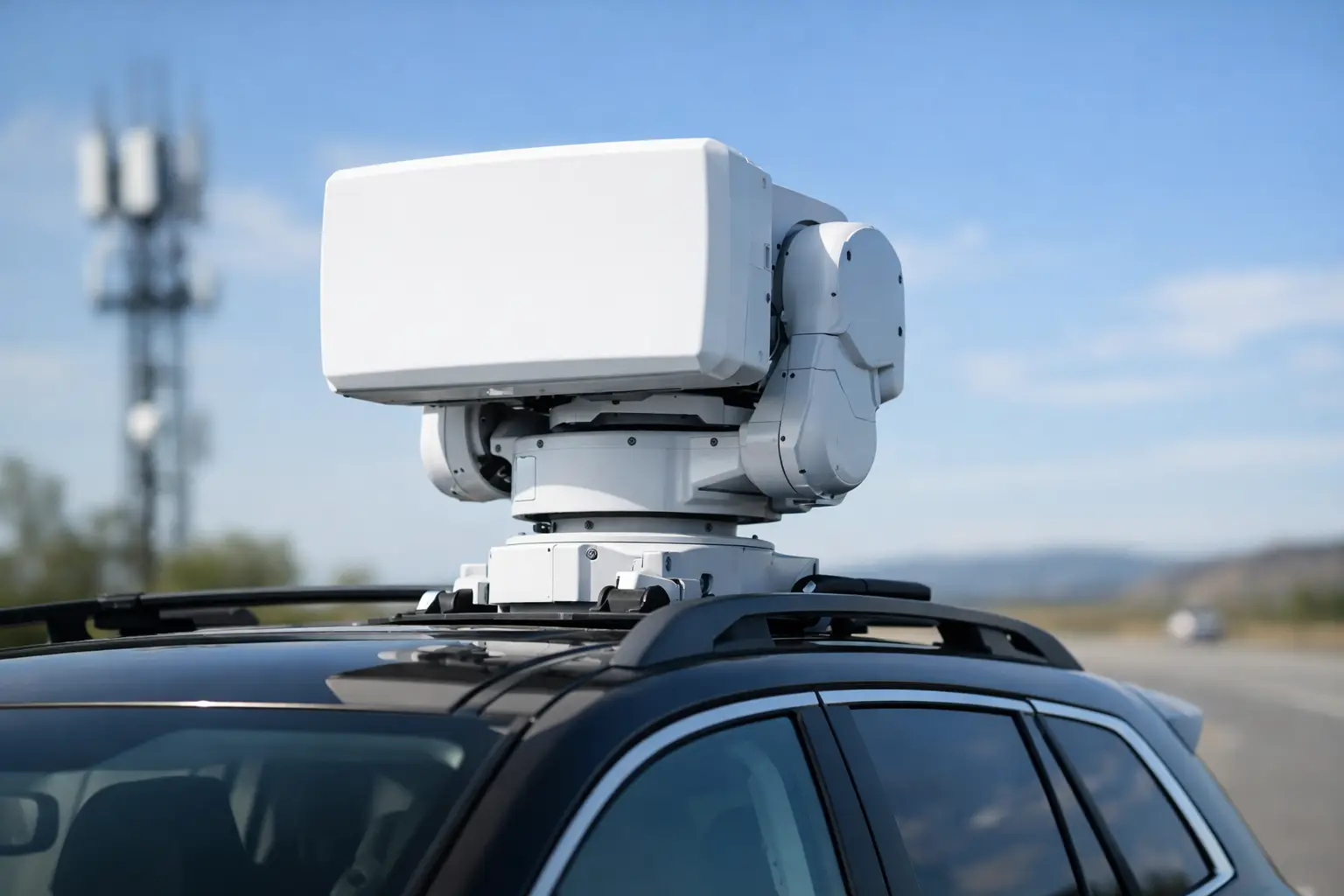
A convoy loses line of sight for a few seconds, a patrol boat rolls in heavy chop, or a utility truck moves between obstructed sectors of a job site. In each case, the network problem is not bandwidth on paper. It is alignment under motion. A stabilized microwave system for vehicles is built to solve that problem by keeping a directional wireless link pointed where it needs to be while the platform moves, vibrates, pitches, and changes heading.
For buyers responsible for continuity in the field, that distinction matters. Standard fixed wireless hardware can perform well on static sites, but once the mounting surface starts moving, link quality becomes a tracking problem as much as a radio problem. The difference between a usable connection and an intermittent one often comes down to stabilization accuracy, auto-aiming behavior, path prediction, and how well the system integrates with the onboard network.
What a stabilized microwave system for vehicles actually does
At its core, a vehicle-mounted stabilized microwave system combines a directional antenna, a stabilization platform, tracking logic, and radio integration into a single transportable link solution. The purpose is straightforward: maintain beam alignment between a moving vehicle and a fixed or moving endpoint so broadband connectivity can continue during motion or during frequent repositioning.
That sounds simple until real operating conditions enter the picture. Vehicles introduce constant vibration, uneven terrain, rapid heading changes, and temporary obstructions. In higher frequency microwave deployments, narrow beamwidth improves throughput and interference performance, but it also reduces tolerance for pointing error. A few degrees of drift can be enough to degrade the link materially. Stabilization compensates for that by continuously correcting antenna position based on platform movement and link conditions.
This is why mature systems are not just antennas on brackets. They are engineered assemblies that account for mechanical movement, RF behavior, environmental exposure, and network architecture.
Why mobility changes the wireless design equation
A fixed backhaul link is largely a surveying and mounting exercise. Once installed, the path is known, alignment is dialed in, and only environmental factors and maintenance affect performance. Vehicle applications are different because the path geometry changes constantly. The mounted system has to deal with changing azimuth, tilt, elevation, and speed while still preserving enough signal quality for the application running over the link.
That application may be live video from a public safety vehicle, operational data from an industrial fleet, onboard crew communications, private LTE backhaul, or a command-and-control extension for defense operations. Each use case has a different tolerance for latency, packet loss, and temporary fade. The right design depends on mission profile, not just maximum throughput.
This is also where many off-the-shelf approaches fall short. A generic wireless bridge may advertise strong radio specifications, but if it cannot maintain alignment through vehicle motion, those specifications have limited value in the field.
Core system elements that determine real performance
The antenna gets most of the attention, but field performance depends on the interaction of several subsystems. Stabilization mechanics matter because the antenna has to remain controlled under vibration and movement, not just under ideal lab conditions. Tracking capability matters because the system has to locate, acquire, and hold the target efficiently. Radio compatibility matters because the stabilized platform has to support the throughput, modulation, and frequency plan required by the network.
The mounting and vehicle integration layer is just as important. Power quality, cabling losses, environmental sealing, shock loading, and available installation space can all affect system behavior. Onboard network integration also deserves more attention than it usually gets during procurement. A well-designed stabilized microwave link should fit cleanly into the vehicle LAN, security architecture, and any existing routing or private cellular environment.
When buyers assess solutions, they should look beyond link budget claims and ask how the system manages acquisition time, stabilization response, path obstruction recovery, and compatibility with the radios and network services already in use.
Auto-aiming and path calculation
Auto-aiming is one of the most practical features in mobile deployments because it reduces setup time and operator burden. In a demanding environment, operators should not have to manually fine-tune a directional link every time a vehicle stops, turns, or relocates. A capable system uses position data, heading input, and tracking logic to find and maintain the correct path with minimal intervention.
Path calculation adds another layer of operational value. In vehicle scenarios, link viability depends not just on raw distance but on terrain, obstruction risk, and movement pattern. Systems designed for professional deployment account for those variables before the vehicle is ever in motion, which improves predictability and shortens time to service.
Stabilization accuracy versus use case
Not every deployment needs the same level of stabilization. A slow-moving industrial vehicle operating on relatively even ground has different demands than a tactical vehicle moving cross-country or a marine platform in rough conditions. Higher performance stabilization generally adds complexity and cost, but under the wrong conditions, under-specifying the system is more expensive in practice because it creates avoidable outages, truck rolls, and operational interruptions.
That is why system selection should start with movement profile, operating environment, and service expectations rather than with hardware price alone.
Where vehicle-mounted stabilized microwave delivers the most value
The strongest use cases share one trait: standard terrestrial connectivity cannot maintain continuity where the asset actually operates. In defense and public safety, that often means extending command, intelligence, or surveillance connectivity to moving platforms without relying entirely on satellite resources. In oil and gas, mining, utilities, and construction, it often means preserving broadband access across mobile assets and temporary work zones where wired infrastructure is impractical.
Maritime support vehicles and port operations can also benefit when directional wireless links need to remain usable in environments with constant movement and difficult RF geometry. Commercial fleets operating in remote corridors may use the system as part of a larger private network design that combines fixed infrastructure, onboard networking, and specialized backhaul.
In each of these sectors, the value is not simply connectivity. It is operational continuity with a controlled architecture.
Engineering trade-offs buyers should evaluate early
There is no single best stabilized microwave system for vehicles in every scenario. It depends on range, frequency, platform type, power availability, and how much interruption the application can tolerate. Narrower beams can improve spectral efficiency and reach, but they require tighter pointing control. More rugged mechanical designs can improve survivability, but they may increase weight and integration complexity. Higher gain can improve path margin, but antenna size may become a constraint on smaller vehicles.
Environmental exposure is another factor that should not be treated as a checkbox. Dust, salt, rain, sustained vibration, shock, and temperature swings all influence mechanical life and RF stability. A platform intended for protected commercial routes is not automatically suitable for offshore, tactical, or industrial abuse cases.
Procurement teams should also consider maintainability. A high-performance system that is difficult to service in the field can become a lifecycle problem. Practical supportability, spare strategy, and compatibility with existing radio ecosystems matter as much as the initial specification sheet.
Integration matters more than standalone hardware
A stabilized link only delivers full value when it is part of a complete communications design. That includes the remote endpoint, network management approach, security controls, onboard Wi-Fi or switching, and any handoff to private LTE or 5G infrastructure. If the system is deployed as a bolt-on device without regard to the larger network, performance gaps usually appear later as congestion, management blind spots, or difficult failover behavior.
This is where solution-led engineering stands apart from commodity hardware sourcing. The right provider looks at the vehicle, the route or operating area, the endpoint architecture, the radio stack, and the field support model together. For organizations building mission-critical mobility, that approach reduces deployment friction and improves long-term results. Companies such as BATS Wireless typically focus on this full-system view because the real challenge is not selling a component. It is keeping the link operational where standard solutions stop working.
How to tell if your operation needs one
If your team is trying to maintain broadband from moving assets using fixed directional equipment, repeated realignment, or a patchwork of lower-performance alternatives, that is usually a sign the architecture needs to change. The same is true if connectivity drops during turns, vibration events, or terrain transitions, even when nominal coverage should exist.
A stabilized microwave system becomes particularly relevant when the application demands high throughput, deterministic behavior, and independence from crowded public networks. It is also a strong fit when you need a purpose-built backhaul layer for mobile operations rather than best-effort connectivity.
The most effective deployments begin with a clear operational question: what must stay connected, while moving, under what conditions, and with what tolerance for interruption? Once that is answered, the engineering path becomes much more precise.
Reliable mobile broadband is rarely a radio-only issue. It is a tracking, stabilization, and integration problem that has to be solved as one system if you expect it to perform when the vehicle starts moving.
September 20, 2026

September 20, 2026

September 20, 2026
September 20, 2026
