
Stabilized Microwave Versus Satellite: Which Fits?
Compare stabilized microwave versus satellite for mobile and remote operations. See where each link type wins on latency, capacity, resilience, and cost.

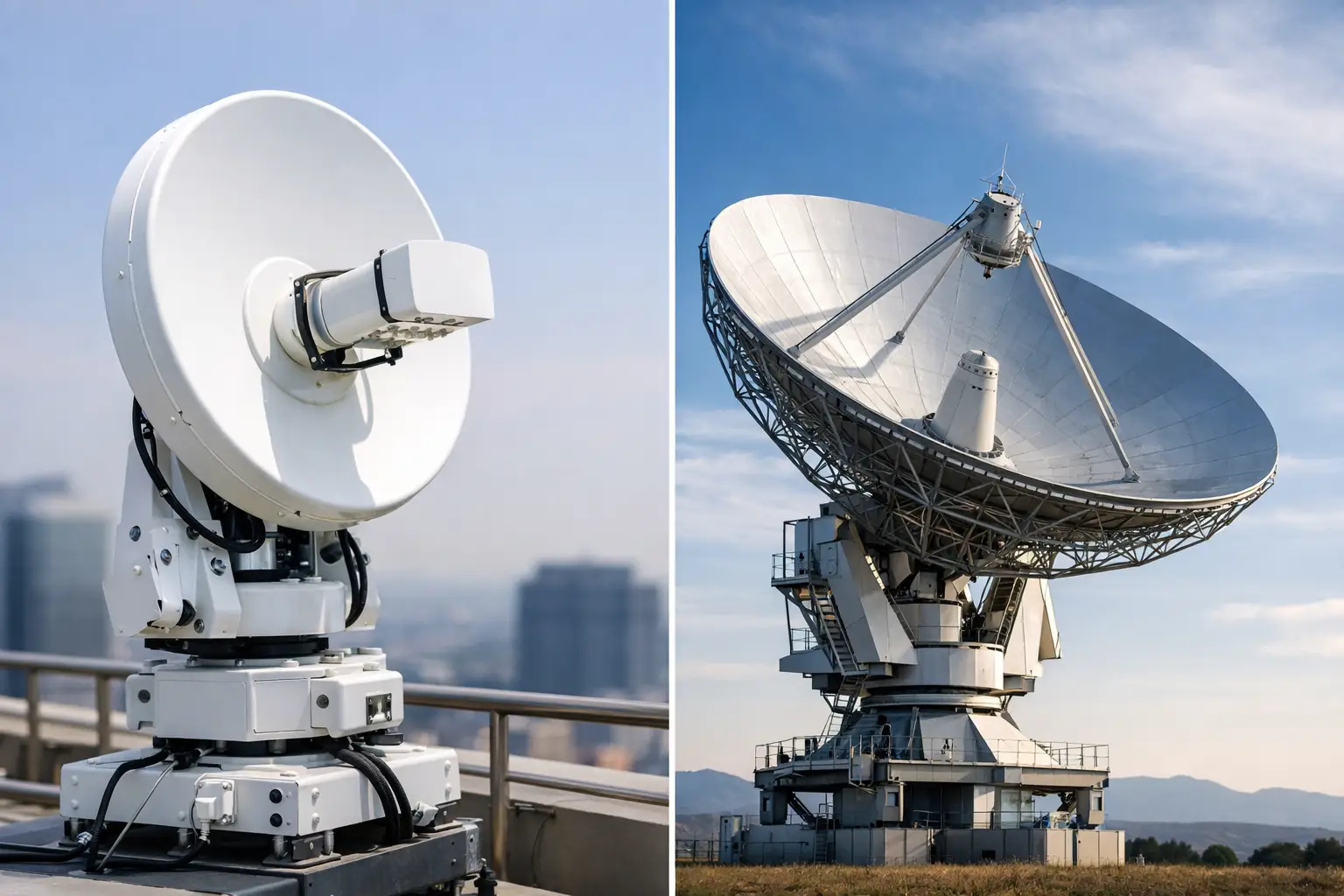
A vessel leaves port, a command vehicle changes position, or a field crew moves beyond terrestrial coverage. The connectivity decision cannot be based on advertised throughput alone. In a stabilized microwave versus satellite evaluation, the real question is whether the network can maintain the required capacity, latency, availability, and security while the operating environment changes around it.
For many mission-critical organizations, the best answer is not an absolute choice. Stabilized microwave and satellite solve different parts of the connectivity problem. Selecting the right architecture starts with understanding their operational limits, not treating either technology as a universal replacement for the other.
Stabilized Microwave Versus Satellite at a Glance
Stabilized microwave creates a high-capacity point-to-point wireless connection between a moving or unstable platform and a known network endpoint. An auto-aiming antenna continuously maintains alignment with a shore site, tower, vessel, aircraft, or other remote node. The system compensates for motion, vibration, pitch, roll, yaw, and changing geometry that would disrupt a conventional directional microwave link.
Satellite sends traffic from the remote terminal to an orbiting satellite and then to a ground gateway or another satellite endpoint. It is designed to reach locations where no practical line-of-sight path to terrestrial infrastructure exists. Depending on the service and orbit, satellite can support fixed, mobile, and rapidly deployable operations across very large geographic areas.
The distinction is fundamental. Microwave extends existing terrestrial network capacity across a direct radio path. Satellite provides coverage beyond the reach of terrestrial infrastructure. Both can support enterprise data, voice, video, private LTE or 5G backhaul, and operational systems, but their performance profiles are materially different.
Where Stabilized Microwave Has the Advantage
Capacity and predictable latency
When a suitable line-of-sight path is available, stabilized microwave generally provides the performance profile that high-demand operations prefer. It can deliver substantial bandwidth with low and predictable latency, making it well suited for real-time video, command-and-control applications, cloud access, onboard user traffic, sensor data, and private cellular backhaul.
That latency advantage matters when personnel are operating remotely, cameras are feeding an operations center, or a private LTE/5G network depends on responsive backhaul. Satellite latency has improved significantly with low Earth orbit services, but it remains subject to service architecture, gateway routing, handoffs, network contention, and coverage conditions. A properly engineered microwave path is typically more deterministic.
Cost efficiency at sustained usage levels
Satellite is often attractive because it can be deployed where no other option exists. However, recurring service costs can rise quickly when operations require large volumes of data, high-definition video, many connected users, or continuous traffic. Stabilized microwave can be a cost-saving solution where a terrestrial endpoint is within reach because the organization is using its own spectrum plan, network capacity, and backhaul resources rather than purchasing every transported gigabyte through a satellite service.
The comparison should include more than terminal cost. Evaluate installation, site infrastructure, spectrum coordination, operational support, maintenance, service subscriptions, expected traffic growth, and downtime exposure. For an offshore platform close enough to shore, a port operation, a windfarm, or a moving asset traveling a defined corridor, microwave can produce a stronger long-term cost model.
Control over the network path
A stabilized microwave system gives the operator greater control over the communications path. Network teams can define radio configuration, quality-of-service policies, segmentation, encryption approach, failover behavior, and integration with existing edge equipment. This is particularly valuable for organizations that need to extend a private 4G/5G network, maintain separate operational and IT traffic, or support regulated environments.
Control does not eliminate the need for sound engineering. The link still depends on clear Fresnel zone conditions, appropriate antenna placement, sufficient fade margin, RF planning, and accurate tracking performance. But it allows the organization to build a network around operational requirements instead of conforming all traffic to a shared service model.
Where Satellite Is the Better Choice
Satellite is the practical answer when there is no viable terrestrial endpoint or when operating geography changes too widely for a microwave network to follow. A disaster response team deployed hundreds of miles from the nearest backhaul site cannot create line of sight through terrain, trees, buildings, or the curvature of the Earth. A satellite terminal can establish connectivity without waiting for towers, fiber, or relay sites.
It also provides geographic resilience. If a storm, wildfire, or infrastructure failure removes terrestrial access, satellite may remain available from a location that has power, sky visibility, and an active service plan. For public safety, defense, emergency management, and remote industrial operations, that independence can be worth more than the performance trade-off.
Satellite is also useful for assets that move outside a predictable route. A commercial vessel crossing open water, a remote exploration team, or an aircraft operating far beyond shore-based coverage may have no consistent microwave target to track. In these conditions, a stabilized satellite terminal or flat-panel antenna can provide the reach that direct microwave cannot.
Line of Sight Is the Deciding Constraint
The most consequential requirement for stabilized microwave is line of sight. This does not simply mean that two sites appear visible on a map. Engineers must account for antenna height, terrain, structures, vegetation, sea state, vessel motion, atmospheric effects, path length, frequency band, and Fresnel zone clearance.
Over water, microwave can travel impressive distances when towers, platforms, or elevated shore sites create a clean path. But sea clutter, ducting, weather, and changing vessel orientation must be considered. On land, hills and dense foliage can make a short path unusable while a longer path from a better-positioned relay site performs reliably.
Auto-aiming stabilization addresses movement at the endpoint. It does not overcome a blocked path. This is why path calculation and site assessment are central to a successful deployment. The radio, antenna, mount, and tracking system must be designed as one operational system.
The Strongest Architecture Is Often Hybrid
Organizations with high availability requirements should consider microwave and satellite as complementary layers. Stabilized microwave can carry primary high-capacity traffic when the asset is within range of terrestrial infrastructure. Satellite can provide backup connectivity, coverage during route transitions, or service in areas where the microwave path is unavailable.
This architecture is especially relevant for maritime operations, mobile command vehicles, temporary industrial sites, and field-deployed private networks. Traffic policies can prioritize operational data, voice, and critical applications over the available link while shifting less sensitive traffic as capacity changes. The network should be designed to fail over without requiring personnel to manually reconfigure services during an incident.
A hybrid design requires discipline. The two links have different bandwidth, latency, jitter, and cost characteristics, so routing and application policies must reflect those realities. Sending all traffic to satellite during a microwave interruption may be technically possible but commercially inefficient. Classifying traffic and establishing clear service priorities protects the applications that matter most.
Questions to Ask Before Selecting a Link
The right decision comes from the mission profile. Start with the asset’s operating area and movement pattern. Is it always within line of sight of a shore site, tower, or relay network? Does it travel predictable routes? How long must communications continue when terrestrial coverage is unavailable?
Then define the traffic requirement. A small telemetry load has very different needs than multi-camera video surveillance, remote engineering access, crew welfare connectivity, and private 5G backhaul on the same platform. Measure expected peak use, not only average consumption. Also identify latency-sensitive applications, required uptime, cybersecurity controls, and the cost of an outage.
Finally, assess deployment reality. Can the antenna be mounted with a clear field of view? Is there sufficient power? Will the platform experience heavy vibration or high sea states? Who will monitor the link, replace field hardware, and support the network after commissioning? The best technology on paper can underperform if these operational details are deferred.
Build the Link Around the Mission
Stabilized microwave is the stronger choice when a moving asset needs high throughput, low latency, and cost-efficient access to a reachable terrestrial network. Satellite is the stronger choice when coverage must extend beyond line of sight and independent geographic reach is the priority. Neither conclusion is useful without a path study, traffic model, and realistic availability target.
For organizations operating where connectivity affects safety, production, response time, or mission execution, the productive next step is to map the route, quantify the application load, and engineer the primary and backup paths before equipment is selected. That approach turns a connectivity purchase into an operational system built to keep working when conditions are least forgiving.

October 10, 2026

October 10, 2026

October 10, 2026

October 10, 2026
