
Best Industrial Wireless Backhaul for Hard Sites
Choose the best industrial wireless backhaul for remote, mobile, and harsh sites with the range, uptime, security, and support your operations require.

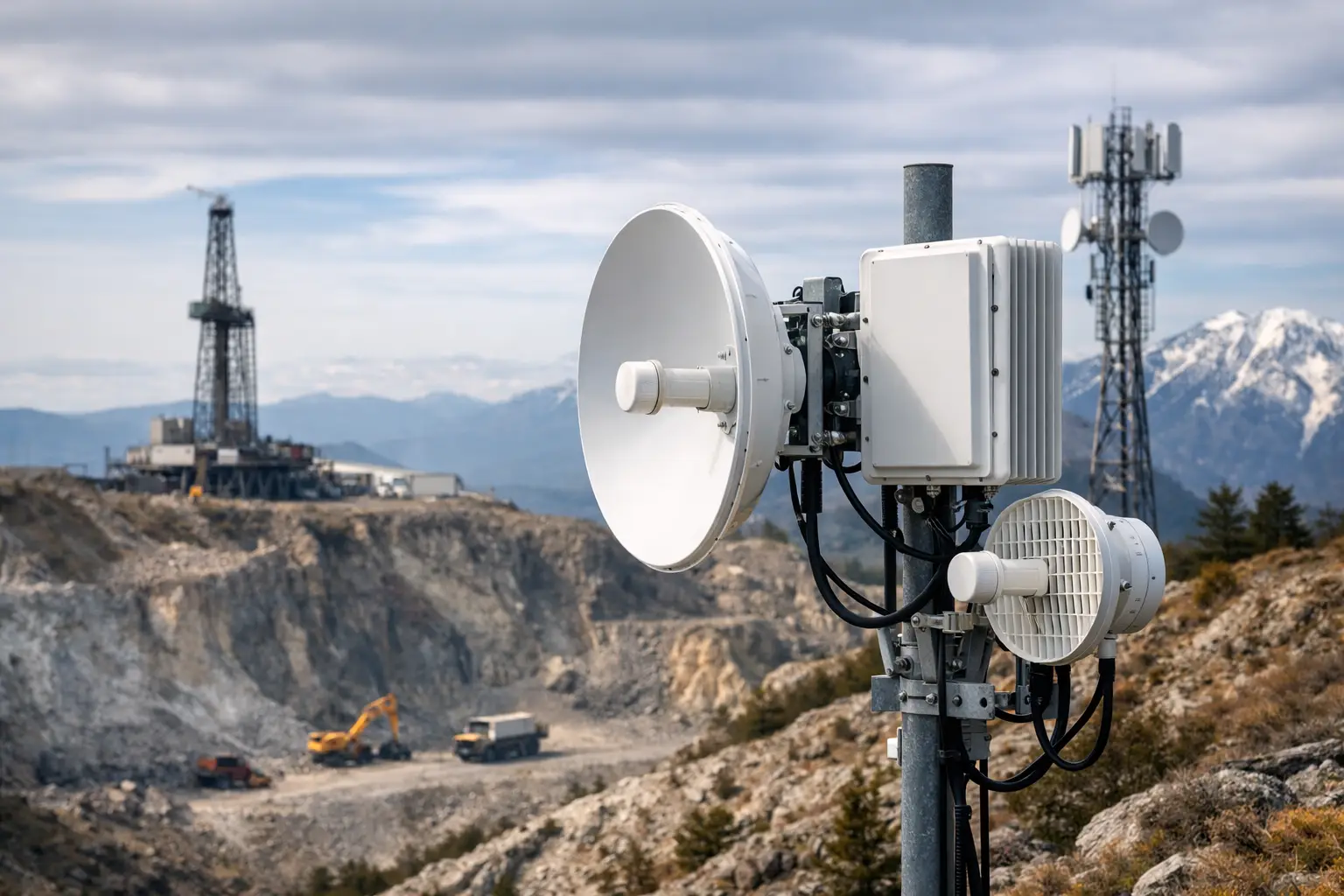
A backhaul link can look excellent on a site survey and still fail where operations need it most: during vessel motion, high winds, crane interference, seasonal foliage growth, or a sudden change in traffic demand. The best industrial wireless backhaul is not simply the radio with the highest published throughput. It is an engineered connection that maintains usable capacity, availability, and control across the real conditions of the site.
For industrial operators, the selection process starts with the operational consequence of an outage. A temporary capacity reduction at a construction site may be manageable. Lost connectivity to offshore personnel, a mobile command vehicle, a remote substation, or an autonomous operating system may not be. That distinction should drive the architecture, hardware class, redundancy plan, and level of field support.
What Makes the Best Industrial Wireless Backhaul?
Industrial backhaul carries traffic from a remote network to a core network, internet point of presence, private LTE or 5G core, or another operational facility. It may support surveillance video, VoIP, SCADA, fleet systems, enterprise applications, safety communications, and private cellular traffic at the same time. The right design must account for more than raw bandwidth.
Availability is usually the first requirement. A link engineered for a short, clear line-of-sight path in fair weather is fundamentally different from one expected to support a production site through rain, salt exposure, vibration, dust, and sustained wind. Link budgets must include realistic fade margin, not just a calculation that works under ideal assumptions. Frequency selection, antenna gain, modulation behavior, and path obstruction risk all affect whether the link can hold service at the required level.
Capacity comes next, but it should be measured against actual traffic behavior. A site with several high-definition cameras may have a predictable baseline demand. A private LTE network serving field crews can generate changing uplink and downlink loads as users move, conduct video calls, upload inspection files, or access cloud applications. Backhaul should be sized for peak operational demand, future growth, and the throughput reduction that can occur when adaptive modulation shifts during adverse conditions.
The third requirement is recoverability. Industrial teams need to know what happens when a primary path degrades or a radio loses alignment. Can traffic fail over to a secondary path? Can the system be monitored remotely? Can local personnel replace a field unit without rebuilding the network from scratch? The best design is one that gives operations a defined response before the outage occurs.
Match the Backhaul Architecture to the Site
There is no single technology that is best for every industrial environment. Point-to-point microwave, millimeter wave, private cellular, mesh, satellite, and fiber each have a place. The decision should follow the terrain, mobility profile, required availability, spectrum options, and economics of the deployment.
Fixed point-to-point microwave for long-range capacity
Licensed and unlicensed microwave systems remain a practical choice for fixed sites with clear or engineered line of sight. They can provide high-capacity links over substantial distances without the civil cost and lead time of trenching fiber. Licensed spectrum is often justified where predictable performance, interference protection, and high availability are operational requirements.
Unlicensed spectrum can be a cost-saving solution for lower-risk sites or shorter paths, but it demands careful spectrum analysis. A band that appears clear at commissioning can become congested as nearby facilities add wireless equipment. For this reason, interference monitoring and a realistic upgrade path matter as much as the initial purchase price.
Stabilized and auto-aiming systems for moving assets
Static antennas are not suitable for every link. Maritime platforms, vessels, mobile command units, rail assets, and mobile industrial equipment can change heading, position, elevation, and orientation continuously. In these cases, the backhaul system must compensate for motion while sustaining the antenna alignment needed for the selected frequency band.
Auto-aiming antenna tracking and stabilized microwave systems address this challenge by combining position data, path calculation, antenna control, and compatible radios. The value is operational: the system reduces dependence on manual pointing and helps maintain connectivity as the asset moves. For a vessel connecting to shore or another vessel, antenna tracking performance can matter more than the data-sheet throughput of the radio itself.
Private 4G/5G backhaul for distributed field coverage
Private LTE and 5G extend connectivity across industrial facilities, ports, mines, wind farms, campuses, and temporary work zones. However, the cellular access network is only as useful as the transport behind it. Backhaul must support the aggregate traffic of the radio access network, the latency tolerance of applications, and the resiliency requirements of the core.
For a distributed private cellular deployment, consider whether each cell site needs a dedicated point-to-point link, whether aggregation is practical, and whether the network needs a secondary transport path. Timing and synchronization requirements should also be addressed early. A design that treats backhaul as an afterthought can limit the performance of an otherwise capable private 5G deployment.
Evaluate the Path Before Choosing Equipment
The physical path determines what a wireless backhaul system can realistically deliver. Network planners should assess terrain, Fresnel-zone clearance, nearby structures, reflective surfaces, vegetation, local weather patterns, and future construction. A clear visual path is not always a clear RF path.
Water introduces its own challenges. Maritime and coastal deployments contend with motion, corrosion, salt spray, ducting conditions, and reflections from the water surface. Oil and gas sites may add hazardous-area requirements, steel infrastructure, process noise, and long distances between facilities. Wind farms can require links across changing terrain while turbines create obstruction and reflection concerns.
A proper site assessment should also identify installation constraints. Can the antenna be mounted high enough to preserve clearance? Is there suitable power, grounding, and lightning protection? How will technicians reach the equipment during an alarm condition? These questions influence total cost and uptime more directly than a simple comparison of radio prices.
Design for Availability, Not Just Speed
A common procurement mistake is specifying a throughput target without an availability target. A 1 Gbps connection that falls below usable performance during the conditions that matter most may be less valuable than a lower-capacity link engineered for consistent service.
Define the traffic that must continue during degraded conditions. For example, video streams may be reduced while voice, control traffic, safety systems, and critical telemetry retain priority. Quality-of-service policies should be built into the backhaul design rather than added after congestion appears.
Redundancy must also be proportionate to the site. A remote monitoring location may use a primary microwave path and a lower-capacity cellular or satellite backup. A critical production site may require diverse microwave paths, independent power sources, separate mounting structures, or a fiber route combined with wireless failover. Two links on the same tower with the same power feed do not provide meaningful physical diversity.
Security and Interoperability Are Operational Requirements
Industrial wireless backhaul often transports sensitive operational traffic and connects systems that were not designed for public-network exposure. Encryption, network segmentation, access controls, secure management interfaces, and logging should be specified as part of the solution.
Interoperability is equally important. The backhaul must work with existing routers, switches, firewalls, private LTE or 5G equipment, timing sources, and network-management platforms. A solution that requires unnecessary proprietary components can create support constraints later. Conversely, selecting commodity components without validating their integration can shift engineering risk to the site team.
Ask vendors how they handle radio compatibility, VLAN and QoS policies, failover routing, remote diagnostics, software lifecycle management, and replacement hardware. A complete answer should describe the operating system, not only the antenna or radio.
Select a Partner That Understands Field Deployment
Industrial backhaul projects are rarely solved by shipping a box. The work includes path engineering, spectrum planning, antenna selection, mounting design, installation, commissioning, acceptance testing, and ongoing technical support. For mobile or harsh-environment deployments, it may also include stabilization, tracking configuration, onboard networking, and integration with mission-specific communications equipment.
BATS Wireless approaches these deployments as complete operational systems, combining antenna tracking, stabilized microwave, integrated radios, and private 4G/5G connectivity where the application requires it. That systems perspective is particularly relevant when a link must perform across moving assets, remote terrain, or environments where manual intervention is expensive and slow.
Before procurement, require a design discussion that addresses the site path, availability objective, traffic model, environmental conditions, installation method, and support plan. A credible provider should be prepared to explain trade-offs. Higher frequency may provide more capacity but demand tighter alignment and greater fade planning. Licensed spectrum may improve predictability but add coordination cost and lead time. Redundancy may increase capital expense while reducing the far larger cost of a field outage.
The right backhaul decision is the one that keeps essential traffic moving when the site is least convenient to reach. Start with that operating condition, then engineer the connection backward from it.

October 10, 2026

October 10, 2026

October 10, 2026

October 10, 2026
