
A Public Safety Network Example That Works
See a public safety network example built for disaster response, with private LTE/5G, mobile backhaul, interoperability, and resilient field operations.


A useful public safety network example is not a diagram showing radios, towers, and a command vehicle. It is a working communications system that continues to move voice, video, data, and location information when commercial service is congested, power is limited, terrain obstructs line of sight, and response assets are moving. The distinction matters because the network is often tested at the precise moment conventional connectivity is least dependable.
Consider a wildfire response spanning rural terrain, a nearby community, and an incident command post. Fire apparatus, law enforcement units, utility crews, drones, medical teams, and mutual-aid agencies all need access to different services. Some require mission-critical voice. Others need body-worn camera uploads, mapping, incident management applications, drone video, or remote access to agency systems. A public safety network must carry those traffic types without forcing every user onto one overloaded or poorly suited connection.
A Public Safety Network Example for Wildfire Response
In this scenario, incident command establishes a temporary communications hub near the operational area. The hub includes a private LTE or 5G network, local compute and core services where required, interoperable radio gateways, and multiple backhaul paths to an emergency operations center or agency network.
Fixed infrastructure may provide the first path. If a fiber-connected facility or public tower is close enough, it can support primary backhaul. But that path should not be treated as the only option. A stabilized microwave link can extend high-capacity connectivity across difficult terrain, while a satellite service can provide a separate route when terrestrial infrastructure is damaged or unavailable. The correct mix depends on required throughput, distance, frequency coordination, terrain, and the time available for deployment.
The local private cellular layer gives responders controlled coverage around the incident base, staging areas, medical tents, checkpoints, and temporary shelters. Instead of competing with the public for capacity on a commercial network, authorized devices operate on a managed network designed around incident priorities. This can include rugged smartphones, vehicle routers, tablets, cameras, sensors, and cellular-connected radio gateways.
The result is not simply better broadband. It is an operational communications environment that can be expanded, moved, and managed as the incident changes.
The Architecture Behind a Field-Ready System
A capable public safety deployment separates access, transport, and command functions so a single failure does not remove every communications option. At the access layer, private LTE or 5G provides mobility and local coverage. Wi-Fi may support fixed work areas or high-density indoor operations. Land mobile radio remains essential for many voice workflows and should be integrated rather than displaced by broadband.
The transport layer carries traffic back to the agency network, command center, internet gateway, or cloud services. This is where microwave, satellite, fiber, and commercial cellular connections have different roles. Microwave can deliver high throughput and low latency over long distances when there is a viable path. Satellite can be deployed where no terrestrial route exists, though latency, capacity, weather effects, and service-plan limits must be understood. Commercial cellular may be useful as an additional path, but it is vulnerable to congestion during large incidents.
At the command layer, network administrators need visibility into users, devices, applications, and link health. They should be able to enforce quality-of-service policies, segment traffic, prioritize emergency applications, and identify a degraded path before it becomes an operational failure. Local services also deserve consideration. If a remote site loses its wide-area backhaul, incident teams may still need local mapping, video distribution, files, and communications tools to remain available on site.
Why Auto-Aiming Matters for Mobile Assets
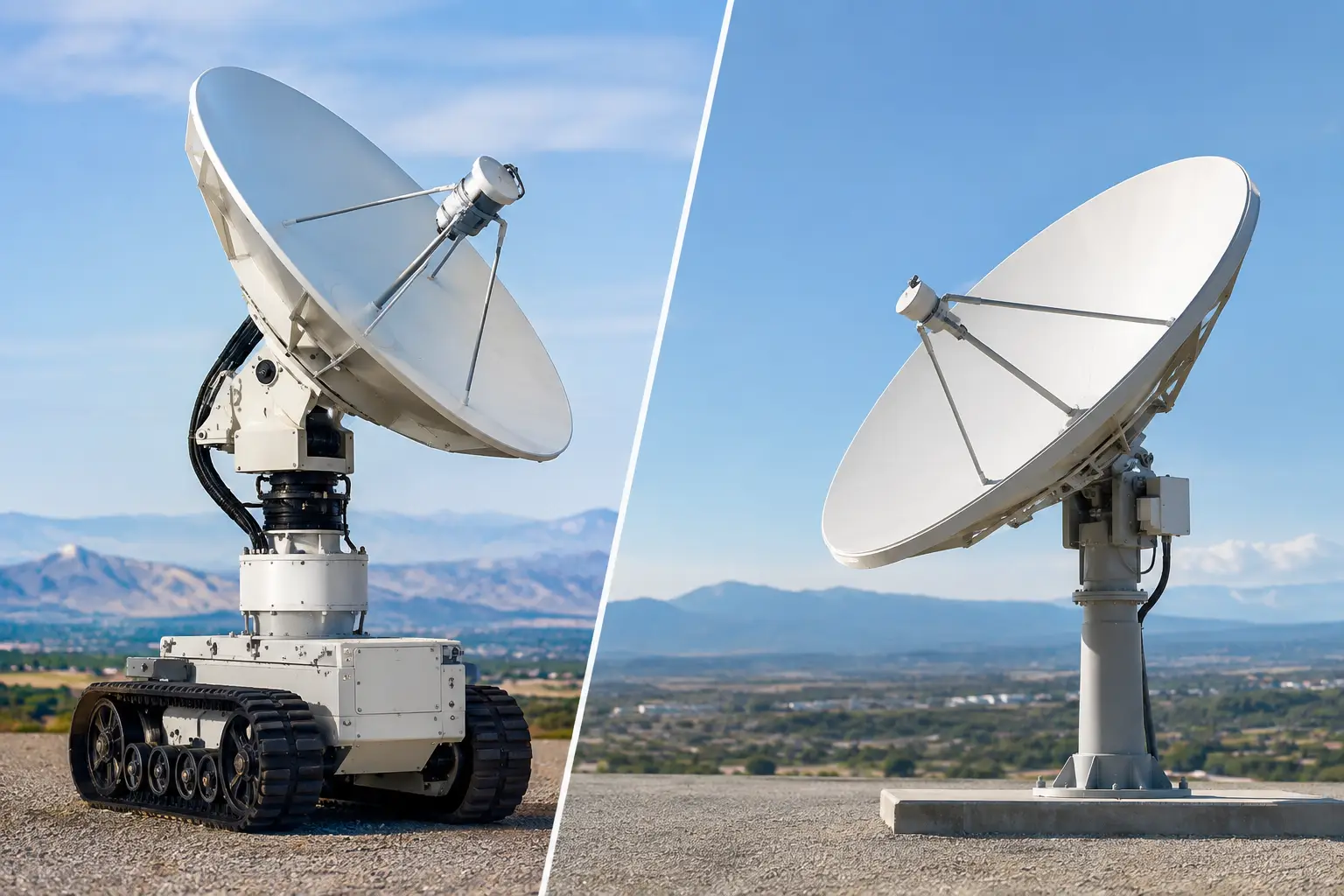
A command vehicle or maritime response platform does not remain perfectly still. Vibration, changing terrain, wind, vehicle movement, and repositioning can degrade a conventional directional wireless link. Manual alignment also consumes time and introduces avoidable uncertainty when a crew is focused on the incident.
Auto-aiming antenna tracking systems address that problem by maintaining alignment between moving or repositioned endpoints. Combined with stabilized microwave systems and path calculation, the approach supports more consistent long-range transport where fixed antennas or basic point-to-point equipment are not practical. For mobile command, disaster response, and temporary operations, that can reduce setup burden while protecting link performance.
Interoperability Is the Operational Requirement
Public safety agencies rarely deploy alone. A county sheriff’s office may work with municipal fire departments, state agencies, federal resources, utilities, hospitals, and contracted field crews. Those organizations bring different devices, frequency plans, security policies, and application requirements.
A network design should therefore account for interoperability at more than the radio level. It must support the exchange of voice, situational awareness data, video, and operational records without unnecessarily exposing each organization’s internal systems. Network segmentation is central to this approach. Fire operations, law enforcement, medical services, public access, IoT sensors, and vendor equipment should not all occupy the same flat network.
Integration choices also depend on the agency’s existing environment. In some cases, the best design is a private LTE/5G overlay that extends current radio and IP infrastructure. In others, the priority is a rapidly deployable standalone system that later connects back to fixed agency resources. Neither model is universally better. The right answer follows the mission, jurisdiction, available spectrum, staffing model, and expected duration of the event.
Design Decisions That Determine Field Performance
Equipment specifications matter, but field performance usually depends on decisions made before deployment. A practical design review should address five areas:
- Coverage and capacity: Model where users will operate, how many will connect, and which applications create sustained uplink traffic, especially drone and video feeds.
- Backhaul diversity: Establish at least two independent transport paths when the mission justifies it. Two services sharing the same damaged power, tower, or conduit route are not truly independent.
- Power continuity: Size battery backup, generators, fuel logistics, and power distribution for the actual load, including radios, edge compute, cooling, and charging stations.
- Cybersecurity and access: Use authenticated devices, encrypted traffic, role-based access, segmentation, and a process for onboarding mutual-aid users without opening the network to unmanaged equipment.
- Deployment workflow: Define who transports, assembles, aligns, tests, monitors, and recovers the system. A technically capable network that requires unavailable specialists is not an incident-ready network.
These areas also shape cost. A highly redundant architecture has a higher initial equipment and engineering cost than a single-link solution. Yet the cost of lost connectivity can be much greater when it delays resource coordination, compromises responder safety, or requires a second deployment after the first system fails.
From Demonstration to Operational Capability
Many agencies validate communications systems in controlled demonstrations, then discover different behavior during a live incident. Traffic loads rise. Users connect personal or unfamiliar devices. Vehicles block antennas. A temporary command post moves. The backhaul path that looked acceptable in a survey experiences interference or weather-related degradation.
For that reason, acceptance testing should resemble real operations. Test with the applications responders use, the number of devices expected during a peak period, and the same field personnel who will operate the equipment. Verify how long setup takes, how the network recovers after power loss, and what happens when the primary backhaul path fails. Documenting those outcomes turns a technology purchase into a repeatable response capability.
BATS Wireless designs engineered wireless systems for these conditions, combining private connectivity, integrated radios, stabilized microwave, and antenna tracking where the mission requires more than a fixed broadband connection. The objective is not to add technology for its own sake. It is to give field teams a communications system that fits the terrain, movement, traffic demands, and operational risk.
The strongest public safety network is the one responders can deploy confidently, operate with limited friction, and trust when every commercial signal around them is under pressure.

October 5, 2026
October 5, 2026

October 5, 2026

October 5, 2026
