
LTE Versus LMR Interoperability in the Field
LTE versus LMR interoperability connects broadband data with proven mission-critical voice. Learn where it works, where it fails, and how to engineer it.

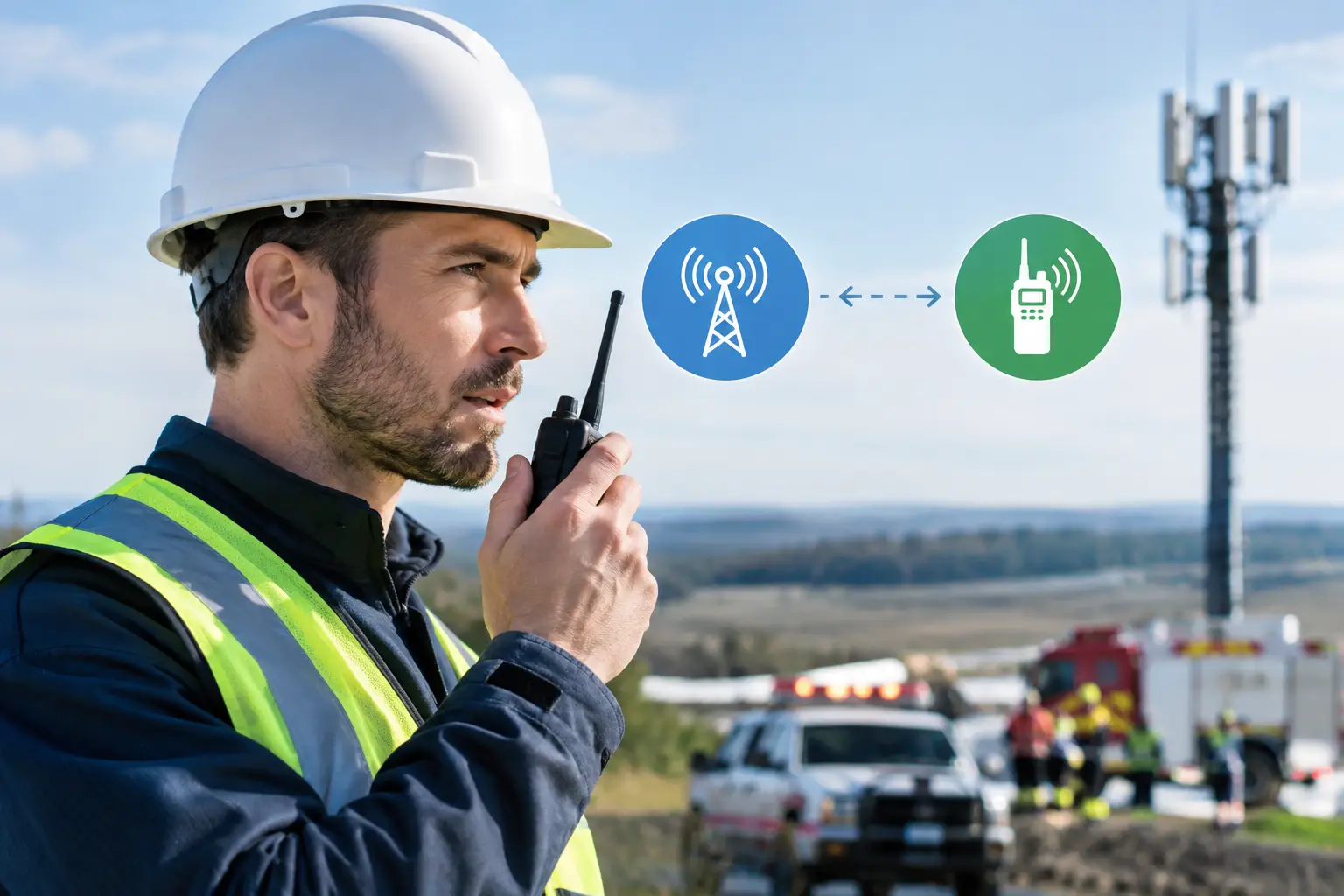
A command vehicle arrives at a wildfire perimeter, a port security team responds to an incident, or a utility crew enters a storm-damaged service area. The people on scene may carry land mobile radios while supervisors, video systems, mapping tools, and remote specialists rely on LTE. LTE versus LMR interoperability is the architecture that determines whether those groups operate as one team or as separate communications islands.
For mission-critical organizations, this is not a simple question of replacing radios with smartphones. Land mobile radio, or LMR, remains the proven voice platform for many field operations because it offers direct communications, familiar controls, predictable talkgroup behavior, and purpose-built devices. LTE adds high-capacity data, video, location services, cloud applications, and broader network reach. The engineering challenge is making each technology useful without allowing either one to become a point of operational failure.
LTE Versus LMR Interoperability: What It Actually Means
Interoperability is often described as connecting two networks. That definition is incomplete. A workable deployment must connect the right users, applications, control functions, and operational procedures at the right time.
At its most basic level, an interoperability gateway can bridge an LMR talkgroup to an LTE push-to-talk group. A dispatcher using an LMR console can communicate with an LTE-connected supervisor, or an LTE user can be patched into an incident command talkgroup. This is useful, but it is only one layer of the system.
A complete design also accounts for identity management, priority and preemption, encryption boundaries, audio quality, logging, dispatch integration, device controls, coverage conditions, and failover behavior. A bridge that passes audio during a demonstration may still be unsuitable for a law enforcement response, offshore platform operation, or industrial emergency if it introduces uncontrolled access, excessive delay, or a single unprotected failure point.
The objective is not to force LTE to behave exactly like LMR. It is to assign voice, data, video, and command functions to the network best able to support them, then create controlled operational paths between those systems.
Why LMR Still Has a Defined Role
LMR is designed around immediate group voice. In conventional and trunked systems, users can select assigned channels or talkgroups and communicate with a simple push of a button. Many systems also support direct or talk-around modes, allowing nearby personnel to communicate without relying on network infrastructure. That capability can matter when commercial coverage is unavailable, a backhaul path is damaged, or operations move beyond the engineered footprint.
Radio users also understand LMR behavior under stress. The devices are rugged, audio accessories are field-tested, and the operating model is embedded in training and incident procedures. For fire, public safety, defense, industrial response, and maritime work, that familiarity has real value.
LTE does not remove these requirements. It can extend communications well beyond an LMR coverage area, support multimedia collaboration, and connect distributed command centers, but its performance depends on radio access, backhaul, core services, and power. Public carrier LTE may be appropriate for routine operations and wide-area reach. Private LTE can provide greater control over coverage, traffic policies, and security. Neither should be assumed to replace direct-mode radio communications in every scenario.
Where LTE Changes the Operational Picture
LTE gives field teams access to information that LMR was never designed to carry efficiently. Live video from body-worn cameras, drones, vessel cameras, or fixed industrial assets can be sent to command. Crews can receive GIS layers, maintenance records, work orders, weather data, and site imagery. Vehicle and personnel locations can be presented alongside talkgroup activity.
These capabilities improve decisions when they are supported by adequate RF design and dependable transport. A video stream is only useful if uplink capacity, latency, and network prioritization support it. A map application is only useful if devices remain connected throughout the work area. On moving platforms, such as vessels, command vehicles, and aircraft support systems, connectivity must account for motion, obstructions, changing path geometry, and handoffs between coverage zones.
This is where engineered private 4G/5G and stabilized microwave backhaul can be central to the interoperability strategy. LTE endpoints may be the visible part of the solution, but transport reliability determines whether critical applications remain available outside fixed terrestrial coverage.
Choose the Right Interoperability Model
The right model depends on mission requirements, not on a preference for a particular radio technology. A common approach is gateway-based voice interoperability, where selected LMR talkgroups connect to LTE push-to-talk groups. This can support mutual-aid operations, command staff outside the radio footprint, and a phased migration to broadband services.
A second model uses dispatch-centric interoperability. In this architecture, a communications center manages interactions among LMR, LTE users, telephony, recording systems, and operational applications. It gives dispatchers visibility and control, although it can create dependency on the dispatch environment if local field communications are not independently maintained.
A third model is application-led interoperability. LTE applications provide the primary collaboration interface, while LMR remains available for tactical voice, direct-mode use, and legacy agency coordination. This is often practical for utilities, energy operators, ports, and industrial organizations that need broadband workflows but cannot disrupt established radio operations.
For remote or mobile deployments, an edge-based model can be more effective. A field communications package may combine LMR gateways, private LTE access, local compute, and resilient satellite or microwave backhaul. Keeping critical functions close to the incident or worksite can reduce dependence on distant infrastructure and preserve local capability during transport degradation.
The Engineering Decisions That Determine Success
Coverage Is Not Interoperability
LTE bars on a device do not prove that the service is suitable for critical use. Engineers need to evaluate signal level, signal quality, uplink capacity, congestion behavior, handoff performance, and backhaul availability across the actual operating area. The same principle applies to LMR coverage. A talkgroup bridge cannot compensate for weak RF performance at the user’s location.
On water, in terrain, around heavy steel structures, or near large industrial equipment, propagation can change quickly. Antenna placement, height, polarization, gain, and obstruction analysis deserve the same attention as core network configuration. For moving assets, auto-aiming antenna systems and stabilized microwave links can maintain high-capacity paths that fixed directional equipment cannot.
Audio Behavior Must Be Tested Under Load
A bridged voice path introduces variables: codec selection, packet loss, jitter buffering, gateway processing, and priority treatment. Small delays may be tolerable for routine coordination but can become disruptive when users interrupt, issue emergency instructions, or coordinate dynamic operations.
Testing should include busy-hour traffic, weak-signal conditions, roaming or handoff events, and degraded backhaul. Teams should also verify how emergency calls, talkgroup affiliation, call recording, console patches, and user alerts behave across the bridge. The goal is operationally acceptable audio, not merely a successful lab call.
Security Boundaries Must Remain Clear
LMR and LTE may use different authentication and encryption frameworks. Bridging them can create questions about who is permitted to join a talkgroup, where audio is decrypted, how credentials are revoked, and what data is retained. These questions require policy and architecture decisions before deployment.
A well-designed system applies role-based access, protects management interfaces, separates operational traffic where appropriate, and documents the limits of each security domain. Interoperability should not quietly expand access to sensitive radio communications beyond the intended user community.
Design for Degraded Operations
Every mission-critical network needs a defined failure posture. If carrier LTE is unavailable, can users fall back to LMR? If the gateway fails, are radio users still able to communicate within their native system? If microwave backhaul drops, can a local private LTE cell support essential on-site functions? If power is interrupted, how long does the system remain operational?
These are design questions, not afterthoughts. Redundant power, diverse transport, local switching, protected enclosures, and clearly trained fallback procedures can make the difference between an integrated system and a fragile one.
A Practical Deployment Path
Start by mapping communications workflows, not just inventorying equipment. Identify which users need one-to-one voice, which need incident talkgroups, which require video or telemetry, and which must continue working when wide-area connectivity disappears. Then define the performance threshold for each function.
Next, assess the existing LMR system, LTE options, site geography, transport paths, and device ecosystem. A private LTE network may be justified where coverage control, traffic separation, and predictable performance are required. In other cases, a hybrid design using carrier LTE, deployable private cells, and resilient backhaul is more cost-effective.
Pilot the selected architecture in representative field conditions. Include real users, realistic traffic, moving assets, adverse weather where possible, and failure scenarios. BATS Wireless approaches these environments as complete connectivity systems, combining RF engineering, integrated radios, antenna tracking, and transport design where operational conditions demand more than fixed-site networking.
The strongest LTE-LMR strategy is usually not a wholesale replacement plan. It is a deliberate communications architecture that preserves the immediacy of LMR, applies broadband where it creates measurable operational value, and gives field teams a clear, tested way to communicate when conditions are least forgiving.
November 12, 2026

November 12, 2026

November 12, 2026
November 12, 2026
