
Stabilized Antennas Versus Gimbals Compared
Compare stabilized antennas versus gimbals for mobile microwave, SATCOM, and private LTE/5G links. Choose control, accuracy, and uptime for the mission.

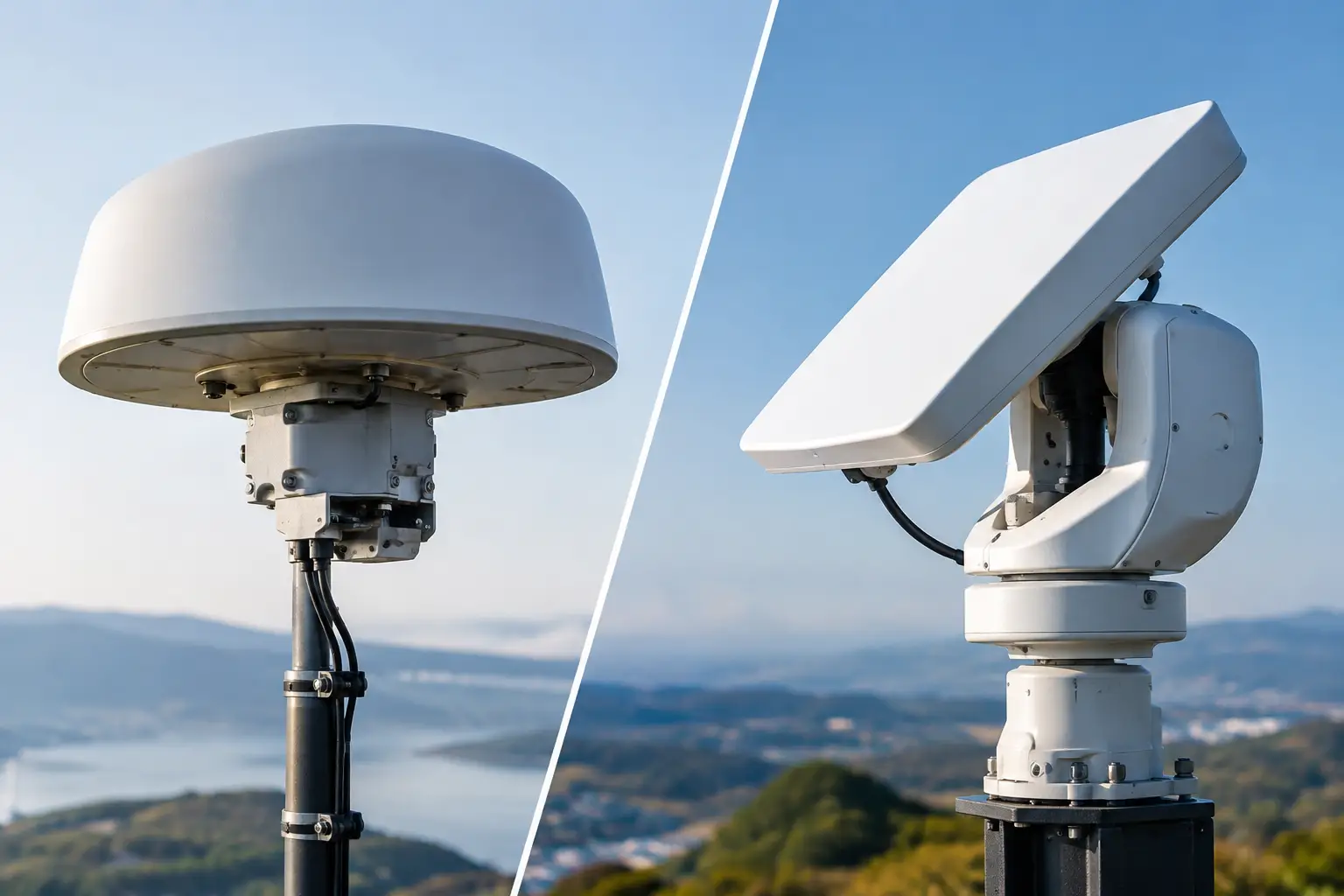
A high-gain microwave link can lose its margin with only a small pointing error. On a vessel in sea state, a vehicle crossing uneven ground, or a mobile command post changing position, that error can turn available capacity into a dropped connection. The question of stabilized antennas versus gimbals matters because the terms are often used interchangeably, even though they describe different parts of a mission-critical communications solution.
A gimbal provides controlled physical movement. A stabilized antenna system uses mechanical movement, sensing, control logic, and often tracking data to keep an RF path aligned. The distinction affects link availability, integration effort, maintainability, and the ability to support high-capacity microwave, SATCOM, private LTE, or 5G backhaul in real operating conditions.
Stabilized Antennas Versus Gimbals: The Core Difference
A gimbal is a mechanical assembly that rotates a payload around one or more axes. In communications applications, that payload may be a directional antenna, a radio, an optical sensor, or a combined antenna-radio package. A two-axis gimbal typically manages azimuth and elevation. A three-axis design can add roll compensation, depending on the platform and required pointing performance.
A stabilized antenna is the broader system. It is designed to maintain an antenna’s orientation or pointing direction despite platform motion. It may include a gimbal, but it also requires the components that make stabilization useful: inertial measurement units, gyros, GNSS position data, encoders, control algorithms, drive motors, path calculation, and interfaces to the RF equipment.
This is why a gimbal alone is not necessarily an auto-aiming antenna system. It can place an antenna at a commanded angle, but it may not know where the remote endpoint is, compensate accurately for vehicle movement, or correct its aim when the link degrades. A stabilized antenna system is engineered to manage those operational variables as a coordinated function.
Motion Control Is Not the Same as Link Control
The practical difference becomes clear when the platform moves. Consider a directional microwave antenna on a vessel communicating with a shore site. The vessel may yaw, pitch, roll, change heading, and travel through areas where the target’s relative bearing changes continuously.
A basic gimbal can respond to motion inputs and hold a set orientation. That may be adequate for applications with modest antenna gain, short paths, slow movement, or a wide beamwidth. It can also be appropriate where an operator manually enters target coordinates or controls the assembly from a local interface.
A stabilized antenna system is built for a more demanding task. It calculates where the antenna needs to point, commands the positioner, compensates for platform motion, and maintains alignment as the mobile endpoint changes location. In more advanced configurations, the system can use received-signal feedback or remote tracking information to refine pointing. This closed-loop behavior is especially valuable when narrow beamwidths leave little tolerance for error.
At higher microwave frequencies, the margin for pointing error becomes tighter. Larger antennas and higher-gain apertures further narrow the beam. A solution that appears stable at lower frequencies or on a stationary test stand may not maintain sufficient alignment once it encounters vibration, acceleration, wind loading, and continuous route changes.
The Antenna, Radio, and Controller Must Work as One System
A common deployment mistake is evaluating the positioner separately from the RF link. Mechanical performance is essential, but it is only one part of end-to-end availability. The antenna’s gain pattern, polarization, radome design, radio output, modulation performance, cable loss, mounting location, and controller behavior all influence results.
For example, a system may have enough mechanical accuracy to point at a remote site, yet still underperform because its update rate cannot keep up with platform dynamics. Another design may track smoothly but use an antenna with insufficient gain for the path length and required throughput. In coastal, offshore, and industrial environments, corrosion resistance, environmental sealing, vibration tolerance, and cable management are also part of the engineering decision.
A purpose-built stabilized microwave system addresses these dependencies from the start. The controller needs compatible interfaces for GPS, compass, inertial sensors, radios, and network management platforms. The mechanical assembly must support the antenna’s weight, wind area, and center of gravity without introducing backlash or unacceptable settling time. The installation must provide an unobstructed RF view while protecting equipment and allowing practical service access.
When a Gimbal Is the Right Choice
A gimbal is not an inferior option. It is the right component for many applications, particularly when the network architecture provides other means of targeting and control.
A gimbal may be the appropriate choice when the antenna points at known, fixed locations and the platform moves only occasionally. It can also fit systems where an external controller already supplies accurate position commands, or where the payload is not an RF antenna but a camera, sensor, or inspection device. In these cases, the organization may need precise pan, tilt, or roll control rather than an integrated communications tracking solution.
Cost and mechanical simplicity can also favor a gimbal. If a site has short paths, forgiving beamwidths, limited motion, and trained operators, adding a full auto-aiming architecture may not deliver proportional value. The key is to distinguish a realistic operating requirement from a lab-condition assumption.
When a Stabilized Antenna System Is Worth the Investment
An integrated stabilized antenna system becomes compelling when connectivity must remain available without repeated manual intervention. Maritime broadband, ground-to-air communications, public safety command vehicles, mobile industrial operations, defense platforms, and temporary backhaul deployments often fit this profile.
In these environments, the operational cost of a lost link can exceed the added cost of tracking capability. A disconnected vessel may lose access to onboard network services. A mobile incident command site may lose situational awareness. A remote industrial crew may be unable to transmit video, telemetry, voice, or production data. The requirement is not simply to move an antenna. It is to preserve a usable RF path while the platform and operating environment change.
Auto-aiming also reduces dependence on specialized operators. That does not eliminate the need for training, commissioning, or network monitoring. It does mean the system can execute routine acquisition and tracking tasks consistently, which helps reduce deployment time and support burden across distributed operations.
Design Questions That Determine the Better Architecture
Before selecting a solution, define the path and platform together. Start with the required throughput, frequency band, path length, link availability target, and remote endpoint behavior. Then assess platform speed, expected roll-pitch-yaw dynamics, vibration, wind exposure, obstructions, and the availability of accurate heading and position data.
The following questions usually expose whether simple motion control is sufficient or whether full stabilization and tracking are required:
- How narrow is the antenna beamwidth at the planned frequency and antenna size?
- Will the remote endpoint be fixed, mobile, or changing during operations?
- Can the platform provide reliable GNSS, heading, and inertial data?
- What acquisition time is acceptable after movement, power cycling, or a temporary blockage?
- Does the application require unattended operation and remote network management?
- Are environmental ratings, corrosion protection, and service access suitable for the deployment location?
These questions should be answered alongside a link budget, not after hardware selection. A strong link budget identifies the required antenna gain and fade margin. The motion profile then determines whether the system can hold that gain where it matters: on the intended path, under expected operating conditions.
Integration Is Where Performance Is Won or Lost
The best architecture is rarely determined by a single specification such as positional accuracy. Network teams should examine how the tracking controller interacts with the radio and how the radio integrates into the broader network. This includes Ethernet interfaces, power design, timing requirements, remote management, cybersecurity controls, and support for the selected microwave, LTE, or 5G equipment.
For a mobile private-network deployment, the stabilized link may serve as the backhaul that connects a field network to the core. In that design, backhaul availability directly affects every device, application, and user behind it. For a maritime installation, antenna placement may require a careful compromise between clear line of sight, vessel structure, motion characteristics, and cable runs. There is no universal mounting rule that replaces an engineering survey.
BATS Wireless approaches these requirements as an operational system rather than a standalone antenna purchase. The objective is compatible, field-ready connectivity that accounts for tracking, radios, network design, installation constraints, and long-term technical support.
A gimbal can be an essential mechanical element, but a stabilized antenna system is the communications architecture that turns movement into sustained connectivity. Start with the link that must stay up, the conditions it must survive, and the team that must operate it. The right level of stabilization becomes much clearer from there.

November 20, 2026

November 20, 2026

November 20, 2026

November 20, 2026
