
Antenna Tracking Software Review for Field Networks
This antenna tracking software review explains the control, integration, and field-performance criteria that determine reliable mobile broadband links.

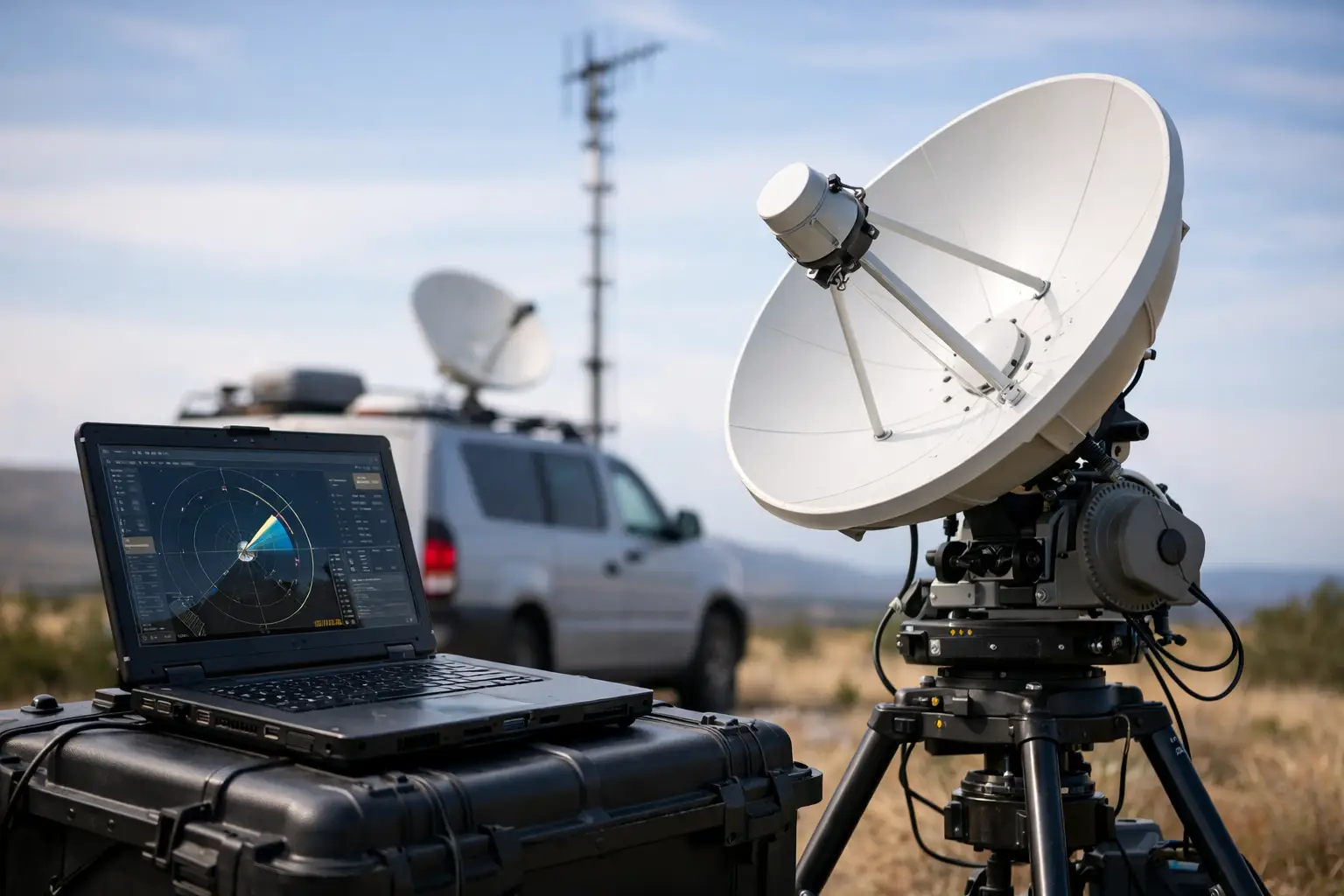
A tracking controller can look precise in a lab and still lose a link when a vessel rolls, a vehicle changes course, or the remote radio takes longer than expected to reacquire. This antenna tracking software review focuses on the criteria that matter when broadband continuity supports operations, safety, command traffic, or revenue-producing field assets. The central question is not whether software can move an antenna. It is whether the full system can maintain usable RF performance under real motion, changing geometry, and imperfect network conditions.
What Antenna Tracking Software Must Actually Do
Antenna tracking software is the control layer that turns position, heading, attitude, and link information into azimuth, elevation, and, where required, polarization commands. In a complete auto-aiming system, it coordinates with sensors, motors, encoders, the antenna pedestal, and the radio or modem. Its job is to keep the antenna pointed accurately enough to preserve the intended link margin as either endpoint moves.
That description sounds straightforward until the operating environment adds roll, pitch, yaw, vibration, GPS drift, compass error, delayed telemetry, changing satellite or tower coordinates, and mechanical backlash. The software must account for the geometry of the path while also respecting the limits of the physical antenna system. A controller that commands aggressive corrections can create overshoot. One that filters too heavily may react too late.
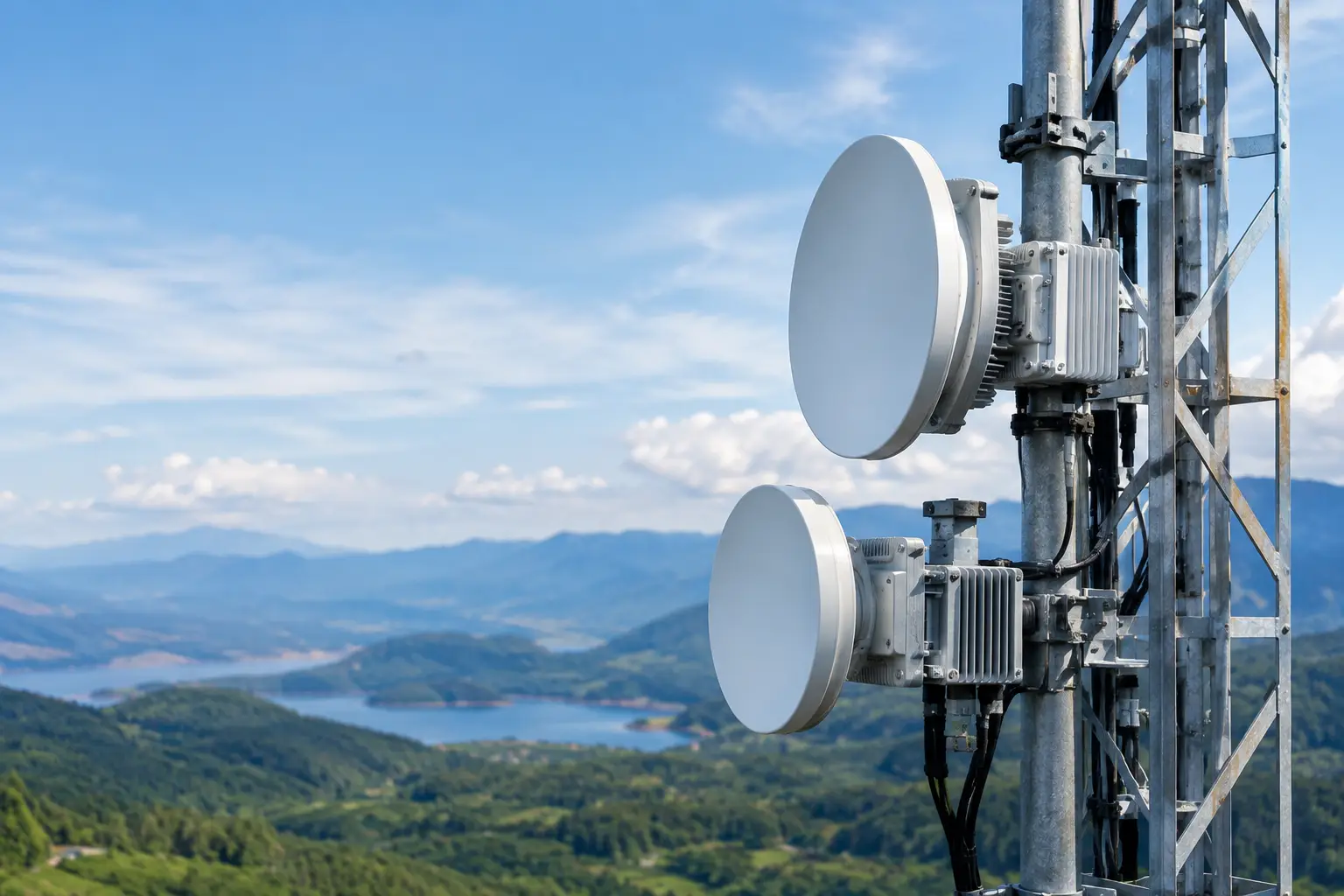
For fixed point-to-point deployments, tracking may mean calculated alignment during installation and automatic correction after movement or tower sway. For vehicles, vessels, aircraft support assets, and mobile command systems, it often means continuous closed-loop operation. The right evaluation standard depends on the mission. A construction site backhaul has different tolerance for interruption than a maritime LTE network carrying operational traffic across moving vessels.
Antenna Tracking Software Review: The Core Evaluation Areas
A useful review should begin with the full link architecture, not a feature checklist. Tracking software is only as effective as the sensors it trusts, the mechanics it drives, and the radio measurements available to it.
Path calculation and coordinate handling
The platform should calculate antenna pointing from known coordinates and update those calculations as the local or remote asset moves. This requires reliable handling of latitude, longitude, altitude, heading, and reference frames. Errors in coordinate conversion or north-reference assumptions can create a pointing error that appears to be a mechanical problem.
Ask how the software handles GPS interruptions, invalid position data, stale remote coordinates, and transitions between calculated pointing and signal-based optimization. In operational systems, the answer should be explicit. Holding the last valid solution may be appropriate for a short sensor dropout. Continuing to steer on corrupted data is not.
For long-range microwave paths, path calculation must also support the precision the link demands. Narrow-beam antennas provide gain and interference control, but their beamwidth leaves less room for estimation error. A tracking engine should make that trade-off visible during configuration rather than hiding it behind a generic tracking mode.
Sensor fusion and stabilization behavior
Mobile deployments need more than GPS position. They need usable attitude data. The software should ingest and reconcile inputs from GNSS receivers, compasses, inertial measurement units, gyros, tilt sensors, and pedestal encoders. It should identify which inputs are authoritative and what occurs when those inputs disagree.
Sensor fusion matters particularly in maritime, offshore, and airborne support environments. A vessel can retain an accurate geographic position while its antenna is moving rapidly through roll and pitch. If the controller only reacts to position changes, it will point at the right location from the wrong orientation.
Evaluate stabilization performance at the system level. Review the update rate, sensor latency, control-loop response, and mechanical limits together. Fast software cannot compensate for a slow pedestal, and a high-speed pedestal will not improve a link if the heading data arrives late or fluctuates excessively.
Acquisition, reacquisition, and signal optimization
Calculated pointing gets the antenna near the target. Signal optimization finishes the job. A capable system should support acquisition routines that search efficiently when the expected target location is uncertain, then refine pointing using received signal level, signal-to-noise ratio, modulation and coding information, or other radio telemetry.
Reacquisition deserves as much attention as initial acquisition. A link may be interrupted by a sharp maneuver, blockage, power event, radio restart, or a remote asset leaving its predicted position. The practical question is how long it takes to return to a stable, useful connection and whether the software can distinguish a temporary fade from a true loss of target.
Software that chases every small RF fluctuation can degrade performance, especially in multipath environments. The best control strategy depends on the radio band, antenna beamwidth, mobility profile, and link budget. Filtering, dead bands, scan boundaries, and retry logic should be configurable by qualified personnel, not locked into one operating assumption.
Radio, network, and control integration
Tracking systems perform better when they can use meaningful data from the connected radio. Integration may include Ethernet-based control, serial interfaces, discrete I/O, SNMP data, modem status, or vendor-specific command sets. The interface should provide more than a basic up-or-down indication whenever the radio supports richer telemetry.
Review compatibility carefully. A tracking application may claim broad radio support while only offering basic control for certain models. Confirm the exact functions available with the intended microwave, LTE, 5G, or private network equipment: configuration, status reporting, link-quality feedback, alarm handling, and recovery actions.
Network integration also affects field support. Operators need a clear view of antenna position, tracker state, sensor health, RF link status, and alarms. Remote management is valuable, but it must not remove local control. During a communications outage, field personnel still need a defined procedure for safe positioning, manual override, and recovery.
Do Not Separate Software From the Pedestal
A common procurement mistake is treating antenna tracking software as a standalone purchase. In mission-critical deployments, the software, pedestal, motors, encoders, sensors, antenna, and radio form one control system. Compatibility on paper is not the same as predictable performance in the field.
Mechanical resolution, gear backlash, torque, environmental sealing, cable management, and travel limits all influence tracking accuracy. So do antenna size and wind loading. A controller that performs well with a compact directional antenna may require different tuning when driving a larger high-gain microwave antenna on a mast or vessel.
This is why engineered systems are often a cost-saving solution over time. The initial price of a generic controller may look attractive, but integration work, tuning delays, repeated truck rolls, and avoidable downtime can quickly exceed the savings. BATS Wireless approaches tracking as part of an integrated communications architecture, matching auto-aiming behavior, stabilized hardware, path requirements, and radio compatibility to the deployment.
Field Tests That Reveal the Difference
A demonstration should simulate the conditions that threaten the actual link. Static pointing accuracy is useful, but it does not prove mobile performance. Test plans should include realistic movement profiles, intentional signal interruption, sensor loss scenarios, power cycling, remote-coordinate changes, and transitions between automatic and manual control.
Four measurements provide a practical baseline for comparison:
- Time to initial acquisition from a known and an uncertain starting position.
- Time to reacquire after a controlled loss of signal or significant heading change.
- Pointing error and link-quality variation during representative motion.
- Alarm accuracy, event logging, and operator recovery time after a fault.
The test should also expose configuration complexity. A system that requires an expert to tune every deployment may still be appropriate for a specialized defense or offshore application, but that operating requirement should be budgeted. For distributed commercial fleets or temporary field networks, repeatable profiles and controlled remote configuration can be more valuable than an extensive set of rarely used parameters.
Security and Lifecycle Support Matter
Because tracking software connects to control hardware and often to operational networks, access control is not optional. Review user roles, authentication methods, remote access design, logging, firmware-update procedures, and the ability to isolate the control network from general user traffic. A poorly secured control interface can become an operational risk even if the RF link is performing well.
Lifecycle support is equally practical. Confirm who owns the configuration files, how replacements are commissioned, whether calibration data can be backed up, and how software versions are managed across a fleet. For critical infrastructure, the most useful vendor is one that can support fault isolation across the antenna, controller, radio, and network path rather than assigning responsibility to another supplier.
Choose for the Mission, Not the Feature Sheet
The strongest tracking software is not necessarily the one with the longest menu of settings. It is the one that maintains the required link performance with the available mechanics, sensors, radio telemetry, and operational staffing. A coastal patrol vessel, an oil and gas platform, a disaster-response command vehicle, and a mobile 5G backhaul site may all use auto-aiming technology, yet each needs different acquisition logic, environmental protection, monitoring, and fallback behavior.
Before selecting a platform, define the permitted outage duration, target link availability, expected movement, antenna beamwidth, remote-end behavior, and recovery process. Those requirements turn an antenna tracking software review from a software comparison into an engineering decision. When the system is designed around the actual path and operating conditions, tracking becomes a dependable part of the communications infrastructure rather than another variable for the field team to manage.
October 10, 2026

October 10, 2026

October 10, 2026

October 10, 2026
