
Best Connectivity Options Offshore for Operations
Compare the best connectivity options offshore, from LEO and GEO satellite to stabilized microwave and private LTE/5G, for dependable maritime operations.

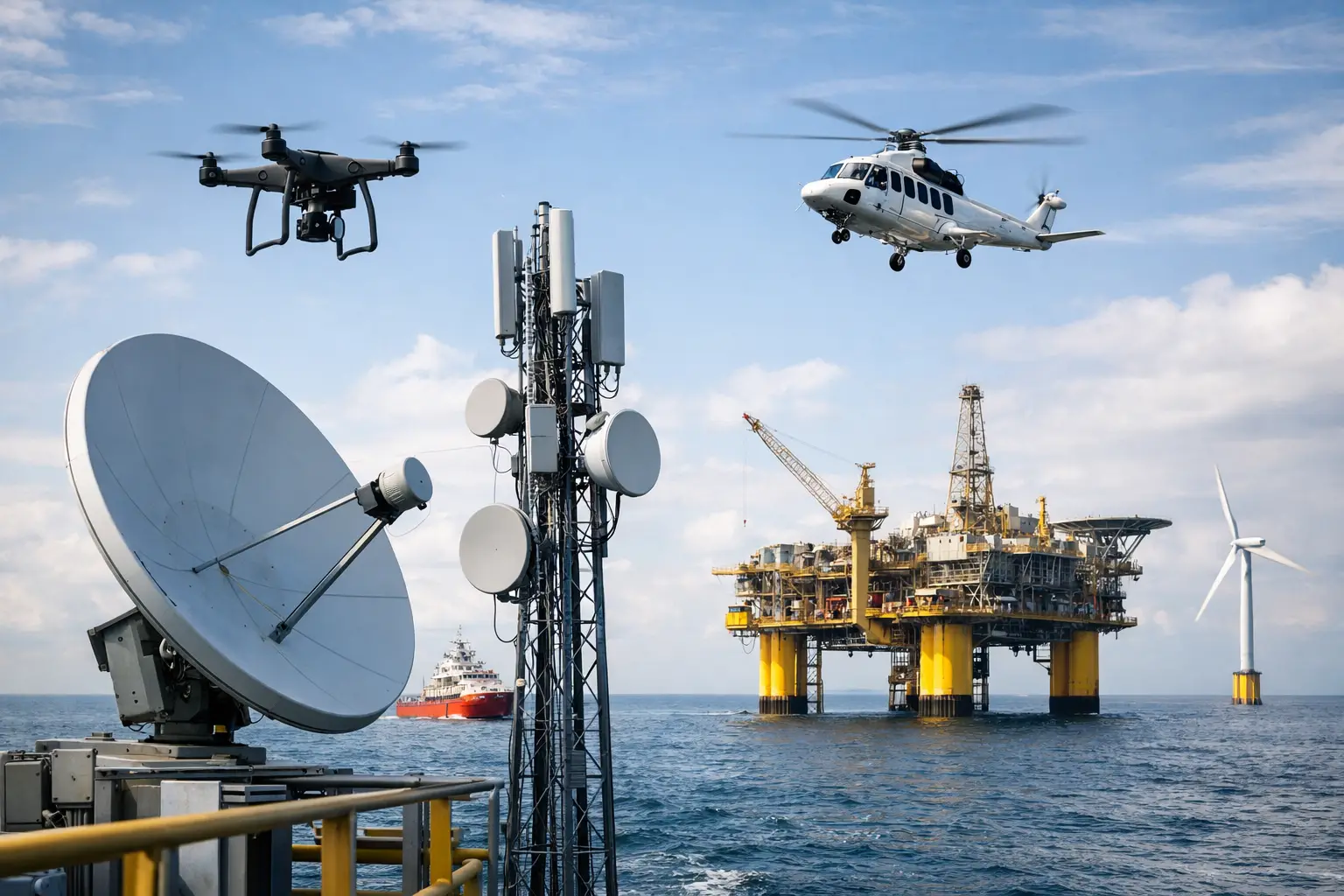
A vessel can be 20 miles from shore or 200 miles offshore, but the communications requirement is the same: the network must support the operation without becoming the operation. The best connectivity options offshore are not defined by a single transport technology. They are defined by how well satellite, stabilized microwave, private LTE/5G, onboard Wi-Fi, and network management work together under changing sea states, vessel movement, route conditions, and application demand.
For maritime operators, offshore energy teams, aquaculture sites, wind farms, and government fleets, the right architecture starts with traffic priorities. Bridge communications, operational technology, voice, video, crew welfare, remote support, and cloud applications do not have equal bandwidth or latency requirements. Treating them as one undifferentiated internet connection creates avoidable cost, congestion, and risk.
Best Connectivity Options Offshore: Start With the Mission
Offshore connectivity is an engineering decision, not a catalog selection. A system that performs well for a stationary platform may fail to meet expectations on a fast-moving vessel. A link sized for email and voice may become unusable when remote experts need high-definition video from a deck operation or when a vessel begins transferring sensor data to shore.
Before selecting a transport, define the operating envelope. Distance from shore, vessel speed and heading changes, antenna mounting location, sea state, coverage geography, uptime expectations, available power, cybersecurity requirements, and the applications that must remain online all affect the design.
It is also necessary to separate critical traffic from convenience traffic. Navigation support, safety systems, operational telemetry, dispatch voice, and security monitoring should receive defined priority and protected capacity. Crew internet access can be a valuable retention and welfare benefit, but it should not be allowed to consume the path required for vessel operations.
Stabilized Microwave for High-Capacity Nearshore Coverage
When an asset operates within practical line-of-sight range of shore infrastructure, stabilized microwave is often the most cost-effective high-capacity option. Unlike satellite services, a well-engineered microwave path can provide low latency and substantial throughput without recurring per-gigabyte constraints. This makes it particularly effective for workboats, ferries, offshore wind service vessels, platforms, barges, port operations, and aquaculture deployments.
The limitation is clear: microwave requires a viable radio path. Curvature of the earth, terrain, tower height, weather, vessel motion, and interference must be evaluated before equipment is specified. A conventional fixed antenna may hold a link at the dock yet lose alignment as the vessel rolls, turns, or moves through its route.
That is where auto-aiming and stabilized antenna systems change the result. The antenna continuously tracks the shore-side endpoint and compensates for vessel movement, preserving link quality without manual intervention. For operators that spend meaningful time in coastal corridors, a stabilized microwave system can reduce dependence on satellite capacity while delivering the performance needed for cloud access, video, VoIP, onboard networks, and operational data.
Microwave does require shore-side infrastructure. The best design may use existing towers, purpose-built coastal sites, or a chain of relay locations to maintain coverage along a route. It is not a universal offshore answer, but where the path is available, it is frequently the performance and cost benchmark against which other options should be measured.
Satellite Extends Coverage Beyond the Microwave Path
Satellite is the primary answer once a vessel moves beyond reliable terrestrial or microwave coverage. It provides geographic reach that shore-based systems cannot, but satellite options differ significantly in bandwidth, latency, coverage, antenna requirements, service economics, and resilience.
LEO satellite for responsive data applications
Low Earth orbit, or LEO, satellite services have changed offshore expectations for latency-sensitive applications. Their lower orbital altitude can support more responsive internet access than traditional geostationary systems, making them attractive for video collaboration, cloud applications, remote access, crew connectivity, and certain operational workflows.
LEO is not automatically the correct primary link for every operation. Coverage availability along a planned route, antenna field of view, service plan structure, vessel installation constraints, and continuity during handoffs between satellites should be assessed. High demand can also make traffic policy essential. If multiple users begin video streaming or large file transfers at the same time, an otherwise capable link can still become constrained.
GEO satellite for broad-area continuity
Geostationary Earth orbit, or GEO, satellite remains relevant for maritime operations that need wide-area availability and established service models. Its higher latency can make interactive applications less responsive, yet GEO can be highly effective for email, telemetry, voice systems designed for satellite conditions, position reporting, backup communications, and data transfer that is not time-critical.
GEO also remains a practical resilience layer. In a multi-transport design, it can provide continuity when a microwave path is unavailable or when another primary service experiences a regional issue. The right choice is not LEO versus GEO as a blanket decision. It is determining which service best supports each route, application class, and failure scenario.
Private LTE and 5G for the Offshore Work Area
Private 4G LTE and 5G are not substitutes for long-range backhaul. They are the access layer that brings controlled wireless coverage to people, equipment, sensors, cameras, and operational devices around a vessel, platform, wind farm, or offshore industrial site.
A private cellular network provides advantages that public carrier service cannot always offer offshore: dedicated coverage, managed device access, predictable quality of service, local control, and the ability to integrate specialized industrial equipment. On a platform or large vessel, private LTE or 5G can support tablets, handheld radios, cameras, maintenance systems, IoT sensors, and field communications while using microwave or satellite as the backhaul to shore.
The practical value is segmentation. Critical controls and operational devices can remain on protected network policies, while contractor devices and general user traffic operate on separate profiles. This reduces the chance that an unmanaged endpoint or high-bandwidth application affects essential services.
Coverage design matters as much as the radio standard. Steel structures, enclosed compartments, deck equipment, and RF reflections create difficult propagation conditions. A site survey, antenna plan, frequency strategy, and validation testing are necessary to produce usable coverage where crews actually work, not merely a favorable signal measurement near an access point.
Build a Multi-Path Architecture, Not a Single Point of Failure
The most capable offshore networks combine transports. A vessel may use stabilized microwave as its preferred coastal connection, LEO satellite as the primary offshore service, and GEO satellite or an alternate satellite network as contingency capacity. A private LTE/5G network and onboard Wi-Fi distribute that connectivity to users and devices under defined policies.
This architecture needs intelligent path selection. Traffic should move between available links according to performance thresholds, application priority, route location, and cost policy. A simple failover design is better than no backup, but it may interrupt active sessions or shift all traffic to an expensive path without regard for business value. Application-aware routing and quality-of-service policies produce better operational behavior.
Network resilience also depends on physical design. Separate antenna locations where practical, protected cable routes, redundant power, properly rated enclosures, and maintainable equipment access deserve the same attention as bandwidth specifications. A second link offers little protection if both systems depend on the same power circuit, mounting point, or damaged cable run.
Security and Network Management Are Part of Connectivity
An offshore link should be engineered as an extension of the enterprise network, not as an isolated internet service. Segmented VLANs or equivalent network zones, firewall policies, encrypted remote access, identity controls, device management, logging, and monitored configuration changes should be part of the deployment plan.
Operational teams also need visibility. They should be able to see link health, latency, packet loss, antenna status, traffic consumption, device activity, and failover events without waiting for a crew member to report a problem. This visibility supports proactive maintenance and provides evidence when a carrier, equipment, route, or onboard application is causing a performance issue.
BATS Wireless designs offshore systems around this complete operational picture, combining stabilized microwave, antenna tracking, integrated radios, onboard networks, and private cellular capabilities where the mission requires them.
Choosing the Right Offshore Connectivity Mix
There is no single best transport for every maritime deployment. Nearshore, high-throughput operations generally benefit from stabilized microwave when shore infrastructure and path conditions support it. Long-range routes require satellite, with LEO, GEO, or a combination selected around coverage, latency, application demand, and service continuity. Private LTE/5G and managed Wi-Fi provide the controlled access layer that makes the backhaul useful across the asset.
The best result comes from designing for the moments when connectivity is hardest: a vessel turning in rough water, a crew transferring critical video, a platform operating at peak device load, or a primary path dropping during an active operation. Build for those conditions first, and the network will deliver value during every ordinary mile offshore.
September 14, 2026

September 14, 2026
September 14, 2026
September 14, 2026
