
Aquaculture Communication Systems That Hold Up
Aquaculture communication systems must stay online in harsh, remote sites. Learn the network design choices that improve uptime, control, and safety.

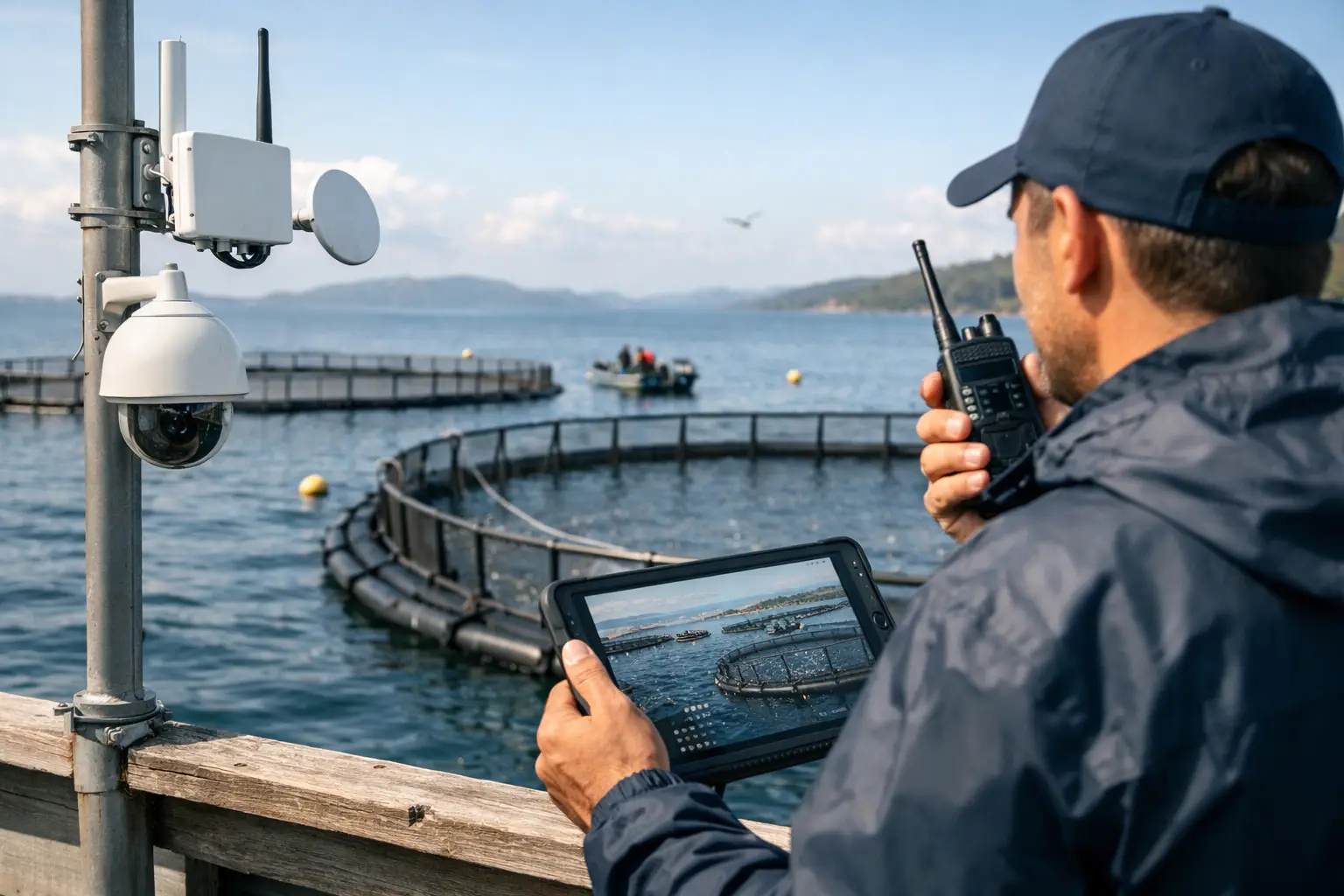
A fish farm can lose visibility fast. One failed backhaul link, one unstable vessel connection, or one dead zone between cages and the shore station can interrupt feeding control, camera access, sensor reporting, and routine operations at the same time. That is why aquaculture communication systems are not just an IT layer. They are operational infrastructure.
For offshore and nearshore farms, communications design has a direct effect on production continuity, staff safety, and cost control. The challenge is that aquaculture sites rarely operate in easy RF conditions. You are dealing with water reflection, moving platforms, long distances, corrosion, weather loading, and assets that do not stay perfectly aligned. Standard enterprise Wi-Fi thinking usually breaks down quickly in that environment. What works in a warehouse or fixed campus often fails over open water.
What aquaculture communication systems need to do
At a practical level, aquaculture communication systems have to support far more than internet access. Most operators need a network that can carry operational traffic across multiple layers at once. That may include video surveillance, SCADA or PLC traffic, feeding system control, environmental monitoring, VoIP, staff connectivity, vessel communications, and access to centralized management platforms.
The technical requirement is not simply bandwidth. It is dependable transport for mixed traffic types across a site that may include shore facilities, barges, feed vessels, pens, workboats, and remote monitoring points. Some applications are latency-sensitive. Others are low bandwidth but mission-critical. A camera stream dropping for a few seconds may be inconvenient. A control link dropping at the wrong moment can stop operations.
This is where engineered architecture matters. A well-designed system separates traffic classes, accounts for mobility, and creates predictable coverage across all operational areas rather than chasing raw throughput numbers that only appear in ideal conditions.
Why aquaculture sites are hard wireless environments
Water is one of the most misunderstood parts of RF planning. Open water can look like a clean path, but it often creates difficult multipath conditions. Signals reflect aggressively off the surface, and performance can swing as wave state, antenna height, and vessel position change. Add wind-driven movement on barges or feeding platforms, and a marginal link can become unstable very quickly.
Distance is the second issue. Many sites sit beyond the practical reach of conventional fixed wireless without careful antenna engineering. The farther the path, the more precision matters. Antenna choice, mounting stability, Fresnel clearance, path calculation, and environmental loading all influence whether a link performs consistently or degrades under real operating conditions.
Then there is survivability. Salt exposure, mechanical vibration, and constant weather stress shorten the life of poorly selected equipment. Buyers in this market are not looking for commodity gear that works until the first rough season. They need systems built for sustained outdoor service and supported by a design approach that takes maintenance access seriously.
The core architecture behind reliable aquaculture communication systems
Most successful deployments start with a simple principle: separate the network into roles. You typically need a reliable backhaul layer between the farm and the shore or central aggregation point, a distribution layer across the site, and local access for onboard or platform-based users and devices.
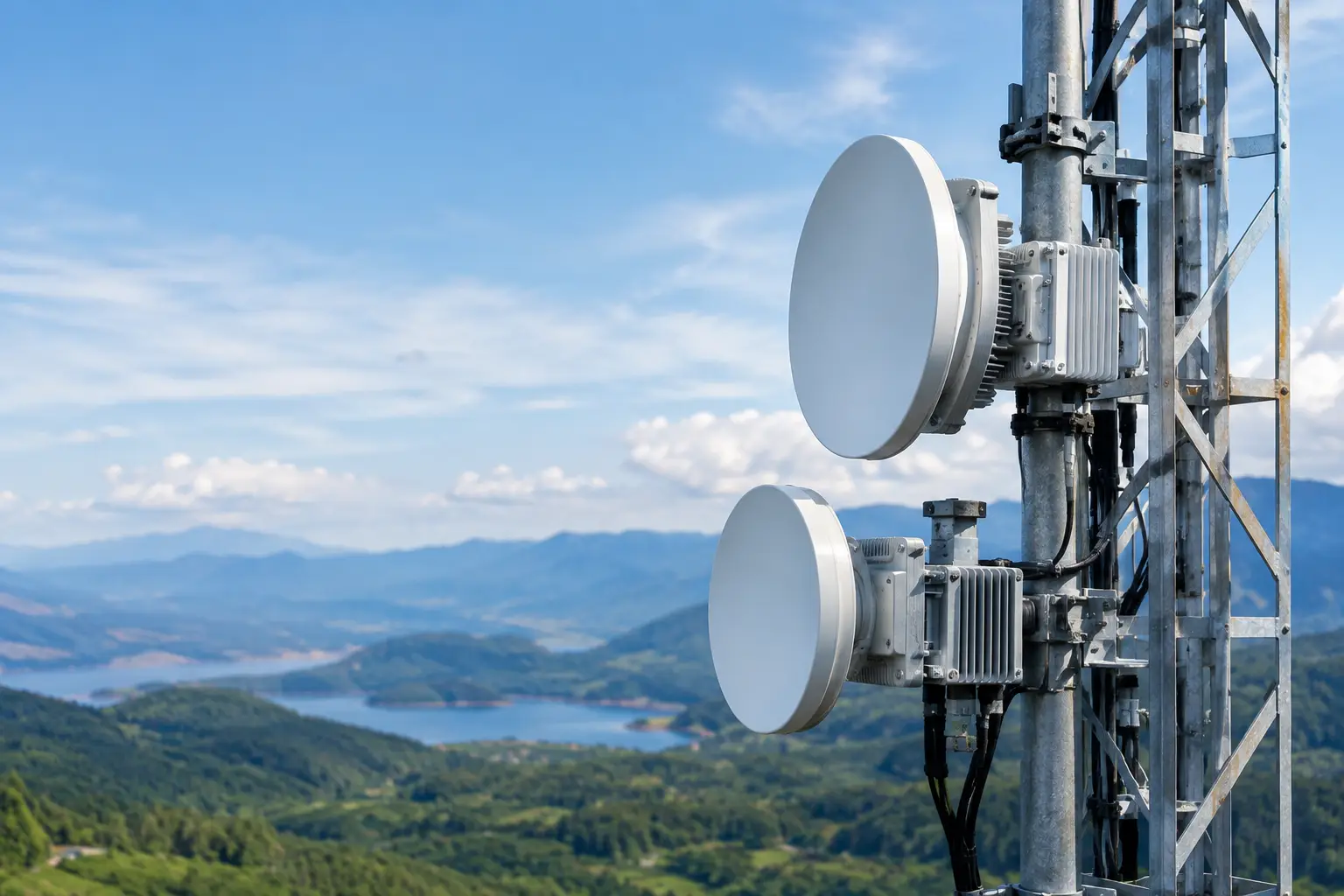
Backhaul is where many projects succeed or fail. If the main path to shore is unstable, every downstream service suffers. For short to moderate distances with clear line of sight, point-to-point microwave may be the right fit. For moving assets or sites exposed to constant motion, stabilized microwave systems and auto-aiming capabilities can make the difference between theoretical coverage and usable operational uptime.
Within the farm itself, communications often require a mix of fixed and mobile links. Barges, cages, and service vessels may all need connectivity, but they do not all behave the same way. A fixed pen structure can support a directional link with known geometry. A workboat cannot. That is why the right design often combines multiple wireless modes instead of forcing the entire site into one technology stack.
Private LTE or 5G also deserves serious consideration in larger or more complex farms. When operators need managed mobility, broader area coverage, and support for multiple user classes and devices, private cellular can offer stronger control than a patchwork of standalone access points. It is not always the cheapest first step, and not every site needs it, but it becomes compelling when operational scale and device density increase.
Matching the network to the use case
Not every farm needs the same level of infrastructure. A nearshore site with stable terrain and minimal vessel movement may perform well with a straightforward microwave backhaul and local wireless distribution. An offshore farm with rotating assets, live video demands, and regular vessel interaction may need antenna tracking, stabilized links, and integrated onboard networking.
The right question is not, “What is the best technology?” It is, “What network behavior does the operation require under normal and degraded conditions?” That distinction matters.
If live HD video from multiple cameras is central to feeding oversight and security, the network needs more than peak capacity. It needs sustained throughput with predictable packet handling. If remote monitoring is mostly low-rate telemetry, the design priority may shift toward long-range resilience and power efficiency. If the site depends on crew mobility and continuous access across boats and barges, handoff behavior and coverage geometry start to matter more than raw speed.
A solution-led provider will design around those realities instead of selling a single radio platform for every job.
Shore-to-site backhaul is the first design decision
In most aquaculture deployments, shore-to-site backhaul deserves the earliest engineering attention because it sets the ceiling for everything else. Fiber is ideal where it exists and where installation is economically realistic. In many farm locations, it is not. Wireless backhaul then becomes the working option, but the path has to be designed with discipline.
That means proper path profiling, antenna selection, fade margin planning, and realistic analysis of seasonal weather effects. It also means accounting for future traffic growth. A farm that starts with cameras and basic telemetry may later add automation, remote analytics, worker connectivity, and more distributed sensors. Replacing the backhaul too soon is an avoidable cost.
This is one reason many industrial buyers prefer engineered systems over general-purpose networking products. The hardware matters, but so does the path calculation, mounting design, and support for operational changes over time.
Mobility changes the design rules
The moment moving assets enter the picture, fixed alignment assumptions become less useful. Service vessels, feed barges, and mobile work platforms introduce a level of instability that conventional directional systems may not tolerate well. That is where auto-aiming and tracking technologies become valuable.
In aquaculture environments, those capabilities are less about convenience and more about maintaining usable connectivity while the platform moves, pitches, or drifts. A manually aligned system might work on a calm day. It becomes a different story in rougher water or during repeated vessel movements through the work cycle.
For buyers evaluating architecture options, this is an area where lowest upfront cost can become the most expensive choice. A cheaper fixed link that requires constant intervention, loses alignment, or creates blind operational windows will usually cost more over the life of the deployment.
Security, segmentation, and operational control
Aquaculture networks are now carrying a blend of operational technology and enterprise traffic. That raises security and control requirements. Feeding systems, sensor networks, maintenance tools, cameras, and crew communications should not all live on a flat network.
Segmentation is essential, both for performance and for risk reduction. Control traffic should be isolated. Video should be managed so it does not consume capacity needed by higher-priority applications. Remote access should be governed carefully, especially when third-party vendors support automation or monitoring platforms.
This is also where private network infrastructure has an advantage. It gives operators more control over traffic policies, user access, and service priorities than unmanaged public connectivity options. Public networks can still play a role, particularly as a backup path, but they are not always enough as the primary operational layer.
What buyers should look for in aquaculture communication systems
The strongest aquaculture communication systems are not defined by a single product spec. They are defined by whether the design reflects field conditions. Buyers should look for a provider that understands moving platforms, RF behavior over water, onboard networking, integrated radios, and long-range backhaul under environmental stress.
Compatibility also matters. Farms rarely operate as greenfield sites forever. New communications infrastructure often has to support existing cameras, control systems, vessel equipment, and management software. That requires practical interoperability, not just a clean diagram on paper.
Support capability is another differentiator. In remote operations, the value of technical service, deployment planning, and lifecycle support is high. A communications partner should be able to help with architecture, installation strategy, optimization, and future expansion. BATS Wireless operates in that part of the market, where engineered wireless systems are built around operational performance rather than commodity hardware turnover.
A good aquaculture network should make the site easier to run, not harder to maintain. That means selecting infrastructure that fits the water, the distance, the motion, and the operational load from the start. The best result is not the most complex system. It is the one that stays available when the site is busy, the weather shifts, and the crew needs the network to simply keep working.
October 10, 2026
October 10, 2026
October 10, 2026

October 10, 2026
