
A Guide to Mission Critical Backhaul Design
This guide to mission critical backhaul explains how to engineer resilient microwave, LTE, and 5G transport for remote, mobile, and high-stakes operations.


A backhaul link can look healthy in a lab and still fail where the operation actually happens: on a vessel in heavy sea state, beside a drilling operation, across uneven terrain, or at a temporary public safety command post. This guide to mission critical backhaul focuses on the engineering decisions that keep transport available when movement, distance, interference, weather, and limited field access are part of the job.
Mission-critical backhaul is not simply a fast connection between an access network and the internet or core. It is the transport layer that carries voice, video, sensor traffic, applications, and command data from the edge to the network services that support the mission. When it fails, private LTE or 5G coverage at the site may remain visible, but users lose the applications and communications that make that coverage valuable.
What Makes Backhaul Mission Critical?
The defining requirement is operational continuity. A construction site can tolerate a short interruption to ordinary office traffic. A public safety response team, offshore crew, unmanned system, or defense operation may not be able to tolerate a loss of push-to-talk, live video, telemetry, situational awareness, or remote control.
That changes the design criteria. Capacity matters, but availability, recovery time, path diversity, latency behavior, security, and field maintainability matter just as much. The correct architecture depends on the application mix and the consequence of an outage. A high-throughput maritime network moving crew welfare traffic and operational data has different priorities from a low-latency command network supporting ground-to-air communications.
A mission-critical design also accounts for conditions that conventional fixed wireless planning often underestimates: antenna motion, mast deflection, vessel roll and pitch, changing line of sight, Fresnel-zone obstruction, salt exposure, extreme temperatures, generator power quality, and limited access to trained technicians.
Start With the Service Requirement, Not the Radio
The most common design error is selecting a radio or frequency band before defining the traffic that must survive an outage. Start by identifying the services that need guaranteed performance and separate them from traffic that can be delayed, shaped, or suspended.
For example, voice, SCADA alarms, control traffic, and selected video streams may require strict priority. Crew internet access, software updates, bulk data transfer, and nonessential cloud synchronization can use remaining capacity. This is not merely a quality-of-service exercise. It determines the throughput target, latency budget, jitter tolerance, and failover behavior for the entire transport design.
Define expected demand under normal operations and the minimum service level during a degraded condition. A redundant path that carries only 20 percent of primary capacity can still be the right cost-saving solution if it preserves command traffic, alarms, and critical voice. Conversely, a remote industrial site moving high-definition inspection video may require a secondary path with materially higher capacity.
Also establish where the backhaul terminates. It may feed an enterprise data center, a cloud-hosted application environment, a mobile network core, an emergency operations center, or a carrier point of presence. Each termination point introduces routing, security, and ownership considerations that should be resolved before equipment is deployed in the field.
Choose the Transport Architecture for the Environment
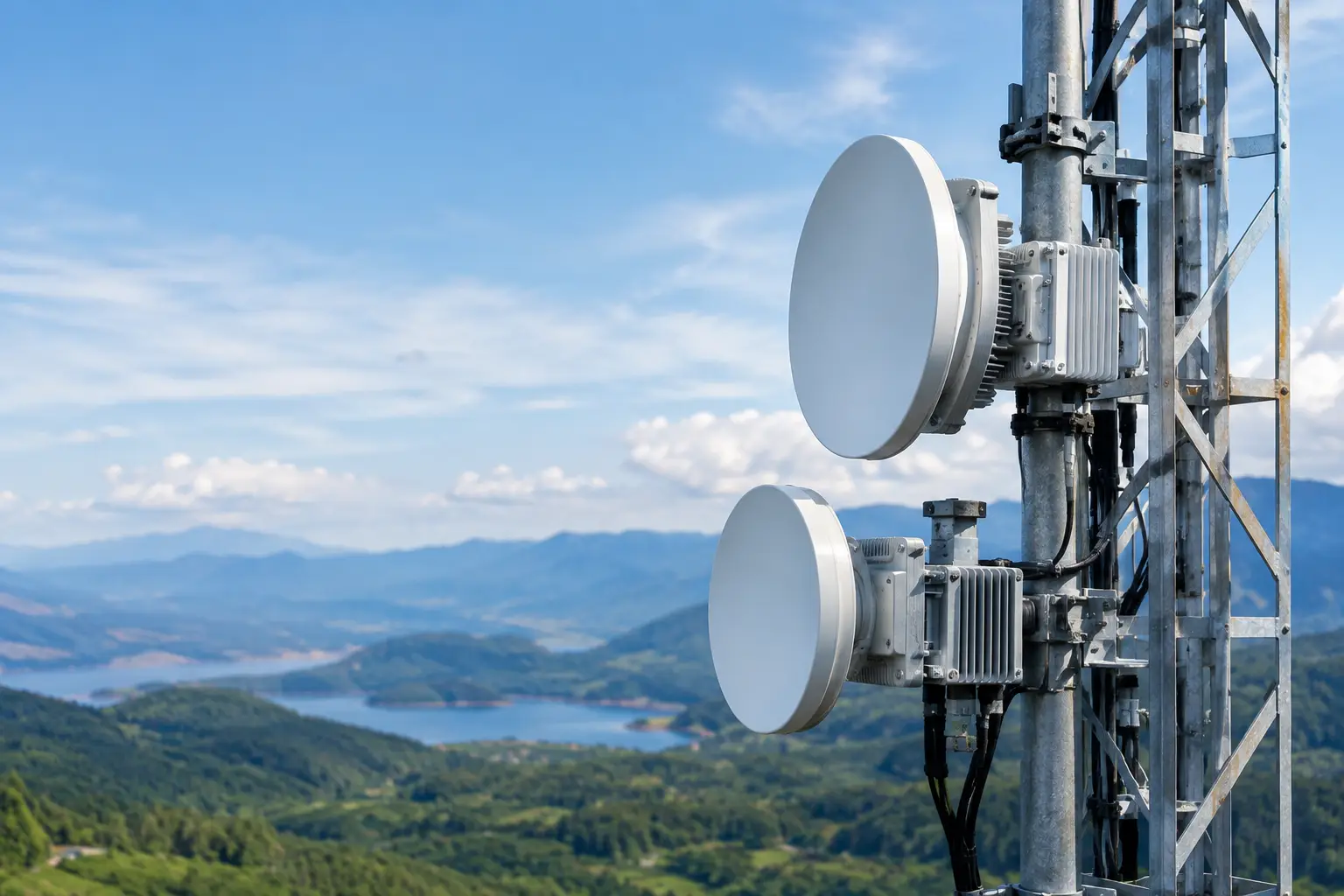
Microwave remains a primary technology for long-range, high-capacity backhaul where fiber is unavailable, impractical, or too slow to deploy. Properly engineered licensed microwave links offer predictable spectrum access and strong performance over long paths. They are often well suited to fixed industrial facilities, utility corridors, remote towers, and shore-based aggregation sites.
Higher-frequency point-to-point systems can provide substantial capacity, but they bring tighter path requirements and greater sensitivity to rain attenuation. They can be highly effective over shorter distances or where a clear path and precise installation are available. They are not automatically the best answer for every remote deployment.
Private LTE and 5G extend coverage and mobility at the edge, but they still need dependable transport from the cell site or distributed radio location back to the core. In many deployments, microwave provides that transport. For mobile or maritime operations, stabilized and auto-aiming antenna systems can maintain a link as the platform moves, avoiding the manual realignment that turns a nominally capable link into an operational liability.
Satellite can be an essential component where terrestrial paths do not exist or where geographic diversity is required. Its trade-off is typically higher latency, variable capacity economics, or both. It is often best used as a primary service for isolated operations, a diverse backup path, or a complement to microwave and cellular rather than treated as a universal substitute.
Fiber is the preferred option when it is available at the required location, timeline, and cost. Yet fiber routes can be vulnerable to construction damage, weather events, or single-route dependency. Critical facilities may use fiber as the primary path and wireless as physically diverse protection, particularly when a second fiber route is not economically justified.
Engineer the RF Path, Not Just the Link Budget
A theoretical link budget is only the starting point. The RF path must be assessed for current and future obstructions, Fresnel-zone clearance, antenna height constraints, terrain variability, local interference, and weather effects. A path that is acceptable at installation can degrade when vegetation grows, temporary structures appear, or a new crane enters a construction zone.
For fixed links, antenna selection and alignment directly affect fade margin and interference rejection. For mobile platforms, the challenge expands to tracking accuracy, stabilization performance, acquisition time, and the ability to maintain pointing through vibration and platform movement. Onboard networks depend on this layer more than users may realize. Strong Wi-Fi or private cellular coverage on a vessel has little value if the external transport link cannot hold lock.
Frequency coordination and spectrum planning should be treated as operational controls, not paperwork. Licensed bands can reduce the uncertainty created by competing emitters, while unlicensed or lightly licensed options may offer faster deployment and lower upfront cost. The right choice depends on congestion risk, link criticality, bandwidth needs, and the organization’s tolerance for unpredictable RF conditions.
Build Redundancy Around Real Failure Modes
Redundancy is valuable only when the backup does not share the same failure point as the primary. Two radios on the same tower, powered by the same electrical circuit and pointed through the same obstructed corridor, may improve equipment availability without providing true service resilience.
A practical mission-critical design considers failure domains across the full chain: radio hardware, antennas, power systems, network switches, routing, towers, physical paths, core connectivity, and management access. Diverse routing may mean a microwave link in one direction and a satellite or carrier network path in another. At a fixed facility, it may mean fiber plus microwave on separate physical approaches.
Failover must also be tested under load. Routing protocols, SD-WAN policies, cellular core behavior, IP address handling, and application session recovery can all affect whether users experience a brief transition or a disruptive outage. Planned maintenance tests are preferable to discovering these behaviors during an incident.
Power resilience deserves equal attention. Remote radios, tracking systems, LTE radios, and network equipment need stable power, surge protection, grounding, battery runtime, and where necessary, generator support. In harsh environments, enclosure ratings, corrosion resistance, connector protection, and cable strain relief are part of availability engineering.
Design QoS and Security as Transport Functions
Mission-critical backhaul carries traffic with different operational value. Classify traffic at the network edge, preserve markings across the transport path, and enforce priorities at every congestion point. Give critical voice, control, and alarm traffic predictable treatment. Use rate limits and policies to prevent bulk transfers or guest traffic from consuming the path during constrained conditions.
Security controls must protect the transport without creating an unmanageable field support burden. Segmentation between operational technology, enterprise IT, guest access, and public-facing services reduces exposure and limits the impact of a compromised endpoint. Encryption, authenticated management access, hardened configurations, logging, and controlled remote administration should be designed into the deployment from the beginning.
For defense, public safety, and industrial networks, interoperability is equally relevant. The backhaul must work with the selected radios, private cellular core, routers, encryption systems, and network management tools. A technically capable point solution that cannot integrate cleanly can increase deployment time and complicate incident response.
Operate the Network Before It Fails
A backhaul system should provide visibility into signal levels, modulation changes, packet loss, latency, jitter, power status, antenna position, and environmental alarms. These indicators help teams identify a degrading path before it becomes a service outage. They also provide the evidence needed to distinguish RF issues from routing, application, or core-network problems.
Field serviceability matters. Equipment should be selected and installed so trained personnel can replace a component, verify alignment, and restore service without unnecessary tower work or specialized troubleshooting. For remote deployments, spare strategy, configuration backups, documented acceptance tests, and remote support access are practical parts of the architecture.
BATS Wireless approaches these deployments as integrated systems, combining antenna tracking, stabilized microwave, radio compatibility, and network design around the operating environment rather than forcing a generic broadband product into a critical role.
The strongest backhaul design is the one that makes its compromises explicit: where capacity can be reduced, where latency can increase, which services must survive, and how the team will restore full operations. Build around those answers, then validate them under the conditions the mission will actually face.
October 11, 2026

October 11, 2026

October 11, 2026

October 11, 2026
