
Best Antenna Tracker Features for Critical Links
Compare the best antenna tracker features for mobile, mission-critical links, from pointing accuracy and stabilization to radio integration and support.

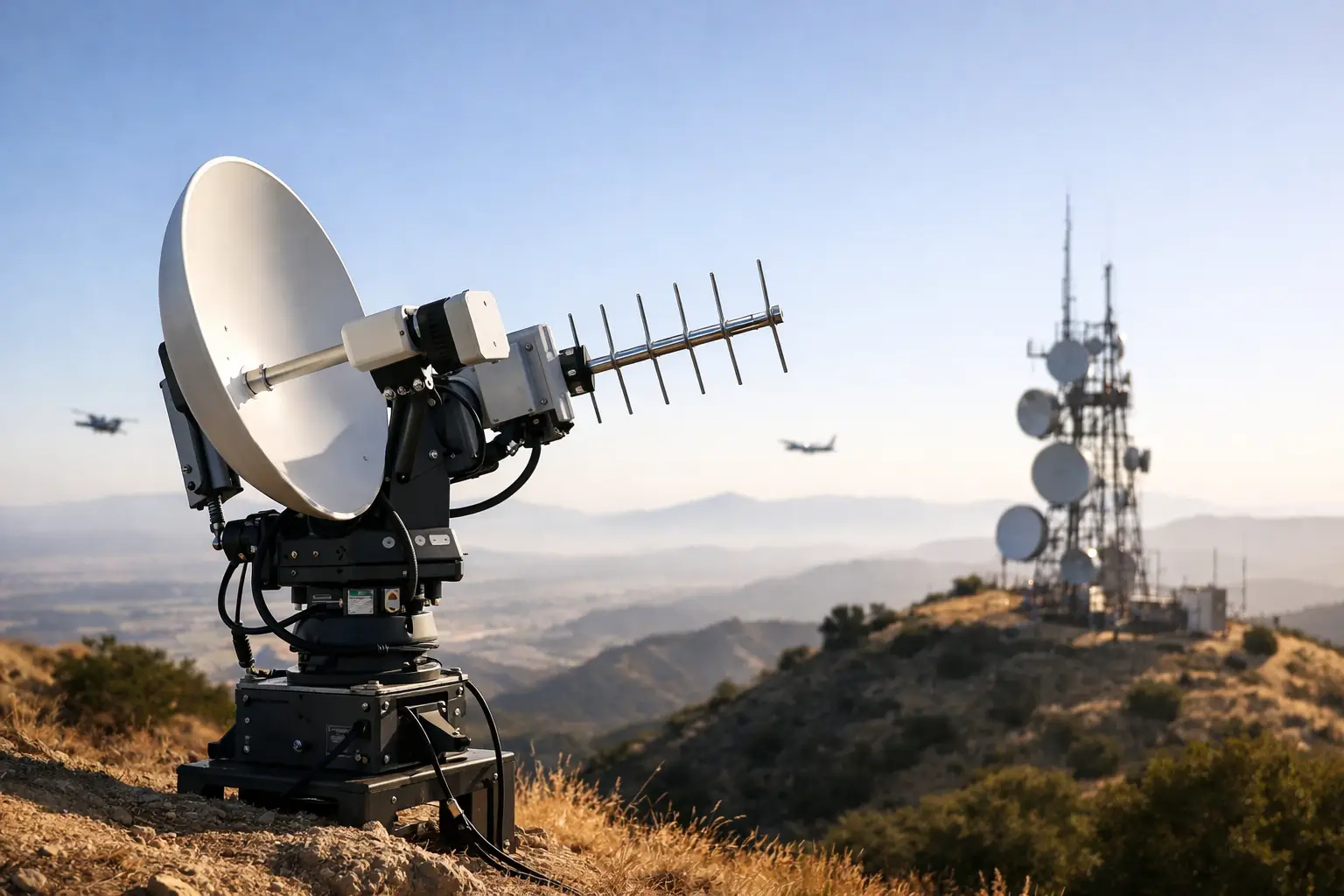
A microwave link can look excellent during commissioning and fail the first time a vessel rolls, a vehicle turns, or a remote platform loses its reference position. The best antenna tracker features are not a generic checklist of motors and sensors. They are the capabilities that keep a high-gain link pointed, stable, and manageable when the operating environment is actively working against it.
For enterprise, industrial, maritime, defense, and public-safety deployments, an antenna tracker should be evaluated as part of the communications system, not as an isolated mechanical accessory. Tracking performance, radio compatibility, network architecture, installation constraints, and field support all affect whether the system delivers usable capacity at the far end of the link.
Start With Pointing Accuracy and Repeatability
High-gain antennas offer the range and throughput needed for long-distance microwave and private LTE/5G backhaul, but their beamwidth can be unforgiving. As antenna gain increases, even a small pointing error can reduce signal level, lower modulation, or interrupt a link entirely. This makes pointing accuracy one of the most consequential antenna tracker specifications.
Accuracy describes how closely the tracker can point to the calculated target direction. Repeatability describes whether it can return to that direction consistently. Both matter. A tracker that finds a target once but introduces small, repeated positional errors during normal movement can produce fading that is difficult to diagnose from the network operations center.
Ask how the manufacturer defines accuracy and under what conditions it was measured. A specification taken in a controlled, stationary test does not automatically reflect performance on a moving vessel, a rough-road vehicle, or a wind-exposed tower. The relevant question is whether the system maintains link margin under the motion profile, range, antenna beamwidth, and weather conditions of the intended deployment.
Closed-Loop Tracking Adds Real Operational Value
Open-loop tracking uses known position and orientation data to calculate where the antenna should point. It is efficient and often highly effective when GPS, heading, and motion inputs are dependable. Closed-loop tracking adds feedback from the received signal or a secondary sensing method, allowing the system to correct for errors that can develop in real operation.
The best approach depends on the application. A predictable point-to-point route may benefit most from precise path calculation and reliable position data. A dynamic maritime or ground-to-air link may justify closed-loop refinement because heading offsets, structural flex, sensor drift, and changing propagation conditions can compound quickly. In critical applications, the ability to acquire, verify, and continuously refine the target is more valuable than a simple claim of auto-aiming.
Stabilization Must Match the Motion Environment
An antenna tracker mounted on a fixed structure solves a different problem than one installed on a boat, vehicle, aircraft-support platform, or mobile command unit. For moving applications, the tracker must compensate for pitch, roll, yaw, vibration, acceleration, and sometimes rapid changes in heading.
Two-axis control may be suitable where the mounting platform remains generally level and motion is limited. Three-axis stabilization is often necessary for maritime operations and other environments where roll and pitch can alter the antenna’s effective pointing direction. The requirement is not to select the highest number of axes by default. It is to select a stabilized microwave system that can maintain the required pointing precision through the actual motion envelope.
Sensor quality is central to this performance. GPS alone does not provide the orientation detail needed for demanding mobile links. A well-engineered system combines position data with heading, inertial measurement, and motion inputs. It should also account for installation offsets, including the physical relationship between the sensors, tracker, and antenna. Those offsets appear minor on a drawing but can create meaningful errors over long paths.
Vibration resistance deserves the same scrutiny. Continuous vibration can affect connectors, fasteners, cable routing, sensor calibration, and mechanical wear. For oil and gas, construction, public safety, and maritime deployments, a tracker needs a mechanical design intended for sustained field duty, not occasional movement.
Evaluate Acquisition Speed and Recovery Behavior
A link is only useful after the antenna has found and held its target. Fast acquisition matters during initial startup, after a planned route change, and after an interruption caused by obstruction, power loss, or severe movement. Recovery behavior matters even more because it determines how long a remote team operates without backhaul.
Look beyond a single acquisition-time claim. Determine whether the system can recover automatically after a short signal fade, a position-data interruption, or a reboot. Ask how it behaves when it loses the target entirely. Does it follow a defined search pattern? Can it use stored routes or target coordinates? Does it alert the operator before a degraded condition becomes an outage?
For emergency response and defense communications, recovery logic can be as important as peak throughput. A field team may not have the time, access, or trained personnel required to manually repoint an antenna every time the operating environment changes.
Best Antenna Tracker Features Include Radio Integration
Mechanical tracking is only one part of the link. The tracker must work cleanly with the selected radio, antenna, power system, network equipment, and management platform. This is where seemingly compatible equipment can create deployment delays or leave operators with fragmented support responsibilities.
Integrated radio compatibility reduces the need for improvised interfaces and gives engineering teams clearer accountability across the system. Confirm support for the target frequency band, radio form factor, control interface, power requirements, and Ethernet or fiber architecture. For licensed microwave, unlicensed backhaul, private LTE, and 5G applications, the tracker must support the radio and antenna combination required to meet capacity, latency, and availability objectives.
Cable management should not be treated as a minor installation detail. Rotating equipment can strain RF, power, and data cables if routing is poorly designed. A practical tracker design protects cable bend radius, limits exposure to weather and motion, and accommodates the equipment package without creating a maintenance burden.
Remote management also deserves attention. Operators need visibility into heading, elevation, target coordinates, signal condition, sensor status, alarms, and controller health. The right level of telemetry allows a network team to distinguish between a propagation issue, radio fault, tracker issue, or site power problem without immediately dispatching personnel.
Ruggedization Is More Than an Enclosure Rating
Environmental specifications are useful, but they do not tell the complete story. A tracker deployed offshore faces salt spray, corrosion, vibration, humidity, and wind loading. A desert deployment faces heat, dust, solar exposure, and wide temperature swings. A public-safety vehicle may face repeated transport shock, quick installation cycles, and limited access to specialized maintenance.
Review the complete operating profile: temperature range, wind survival, wind operating limits, ingress protection, corrosion resistance, shock and vibration tolerance, and available environmental testing. Then consider serviceability. A system may survive harsh conditions but still impose high cost if technicians cannot inspect, calibrate, or replace components efficiently in the field.
There is a trade-off. More protective housings, larger drives, and higher-grade materials can add weight, power demand, and cost. Those trade-offs are justified when they prevent recurring outages or premature replacement. They are not automatically necessary for a protected, fixed industrial installation. The deployment should drive the design decision.
Path Calculation and Network Design Should Work Together
An effective tracking system understands more than the current compass direction. It needs a reliable way to calculate and maintain the path between moving and fixed endpoints. This requires accurate site coordinates, altitude where relevant, reference-frame alignment, and consideration of obstructions along the route.
For ground-to-air, maritime, and mobile field deployments, path calculations should account for expected travel areas rather than a single static location. Network design must also account for handoffs, overlapping coverage, failover paths, and realistic link budgets. A tracker cannot compensate for an under-engineered RF path with insufficient fade margin or a site that is regularly blocked by terrain, structures, or vessel equipment.
This is why engineered systems have an advantage over component-only procurement. BATS Wireless approaches auto-aiming systems as part of the end-to-end communications design, connecting tracking capability with antenna engineering, integrated radios, stabilized microwave systems, and operational network requirements.
Choose Supportability, Not Just Specifications
A tracker can have an impressive data sheet and still be a poor operational fit if it requires proprietary field procedures, lacks diagnostic visibility, or leaves the customer to coordinate between multiple suppliers. Before procurement, determine who owns system-level commissioning, software configuration, alignment, troubleshooting, and lifecycle support.
For long-term deployments, confirm the availability of spares, firmware maintenance, technical documentation, and escalation support. Consider whether personnel can be trained to perform routine inspections and first-level fault isolation. The goal is not to eliminate specialized support. It is to reduce the frequency and cost of avoidable site visits.
The right antenna tracker is the one that protects communications continuity under the conditions your operation actually faces. Specify it from the link budget, motion profile, radio architecture, and service model forward. That process produces a system that stays on target when the job gets difficult, which is the moment tracking capability matters most.

October 25, 2026

October 25, 2026

October 25, 2026
October 25, 2026
