
Ground Air Connectivity for Critical Operations
Ground air connectivity combines tracking antennas, private LTE/5G, and microwave backhaul to keep aircraft, crews, and command systems connected.

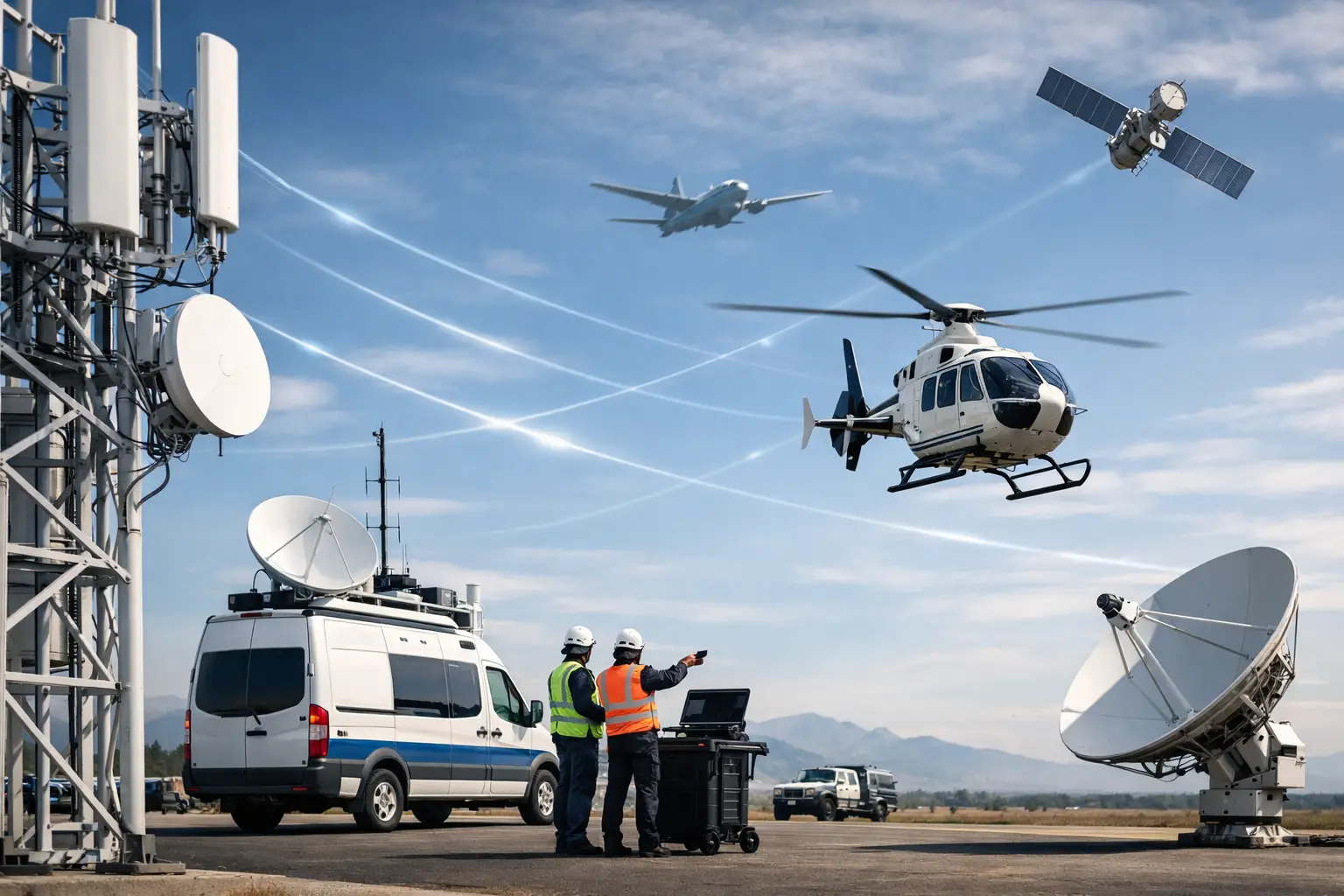
A helicopter can cross a coverage boundary in seconds. A fixed-wing aircraft can move beyond the reach of a terrestrial sector before a conventional network has time to recover. For defense, public safety, aviation support, and industrial operators, ground air connectivity is not simply an airborne internet requirement. It is the communications architecture that keeps crews, mission systems, field teams, and command personnel operating from the same current information.
The challenge is that aircraft do not behave like fixed sites. They move quickly, change altitude, bank, vibrate, and operate in terrain that blocks or reflects RF energy. A connection that looks strong during a static test can degrade sharply once the platform turns, the antenna loses alignment, or the aircraft moves behind terrain. Effective ground-to-air communications must account for those real operating conditions from the start.
What Ground Air Connectivity Must Deliver
Ground air connectivity is the engineered wireless link between airborne platforms and terrestrial network infrastructure. Depending on the mission, it may support voice, video, telemetry, command-and-control traffic, sensor feeds, aircraft health data, onboard user access, or a combination of these services.
The network requirement is usually broader than raw throughput. A high-resolution video feed may demand significant capacity, but an operational voice channel or command message can have a far greater consequence if it is interrupted. That distinction drives design decisions around link availability, traffic prioritization, redundancy, encryption, and failover behavior.
A practical system must also preserve connectivity across changing ranges and angles. The aircraft may be close to a ground station during takeoff, then move tens of miles away, descend into a valley, or pass through a congested RF environment. The link budget, antenna pattern, available spectrum, and network routing all need to support the intended flight profile rather than an idealized point-to-point path.
Why Standard Fixed Wireless Falls Short
A fixed wireless link assumes stable endpoints. Its antennas are carefully aligned once, mounted securely, and expected to maintain a predictable path. That approach does not translate directly to an aircraft.
An airborne endpoint needs to maintain alignment while the platform moves in three dimensions. Vibration and aircraft motion can reduce effective antenna gain. Changes in elevation and heading alter the path continuously. At longer distances, even a small pointing error can materially affect link performance.
This is where auto-aiming and stabilized antenna systems become central to the design. Rather than relying on manual alignment or a broad, low-gain antenna pattern, a tracking system continuously calculates and follows the remote platform. It keeps a directional link focused where it delivers the most value: on the aircraft, at the required range, during actual movement.
The Core Architecture Behind Reliable Ground Air Connectivity
There is no single architecture for every fleet or mission. A medevac program, a military training range, a wildfire response operation, and an offshore aviation support network all have different coverage, security, and mobility requirements. Still, reliable deployments are typically built from the same functional layers.
Tracking and Stabilized Antennas
The RF link begins with antenna performance. Directional antennas provide the gain needed for longer-range communications, but they require accurate pointing. Ground-based tracking antennas follow the aircraft position and compensate for movement, while stabilized airborne systems help maintain the link through pitch, roll, yaw, and vibration.
System selection depends on aircraft speed, operational range, desired throughput, available installation space, and the level of environmental exposure. A compact platform may require a different antenna and radio configuration than a larger rotary-wing aircraft with higher payload capacity. Installation constraints matter as much as theoretical RF performance.
Microwave and Integrated Radio Links
Stabilized microwave systems are well suited to applications that need high-capacity, low-latency communications between an aircraft and a ground network. They can carry mission video, sensor traffic, operational data, and network access without relying exclusively on commercial cellular coverage.
Radio compatibility is a critical engineering detail. The antenna, tracking controller, radio, waveform, and network equipment must operate as a coordinated system. A strong antenna cannot compensate for an incompatible radio configuration, poor frequency planning, or an undersized backhaul path. Integrated systems reduce those gaps by bringing antenna tracking, path calculation, and radio operation into one deployment model.
Private LTE and 5G for the Operational Area
Private 4G/5G can extend controlled broadband coverage around an airfield, training range, industrial site, disaster area, or remote operations base. It is particularly useful where organizations need local control over users, devices, quality of service, and security policies.
Private cellular is not always the primary long-range air link. In many deployments, it serves as the local access network for ground crews, vehicles, sensors, and command posts, while microwave or other high-capacity links provide airborne connectivity and backhaul. Used together, these technologies create a more complete operating network rather than a collection of isolated point solutions.
Backhaul That Does Not Become the Bottleneck
The airborne link receives most of the attention, but the backhaul determines whether data can reach the systems and people who need it. A live video stream has little operational value if the ground station connects to an undersized, congested, or unreliable network path.
Backhaul planning should include expected traffic volumes, peak mission demand, latency tolerance, route diversity, and the availability of alternate paths. Fiber may be available at a permanent base. In remote locations, a microwave backbone, cellular uplink, satellite path, or a combination of options may be necessary. The right choice depends on the site, required capacity, and tolerance for service interruption.
Designing for Mission Conditions, Not Demonstrations
Ground-to-air systems should be evaluated against measurable operating requirements. Range is one factor, but it is not enough to ask how far a link can reach under ideal line-of-sight conditions. Teams should define the actual mission area, flight altitude, aircraft speed, terrain profile, expected obstructions, weather exposure, and service-level requirements.
Frequency selection deserves the same discipline. Higher frequencies can support substantial capacity but may introduce stricter line-of-sight and environmental considerations. Lower bands can provide different propagation characteristics but may have limited bandwidth or greater interference exposure. Spectrum availability, licensing, and coordination requirements also vary by application and location.
Network engineers should identify which traffic is mission-critical and enforce quality-of-service policies accordingly. Command traffic, voice, and essential telemetry may need priority over general user traffic or noncritical uploads. Segmentation is equally important. Airborne systems, crew devices, maintenance equipment, and guest access should not automatically share the same network privileges.
Redundancy should be intentional rather than assumed. A secondary radio path, alternate ground station, diverse backhaul route, or fallback cellular connection can protect an operation when the primary path is obstructed or unavailable. Redundancy adds cost and complexity, so the design should match the consequence of an outage. A training application and a life-safety mission do not carry the same risk profile.
Deployment Details That Determine Field Performance
The most capable hardware still depends on a disciplined deployment. Site surveys should examine terrain, Fresnel zone clearance, potential RF interference, mounting positions, power availability, grounding, environmental protection, and access for maintenance. For mobile ground stations, setup time, transportability, and operator workflow are also central requirements.
Tracking systems need accurate position data and a reliable understanding of the aircraft’s path. The system should be tested across representative flight patterns, including turns, elevation changes, and edge-of-coverage routes. A straight-line flight test alone does not confirm performance during the movements that stress antenna tracking.
Operational support matters after commissioning. Teams need visibility into signal levels, alignment behavior, throughput, latency, packet loss, and radio health. Remote monitoring can reveal a declining link before it becomes an operational failure. It also provides the performance evidence needed to refine antenna placement, frequency plans, and capacity assumptions over time.
For agencies and enterprises managing mixed fleets, interoperability deserves early attention. The network may need to connect aircraft from different manufacturers, legacy radios, mobile command vehicles, private cellular infrastructure, and existing IT or security systems. An engineered solution should fit the operational environment instead of forcing every asset into a single equipment model.
Where Ground Air Connectivity Creates Operational Value
Public safety aviation teams can send live video and location data from an aircraft to incident command, helping personnel allocate resources with a current view of the scene. Defense organizations can support training, range communications, mobile command operations, and airborne situational awareness without depending solely on commercial infrastructure.
Industrial operators use ground-to-air communications to connect aircraft supporting remote inspections, logistics, offshore operations, and critical infrastructure work. In disaster response, rapidly deployable ground stations and private networks can restore communications where fixed infrastructure has been damaged or is absent.
BATS Wireless designs these systems as complete communications environments, combining auto-aiming antenna technology, stabilized microwave capability, integrated radios, private LTE/5G, and deployment expertise. The objective is not a laboratory-grade signal reading. It is sustained network performance when the aircraft, terrain, weather, and mission tempo make connectivity difficult.
The right next step is to define the mission before selecting the equipment: where aircraft will fly, what data must move, how long an interruption can be tolerated, and which ground systems must receive that data. Those answers turn ground air connectivity from a collection of components into an operational communications system built for the work ahead.

October 10, 2026

October 10, 2026

October 10, 2026

October 10, 2026
