
How to Choose Antenna Tracking Systems for Critical Links
Learn how to choose antenna tracking systems for mobile, maritime, and remote links by evaluating accuracy, radios, environment, and lifecycle support.

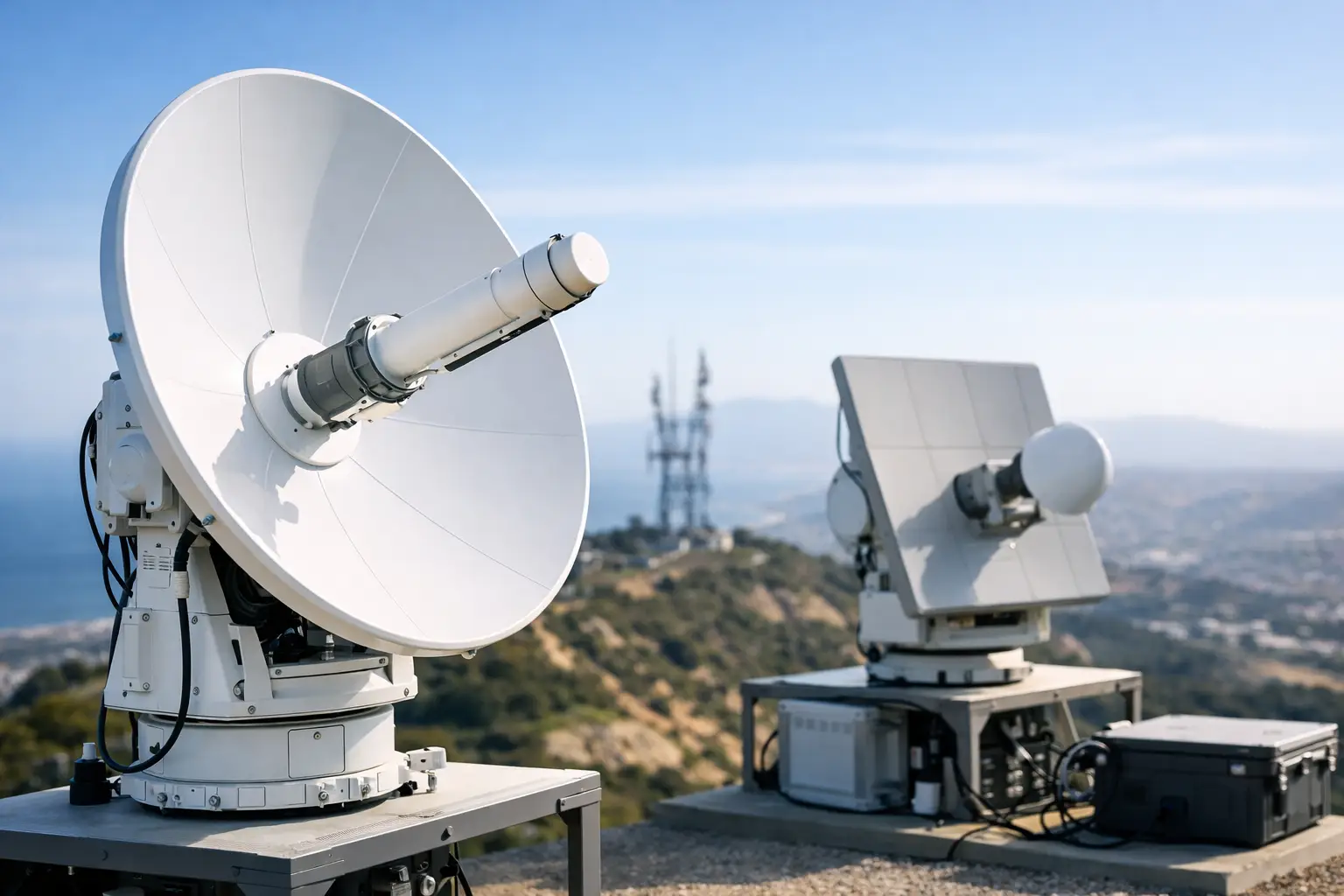
A dropped link is rarely caused by one component alone. On a moving vessel, emergency vehicle, drilling site, or remote industrial asset, it is usually the combined effect of platform motion, changing geometry, RF conditions, power limits, and equipment that was selected for a less demanding use case. Knowing how to choose antenna tracking systems starts with defining the operational link, then selecting an auto-aiming solution engineered to hold that link under real field conditions.
The right system is not simply the antenna tracker with the highest stated accuracy. It is the system that maintains usable throughput, fits the radio architecture, withstands the environment, and can be supported throughout the operating life of the network.
Start With the Link, Not the Hardware
An antenna tracking system should be selected against the performance of the complete wireless path. Before comparing pedestals, radomes, or tracking specifications, establish what the connection must carry and what happens when it is unavailable.
A short-duration video interruption may be acceptable for one commercial application. It is unacceptable when the same link supports command communications, public safety coordination, vessel operations, remote process control, or a private LTE/5G backhaul connection. Define the required availability, minimum throughput, maximum acceptable latency, and outage tolerance for the mission.
Then map the endpoints. Is the fixed site a tower, a shoreline facility, an offshore platform, an aircraft, or another mobile asset? Is the moving endpoint traveling on predictable routes, circling a work area, changing heading frequently, or operating with limited line of sight? These details determine whether the application needs basic position-based pointing, continuous auto-tracking, stabilization, or a combination of methods.
The RF link budget remains central to the decision. Frequency band, channel width, antenna gain, transmit power, receiver sensitivity, fade margin, path length, and expected obstructions all affect the amount of pointing error the system can tolerate. A narrow-beam, high-gain microwave link can deliver exceptional capacity, but it demands tighter pointing control than a lower-frequency, wider-beam link.
How to Choose Antenna Tracking Systems by Operating Geometry
Tracking performance is defined by movement, not by a data-sheet number in isolation. The system must acquire the target quickly, calculate the correct path, and continue to point accurately as the platform moves.
Define Range, Speed, and Direction Changes
A vehicle traveling along a straight road presents one type of tracking problem. A vessel that rolls, pitches, yaws, and changes course in open water presents another. Ground-to-air communications introduce fast elevation changes and higher angular rates. Ask for the expected minimum and maximum range, platform speed, angular velocity, acceleration, and elevation angle across the full operating area.
The minimum range matters as much as maximum range. As a mobile asset moves close to a fixed terminal, the pointing angle can change rapidly. A tracker that performs well at long distance may not have the response speed or control resolution to sustain the link during close passes.
For sites with terrain, structures, cranes, turbines, or offshore equipment, evaluate the full route rather than a single clean path profile. A system may need to reacquire after a temporary blockage, hand off between fixed sites, or operate through known interference zones. Path calculation and target-prediction capability can reduce reacquisition time when GPS or other position data is available.
Match Tracking Precision to Antenna Beamwidth
Pointing accuracy should be evaluated against the half-power beamwidth of the installed antenna. The narrower the beam, the lower the allowable pointing error. This relationship is why a high-capacity microwave system needs more than a motorized mount. It needs precise sensors, stable control loops, reliable position feedback, and mechanics that do not introduce backlash or flex under load.
Do not select an extremely narrow beam solely because it produces the highest theoretical gain. Narrow beams can be the right choice for long-range, high-throughput backhaul, but only when the tracker, platform stability, installation alignment, and operating geometry support it. In some applications, a modest reduction in gain and a wider beam can produce better overall availability.
Look beyond static accuracy specifications. Confirm repeatability, acquisition time, tracking update rate, backlash, and performance during motion. For stabilized microwave systems, ask how the platform’s roll, pitch, and yaw are measured and compensated. Sensor quality and control integration often separate a field-proven system from an assembly that works only in calm conditions.
Select the RF Architecture as a Complete System
A tracking antenna is only one part of the connection. The tracker, antenna, radio, modem, power system, network equipment, and management platform must operate as an integrated design.
Confirm compatibility with the required radio platform, frequency band, polarization, duplexing method, and interface requirements. This is especially important where an organization already has licensed microwave equipment, private 4G/5G infrastructure, or a standardized radio vendor. Physical fit alone is not sufficient. The antenna gain, connector arrangement, cable losses, radio mounting approach, and control interfaces must all support the required performance.
For applications requiring two-way capacity, consider whether separate transmit and receive paths, diversity, multiple-input multiple-output configurations, or dual antennas are needed. These choices can improve throughput and resiliency, but they add weight, wind loading, power demand, and installation complexity. The best architecture is the one that meets the service objective without burdening the mobile platform beyond its practical limits.
Network design also deserves early attention. If the tracking link feeds an onboard network, mobile command center, remote SCADA environment, or private cellular node, define traffic prioritization, failover behavior, quality-of-service policies, and remote management requirements before equipment is ordered. A highly accurate antenna tracker cannot compensate for an undersized router, poor power conditioning, or an unplanned network handoff.
Engineer for the Platform and Environment
Environmental suitability is a performance requirement, not a compliance checkbox. Salt spray, vibration, shock, wind, sand, high heat, ice, hydraulic noise, engine interference, and continuous duty can degrade a system that appears capable on paper.
For maritime deployments, assess corrosion resistance, sealing, radome construction, drainage, and service access. For oil and gas, mining, construction, and public safety vehicles, consider vibration profiles, mounting strength, cable routing, electromagnetic interference, and the ability to operate from the available DC or AC power source. Defense and industrial users may also require specific environmental, security, and documentation standards.
Weight and center of gravity matter on mobile platforms. A larger antenna can improve link margin, yet its wind load and inertia can affect tracking response and place additional stress on the mounting structure. The installation must be designed for the complete assembly, including radios, brackets, radome, cables, and any required stabilization hardware.
It is also worth examining maintainability before deployment. Can field technicians safely access the system? Are connectors protected from repeated weather exposure? Can a damaged cable, radio, or antenna module be replaced without extensive realignment? A practical service design reduces downtime when an asset is far from a central facility.
Validate Auto-Aiming Performance Before Deployment
The strongest procurement process includes a defined factory acceptance test and site acceptance test. These tests should reflect the actual mission profile rather than a stationary bench demonstration.
Acceptance criteria should address at least these operational measures:
- acquisition and reacquisition time at representative ranges
- received signal level and throughput during platform motion
- tracking error relative to the selected antenna beamwidth
- performance during expected roll, pitch, yaw, vibration, or route changes
- recovery behavior after line-of-sight blockage, power interruption, or radio restart
Testing should also confirm system behavior at the boundaries of the coverage area. A link that works at a demonstration distance may perform differently at the far edge of range, near an obstruction, or during heavy weather. If high availability is required, validate redundant power, alternate backhaul, and failover operation as part of the same test plan.
Evaluate Lifecycle Support and Deployment Expertise
A tracking solution is an operational system with mechanical, RF, networking, and software dependencies. The supplier should be able to support more than the initial equipment shipment. Look for expertise in RF path analysis, antenna selection, mounting design, radio integration, network configuration, commissioning, and ongoing technical support.
Ask what spare components should be held locally, what diagnostics are available remotely, and whether configuration backups can be restored quickly. For multi-site or fleet deployments, standardizing the tracker, radio architecture, installation practices, and monitoring methods can lower support costs while making performance easier to manage.
BATS Wireless approaches antenna tracking as part of the larger connectivity architecture, combining auto-aiming capability, stabilized microwave systems, compatible radios, and deployment engineering for demanding environments. That systems perspective is particularly valuable when the application must remain connected far beyond conventional broadband coverage.
Choose the system that has been engineered around your actual movement, path, radio, and environment – then prove its performance under those conditions before it becomes part of daily operations.

October 10, 2026

October 10, 2026

October 10, 2026

October 10, 2026
