
Best Backhaul Options for Remote Operations
Compare the best backhaul options for remote operations, from stabilized microwave and private 5G to satellite, with practical design criteria for uptime.

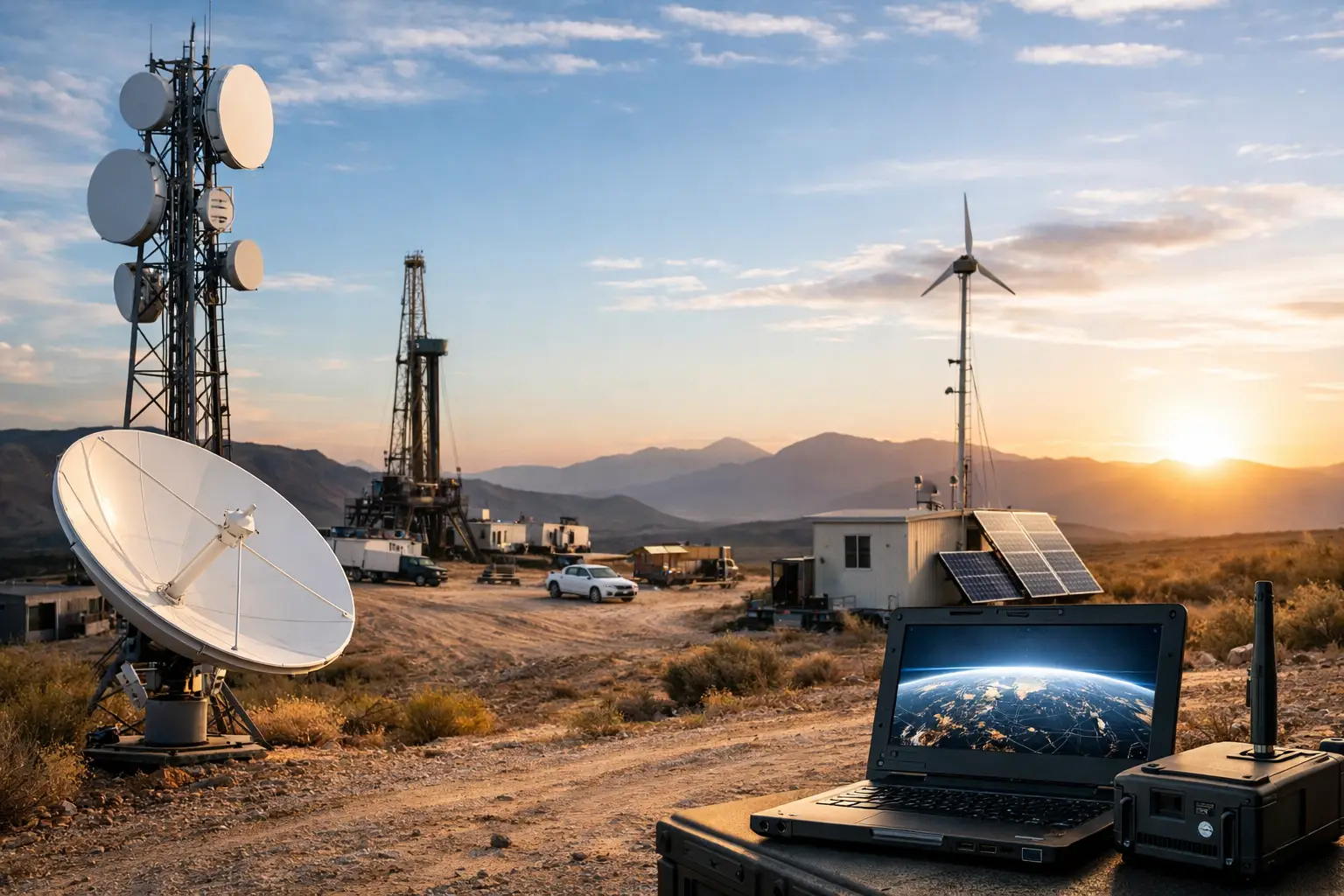
A drilling platform 40 miles offshore, a mobile command vehicle at a wildfire perimeter, and a temporary construction site outside fiber coverage have the same network problem: the access network is only as useful as the path carrying its traffic back to the core. The best backhaul options for remote operations are not selected by headline bandwidth alone. They are selected around availability, path conditions, mobility, latency, security, installation constraints, and the cost of losing communications when operations are underway.
For most mission-critical deployments, the right answer is a layered architecture rather than a single transport method. A high-capacity primary path, an independent backup path, intelligent routing, and equipment engineered for the environment provide far better operational continuity than a low-cost connection with no recovery plan.
What Backhaul Must Do in Remote Operations
Backhaul connects a remote LAN, private LTE or 5G network, radio system, camera network, or onboard network to a central data center, cloud environment, public safety core, or internet point of presence. In remote settings, that connection often has to cross water, difficult terrain, restricted airspace, moving assets, or areas with no terrestrial infrastructure.
The operational requirement goes beyond internet access. Voice, video, telemetry, dispatch, SCADA traffic, situational-awareness feeds, and remote support may share the same transport path. Some applications tolerate a brief delay. Others cannot tolerate packet loss, extended latency, or an unplanned handoff. A network design must identify those differences before choosing a backhaul medium.
Capacity matters, but committed throughput matters more. A connection that delivers 500 Mbps in favorable conditions and falls sharply during rain, vessel motion, congestion, or obstruction may be unsuitable for a system carrying live video and operational control traffic. Engineers should define the minimum usable capacity during the worst credible operating condition, not the peak rate shown in a coverage estimate.
Best Backhaul Options for Remote Operations
Stabilized and Auto-Aiming Microwave
Point-to-point microwave is often the strongest primary option when a clear or engineered radio path is available. It can provide high throughput, low latency, predictable performance, and strong control over the end-to-end network. For fixed sites, properly aligned microwave links can extend broadband across terrain where trenching fiber is impractical or prohibitively expensive.
For moving platforms, conventional fixed antennas are not enough. Vessel roll, yaw, pitch, vehicle motion, and changing range can degrade a link in seconds. Stabilized microwave systems with auto-aiming and antenna tracking maintain alignment between moving and fixed endpoints. They are particularly effective for maritime operations, ground-to-air applications, mobile command systems, and other environments where line of sight changes continuously.
Microwave has real constraints. It requires path analysis, Fresnel zone clearance, suitable mounting, spectrum planning, and consideration of rain fade at higher frequency bands. It is not a universal answer in mountainous terrain, dense urban clutter, or areas where the remote asset cannot maintain a viable radio path. When the path works, however, it is difficult to match microwave for capacity and latency without building fiber.
Fiber and Existing Terrestrial Transport
Where it is available at the remote edge, fiber remains the reference standard for high-capacity, low-latency backhaul. It is well suited to mines, industrial plants, ports, wind farms, utility sites, and permanent campuses where the construction timeline and right-of-way requirements are manageable.
The limitation is deployment economics. Extending fiber to a single remote asset can involve permitting, civil construction, environmental restrictions, water crossings, and long repair windows. In many industrial projects, fiber is best used as the aggregation point or shore-side connection, while microwave extends service to the assets that cannot be economically cabled.
A practical design also avoids treating fiber as automatically diverse. Two circuits from different providers can share the same conduit, landing station, power source, or upstream route. Physical route diversity should be verified, especially when fiber is positioned as the failover path for a critical wireless link.
Satellite Backhaul
Satellite is often the only immediately deployable option outside terrestrial coverage. It supports emergency response, exploration, maritime operations, temporary sites, and early-stage projects where the permanent network is not yet in place. Its geographic reach makes it indispensable, but its performance profile must match the application.
Geostationary satellite can support broad-area coverage, though latency is typically a concern for interactive applications, real-time control, and certain voice workflows. Low Earth orbit services can materially reduce latency and may offer higher capacity, but service availability, terminal visibility, mobility support, contention, and regulatory conditions can vary by location and operating model.
Satellite works well as a primary path for moderate traffic loads or as an independent backup for a terrestrial or microwave system. The engineering question is not whether satellite is “good” or “bad.” It is whether its committed capacity, latency, antenna requirements, and service continuity meet the traffic priorities at the site. Critical systems should use QoS policies so business-essential traffic is not displaced by software updates, guest access, or nonessential video streams.
Cellular, Private LTE, and Private 5G
Public cellular backhaul is useful when commercial coverage is strong, the application can tolerate variable performance, and rapid deployment is the priority. Dual-carrier cellular routers can provide valuable path diversity for field crews, temporary sites, and mobile assets. They should be assessed by actual field measurements, not a coverage map alone.
Private LTE and private 5G add a different capability. They provide controlled wireless access across the operational area, but the private network still needs a backhaul connection from its core, edge, or aggregation point. That upstream path may be fiber, microwave, satellite, or a combination of the three.
For a mine, port, warehouse yard, or wind farm, private cellular can simplify mobility and device management while microwave carries aggregated traffic to a fiber-connected hub. This architecture separates local coverage from long-haul transport and allows each layer to be engineered for its actual job. It also gives operators more control over traffic segmentation, authentication, and service priorities than a public-network-only design.
Mesh Networks and Multi-Hop Wireless
Mesh and multi-hop wireless can extend connectivity through a large worksite, across a dispersed sensor network, or between temporary field positions. It is valuable when nodes need to be added quickly and no single central location can reach every endpoint.
The trade-off is cumulative capacity and latency. Every wireless hop consumes airtime, adds another potential failure point, and can complicate troubleshooting. Mesh is best treated as an access-extension method or a temporary transport layer, not as a substitute for a planned high-capacity backhaul path. Where a site depends on video, private cellular traffic, or operational data, aggregate traffic should be brought to a well-designed microwave, fiber, or satellite gateway as early as possible.
Design the Path Around Failure Modes
The most effective remote backhaul designs start with a failure analysis. Ask what happens if a tower loses power, a vessel changes heading, a microwave path is obscured, a satellite terminal loses sky view, or a carrier experiences congestion. The answers determine whether redundancy is meaningful or merely expensive.
A strong design separates common points of failure. For example, a stabilized microwave primary link and satellite backup can protect against different failure modes. Two microwave links routed through separate towers may add capacity but offer limited protection if both depend on the same shore-side power system. Diversity should apply to transport medium, physical route, power, network edge, and, where necessary, management access.
Power is frequently the overlooked element. Remote radios, tracking systems, routers, and edge compute equipment need conditioned power, battery runtime sized for operational needs, and often generator integration. Environmental design matters as well. Salt spray, vibration, temperature extremes, wind loading, corrosion, and enclosure heat can shorten equipment life long before link budget becomes the issue.
Match Performance to Traffic Priorities
Not all traffic should receive equal treatment. Voice, dispatch, control traffic, and network management typically require strict priority. Live video may require substantial bandwidth but can be rate-limited or adapted during a degraded condition. Bulk synchronization, updates, and user browsing should be shaped so they do not consume the path when an incident occurs.
This is where integrated engineering has commercial value. A backhaul system is not simply an antenna and a radio. It includes path calculation, antenna selection, mounting, tracking behavior, frequency coordination, routing, QoS, security controls, monitoring, and field support. BATS Wireless approaches these elements as an operational system because the link must continue performing after deployment day.
A Practical Selection Process
Start with the application load and service-level requirement. Establish expected and peak traffic, acceptable latency, outage tolerance, mobility requirements, coverage geography, and the duration of the deployment. Then survey available paths: fiber handoff locations, tower and mounting options, radio line of sight, satellite visibility, carrier performance, spectrum constraints, and power sources.
Next, model the primary path under adverse conditions and define a backup path that does not fail for the same reason. A fixed inland site may use licensed microwave with fiber diversity. An offshore vessel may use stabilized microwave near shore, satellite beyond the microwave service area, and local onboard Wi-Fi or private LTE for devices. A disaster-response deployment may use cellular and satellite on day one, then add microwave once a reliable hub location is established.
The right decision is the one that protects the mission at a justified cost. Build the backhaul around the conditions your operation will actually face, test failover before the site goes live, and retain enough visibility to diagnose the network from wherever the next incident occurs.
October 25, 2026

October 25, 2026
October 25, 2026
October 25, 2026
