
Maritime LTE Versus VSAT: Which Fits Best?
Maritime LTE versus VSAT comes down to range, latency, throughput, and cost. Compare both for vessels, fleets, and offshore operations.

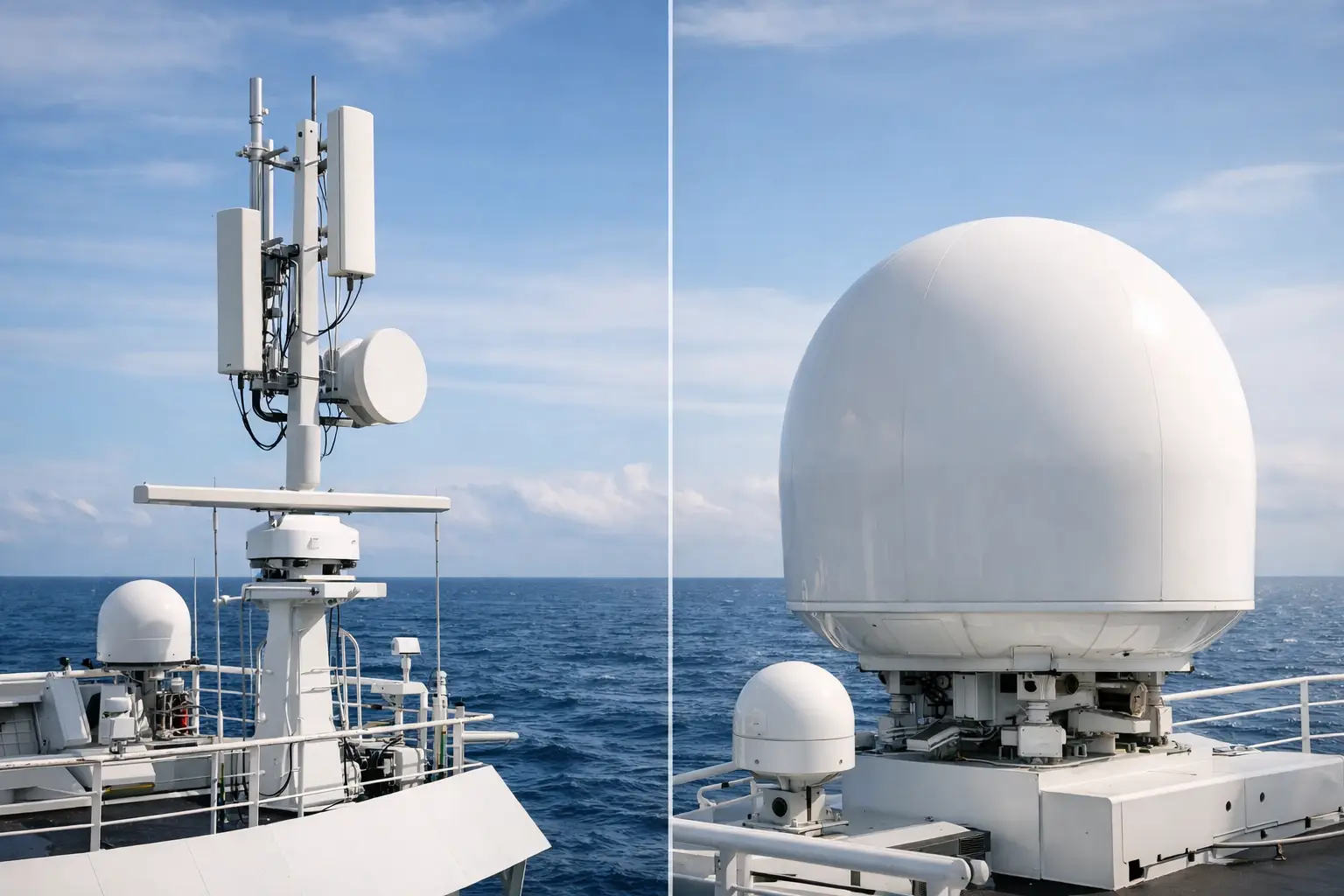
When a vessel loses useful bandwidth 20 miles off the coast, the problem is rarely the router. It is usually the network architecture. Maritime LTE versus VSAT is not a simple speed comparison – it is a coverage, latency, cost, and operational continuity decision that affects crew welfare, telemetry, safety systems, and commercial uptime.
For maritime operators, offshore service providers, port-linked fleets, and government users, the wrong connectivity design creates two predictable outcomes: paying satellite rates for traffic that could stay terrestrial, or depending on cellular service long after the shoreline can no longer support it. The right answer depends on where the vessel operates, how often it moves between nearshore and offshore zones, and what applications must keep working under all conditions.
Maritime LTE versus VSAT in practical terms
Maritime LTE uses coastal cellular infrastructure to extend broadband over water. In the right design, that means high-throughput, low-latency connectivity for vessels operating in ports, harbors, inland waterways, coastal routes, offshore wind support corridors, aquaculture zones, and other nearshore environments. Performance improves further when the system includes high-gain antennas, auto-aiming capability, onboard network integration, and path-aware engineering rather than standard off-the-shelf marine internet gear.
VSAT uses satellite links to provide coverage well beyond terrestrial network reach. That makes it the default option for blue-water operations, deep offshore activity, and mission profiles that cannot tolerate coverage gaps once a vessel moves beyond coastal LTE range. The advantage is geographic reach. The trade-off is usually higher recurring cost, more constrained bandwidth economics, and latency that can affect certain applications.
The decision is less about which technology is better in absolute terms and more about which network layer should carry which traffic, in which operating envelope, at what cost.
Where maritime LTE has the advantage
If your vessels spend most of their time in coastal waters, maritime LTE often delivers the best performance-to-cost ratio. Terrestrial wireless generally offers lower latency than satellite, which matters for cloud applications, remote support sessions, voice, video collaboration, VPN access, and operational systems that suffer when round-trip delay climbs.
That lower latency is not a marketing detail. It changes how usable the network feels. Chart updates, maintenance diagnostics, video feeds, and business applications all perform better when the path stays on a well-engineered LTE network close to shore.
Bandwidth economics also favor LTE in many nearshore use cases. For operators moving large amounts of vessel data, supporting crew connectivity, or feeding multiple onboard systems, terrestrial capacity can be a cost-saving solution compared with pushing the same traffic over satellite. That becomes even more relevant for fleets with repeated coastal routes, pilot vessels, ferries, workboats, patrol craft, tugs, dredging operations, and offshore support vessels that regularly return to terrestrial coverage footprints.
Another advantage is architectural control. Maritime LTE can be designed as a public network solution, a private LTE deployment, or a hybrid approach. For industrial and government operators, that opens options around traffic prioritization, coverage shaping, security policy, and integration with existing WAN and onboard network infrastructure.
Where VSAT remains essential
VSAT earns its place when coverage certainty matters more than terrestrial economics. Once a vessel moves far beyond the coastal RF environment, satellite becomes the reliable path. That is why blue-water cargo, long-range research missions, offshore production support, and defense operations continue to depend on it.
The strongest case for VSAT is not that it always performs better. Often, it does not. The strongest case is that it continues to perform where LTE cannot reach. If the mission requires continuous connectivity across wide ocean areas, terrestrial systems alone are not enough.
VSAT can also provide a critical resilience layer for vessels that mostly operate near shore but cannot afford a complete communications loss during route deviations, weather rerouting, emergency response, or extended offshore assignments. In those cases, the satellite link may carry essential traffic while LTE handles primary bulk usage whenever available.
This is where buyers need to separate coverage from service quality. A satellite link may offer coverage almost anywhere, but that does not mean it is the most efficient path for every application. Using VSAT for everything can solve one problem while creating another – unnecessary operating expense.
The real comparison points
The maritime LTE versus VSAT conversation usually starts with speed, but operational buyers should begin with four factors: coverage area, latency tolerance, traffic type, and monthly cost profile.
Coverage is the hard boundary. If the vessel remains inside a practical coastal footprint, LTE is a serious contender for primary connectivity. If the vessel regularly moves well offshore, VSAT becomes necessary somewhere in the architecture.
Latency is the next filter. Real-time video, interactive remote support, voice platforms, cloud applications, and user experience-heavy workflows all benefit from LTE. Satellite latency may still support these services, but often with more compromises.
Traffic type matters just as much. Telemetry, IoT data, vessel systems monitoring, crew welfare traffic, security video, file synchronization, and application access do not all require the same path. Smart network design assigns the right traffic to the right bearer instead of treating the vessel like it has only one link.
Then there is cost. LTE often wins on recurring service economics in nearshore deployments. VSAT often wins on availability beyond terrestrial reach. The budget question is not just monthly airtime. It includes hardware, installation, antenna performance, stabilization requirements, support burden, and how much downtime or degraded operation the business can absorb.
Why antenna and tracking design change the outcome
A common mistake in maritime connectivity planning is comparing LTE and VSAT as if the radio access technology alone determines success. It does not. Offshore and over-water performance is heavily influenced by antenna system design, vessel motion, horizon limits, RF path conditions, and how intelligently the system maintains alignment.
For maritime LTE in particular, stabilized and auto-aiming antenna systems can materially extend usable coverage and improve signal consistency compared with basic omnidirectional setups. That matters on moving vessels where roll, pitch, and heading changes disrupt weaker links. It also matters in congested coastal environments where signal quality, not just signal presence, determines real throughput.
The same principle applies to satellite systems. Not all VSAT installations deliver equal outcomes. Antenna quality, stabilization, blockage management, integration with onboard distribution, and failover logic all affect whether the link performs like a business asset or an expensive last resort.
For that reason, experienced buyers look beyond bandwidth claims and ask harder questions about link stability, handoff behavior, onboard network integration, and field serviceability.
Hybrid architecture is often the best answer
In many real deployments, the winner in maritime LTE versus VSAT is neither one by itself. It is a hybrid design with policy-based routing and clear operational priorities.
A vessel operating between port, coastal work zones, and occasional offshore areas may use maritime LTE as the primary path for high-volume and latency-sensitive traffic, then shift critical services to VSAT when terrestrial coverage falls away. That approach preserves performance where LTE is strongest and preserves continuity where satellite is required.
This is particularly effective for offshore wind support, coastal energy operations, public safety vessels, and commercial fleets with mixed route patterns. It supports better user experience, better cost control, and better resilience than a single-network strategy.
It also aligns with how modern vessel communications should be engineered: not as a one-link purchase, but as a layered system with intelligent failover, onboard segmentation, application-aware routing, and hardware built for motion and environmental stress.
How to choose based on mission profile
If the vessel spends most of its working life near shore, maritime LTE should be evaluated first, especially where low latency, high throughput, and cost efficiency are priorities. If the mission includes extended offshore or open-ocean operation, VSAT moves from optional to necessary.
If the operation crosses both environments, hybrid is usually the right answer. The question then becomes how to optimize link switching, traffic policy, and antenna architecture so the vessel gets the most from each network.
This is where engineered solutions matter. A generic internet package may connect a boat. It will not necessarily support operational continuity across varying sea states, routes, and application demands. That is the difference between buying bandwidth and deploying a communications system.
For organizations that treat vessel connectivity as business infrastructure, the best decision is the one that matches network design to the operating envelope, not the one built around a single technology preference. In practice, the smartest maritime network is usually the one that knows when to stay terrestrial, when to go satellite, and how to make both work as one system.

October 10, 2026

October 10, 2026

October 10, 2026

October 10, 2026
