
Rugged Microwave Radios for Critical Field Links
Rugged microwave radios deliver high-capacity links in harsh, mobile environments. Learn how to specify radios, antennas, and network architecture today.


A microwave link that performs perfectly from a fixed tower can fail quickly when installed on a moving vessel, a temporary command vehicle, or an industrial site exposed to wind, vibration, salt, dust, and changing terrain. Rugged microwave radios are built for those conditions, but the radio itself is only one part of the system. Long-term field performance depends on the relationship between radio, antenna, mounting, tracking, path design, power, and network architecture.
For organizations extending broadband beyond fiber reach, microwave remains a practical way to deliver high-capacity backhaul without the cost and delay of building new terrestrial infrastructure. The engineering challenge is making that capacity available where conditions are least predictable.
What Makes Rugged Microwave Radios Different?
A rugged microwave radio is designed to maintain a dependable point-to-point or point-to-multipoint connection outside the controlled conditions of a typical telecom shelter. That means more than a weather-rated enclosure. The system must tolerate temperature swings, moisture ingress, shock, vibration, unstable power, electromagnetic interference, and the operational demands of field maintenance.
For stationary sites, the primary concern may be environmental durability and path availability. For mobile operations, the challenge expands. A vehicle, vessel, or airborne platform can change heading, pitch, roll, elevation, and distance from the remote endpoint. At microwave frequencies, even small alignment errors can reduce receive levels enough to affect throughput or interrupt service.
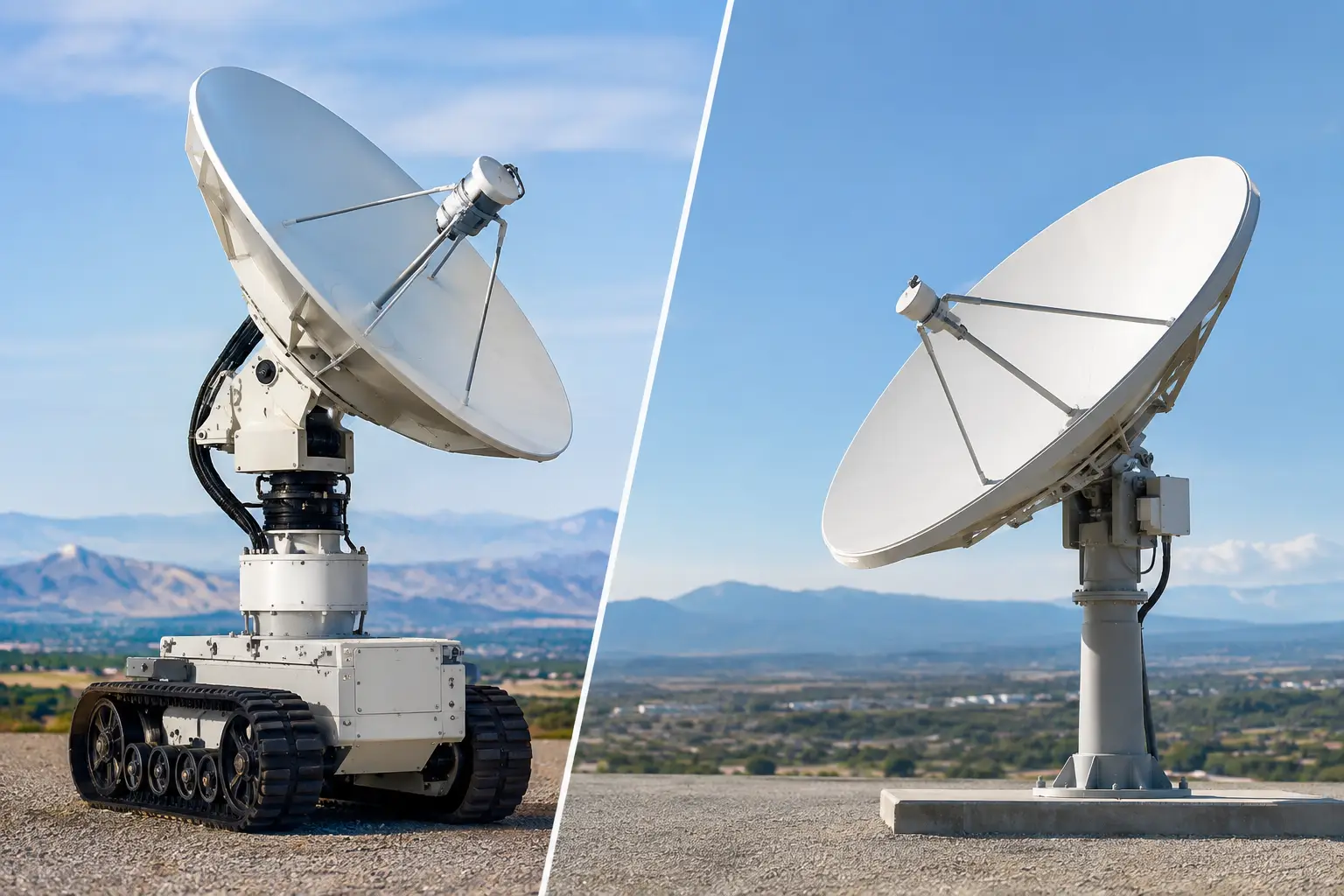
This is why stabilized microwave systems and auto-aiming antennas are often central to the design. They continuously maintain antenna alignment as the platform moves, helping preserve the narrow beamwidth that gives microwave its capacity and spectrum efficiency. A radio with high transmit power cannot compensate for a poorly managed antenna path.
Start With the Operational Requirement
The right microwave system begins with the service requirement, not a data sheet comparison. Network teams should establish what traffic must remain available, where the assets will operate, and what level of interruption is acceptable. A link carrying general internet access has different design criteria than one supporting command communications, real-time video, telemetry, voice, private LTE, or 5G backhaul.
Capacity requirements matter, but they are not the only consideration. A 1 Gbps link may be technically achievable over a short, clear path, yet the same modulation and channel width may not deliver the needed availability over water, through heavy rainfall, or across a route with intermittent obstructions. The appropriate design often uses adaptive modulation so the link can preserve connectivity at lower capacity when path conditions degrade.
Latency should also be assessed in the context of the application. Microwave is frequently selected because it can provide low-latency transport compared with satellite options. That advantage is valuable for operational video, remote control, coordinated public safety response, and onboard network services. However, the end-to-end result depends on routing, security appliances, cellular cores, local switching, and traffic policy as much as the RF hop itself.
Fixed, Temporary, and Mobile Links Require Different Designs
A fixed industrial facility may use a licensed microwave path with engineered fade margin, high-gain antennas, and protected mounting positions. The goal is typically maximum availability over years of operation. A temporary construction site or disaster response location may prioritize rapid deployment, compact equipment, and flexibility as the site footprint changes.
Maritime and vehicle-mounted operations introduce another category. Here, antenna stabilization, tracking speed, mechanical integration, and path calculation become essential. The radio must work with a system that can find, acquire, and remain locked on a remote node while the platform is in motion. The most capable antenna is not useful if its control system cannot respond to real operating dynamics.
RF Path Design Determines Real-World Availability
Microwave is line-of-sight technology, but line of sight is not simply a visual assessment. Engineers need to account for Fresnel zone clearance, antenna height, terrain, foliage, structures, water reflections, atmospheric conditions, and the link’s operating frequency. A path that appears clear from ground level may have insufficient Fresnel clearance and suffer from multipath fading or periodic signal loss.
Frequency selection involves meaningful trade-offs. Higher bands can support wider channels and high throughput, but they generally have greater rain attenuation and may require shorter paths or more conservative availability targets. Lower microwave bands can support longer links and improved performance in adverse weather, although spectrum availability, antenna size, and licensing requirements may shape the decision.
Over-water links deserve particular attention. Reflection from the water surface can create destructive interference that changes with wave height, tide, vessel motion, and path geometry. A system intended for maritime LTE or vessel connectivity should be engineered for these effects rather than treated as a standard land-based link installed near the coast.
Fade margin is the practical reserve that helps a radio maintain service when conditions are worse than nominal. It should be based on availability objectives, path length, frequency, climate data, antenna gains, and expected obstructions. Simply selecting the highest advertised radio throughput without calculating the path budget can create a network that works during commissioning and underperforms when it matters.
Antennas and Radios Must Be Treated as One System
In demanding deployments, compatibility is not a minor procurement detail. The radio, antenna, waveguide or cabling, mounting hardware, tracking controller, power system, and network interfaces must operate as an integrated platform.
A high-gain parabolic antenna can provide excellent link budget, but its narrow beam increases alignment sensitivity. That may be appropriate for fixed backhaul or for a stabilized platform with accurate auto-aiming capability. Wider-beam antennas can simplify acquisition and tolerate more movement, but they may reduce range or capacity. The preferred choice depends on the mission profile, not a universal hardware preference.
Mechanical design also affects RF performance. Antenna mounts must hold alignment through wind loading, vibration, and repeated movement. On a vehicle or vessel, the installation must consider center of gravity, cable routing, service access, corrosion protection, and interference from nearby equipment. Small integration mistakes can turn an industry-leading radio into a recurring field-support issue.
BATS Wireless approaches these deployments as complete connectivity systems, combining antenna engineering, stabilized platforms, integrated radio compatibility, and path planning rather than supplying a radio as an isolated component.
Network Architecture Should Plan for Degraded Conditions
A field microwave link should not be engineered around ideal RF conditions alone. Traffic shaping, quality of service, redundancy, and local survivability determine whether operations continue when available bandwidth falls.
For example, a mobile command network may prioritize voice, dispatch, camera control, and critical applications ahead of guest access or bulk file transfer. A remote industrial site may keep local control traffic operational if the backhaul capacity is reduced. In private 4G or 5G deployments, the architecture should identify which functions remain local and which depend on the microwave transport path.
Redundancy can take several forms. A secondary microwave path may be appropriate for high-value fixed sites. Cellular, satellite, or another terrestrial service can provide failover for locations where a second microwave route is impractical. Redundant paths are not identical in performance or cost, so the design should assign each transport method to the traffic and failure scenario it can support effectively.
Security should be built into the network design as well. Encryption, segmentation, access controls, management-plane protection, and monitoring are particularly relevant when links connect field operations to enterprise networks or government systems. Physical durability does not replace network security discipline.
Questions to Ask Before Selecting a System
Procurement teams can avoid costly redesigns by asking a few operational questions early. What is the required throughput at the worst acceptable conditions, rather than at peak modulation? Is the endpoint fixed, relocatable, or continuously moving? How quickly must the link deploy and reacquire after movement? What obstructions, weather patterns, and interference sources are expected? Is licensed spectrum available or required for the mission? And who will maintain the equipment when a fault occurs outside normal working conditions?
Supportability is often underestimated. A field-deployable system should provide clear diagnostics, manageable spare components, practical alignment procedures, and remote visibility into radio status, signal quality, traffic load, and power conditions. The best maintenance event is the one prevented by early warning and sound system design.
Rugged microwave radios deliver their greatest value when they are specified as part of an engineered communications path. Define the operating environment first, design for the conditions that cause failures, and select a system that keeps critical traffic moving when the site, platform, or weather refuses to cooperate.

October 10, 2026

October 10, 2026

October 10, 2026
October 10, 2026
