
CBRS Adoption for Mission-Critical Networks
CBRS adoption is reshaping private wireless planning. See where it fits, what it requires, and how to deploy reliable LTE and 5G operations at scale.


A construction superintendent needs coverage across a changing jobsite. A port operator needs secure mobility from the gate to the far end of the yard. A utility crew needs broadband beyond the reach of commercial cellular service. In each case, CBRS adoption can give operations teams more control over wireless performance without requiring the spectrum cost and regulatory burden associated with a traditional licensed network.
The value is not simply that CBRS makes private LTE and 5G more accessible. It gives organizations a practical middle ground between Wi-Fi, carrier service, and fully licensed spectrum. For mission-critical environments, that middle ground can be the difference between a network that works in a conference room and one that continues to serve vehicles, field crews, sensors, cameras, and operational applications in the real world.
Why CBRS adoption is accelerating
The Citizens Broadband Radio Service operates in the 3.5 GHz band and supports a shared-spectrum model in the United States. Spectrum access is coordinated through a Spectrum Access System, or SAS. That coordination protects incumbent users while allowing General Authorized Access users and Priority Access License holders to operate in the same band under defined rules.
For enterprise and industrial buyers, the practical benefit is clear: CBRS can support a dedicated cellular network using spectrum that is more available and controllable than many alternatives. A private network can be designed around operational requirements rather than the coverage priorities of a public carrier.
This matters when connectivity must reach across outdoor facilities, remote assets, temporary sites, industrial campuses, coastal operations, or infrastructure corridors. Wi-Fi remains effective for many indoor and localized applications, but it was not designed to provide wide-area mobility, managed handoffs, and cellular-grade device control across a large operational footprint. Carrier service may be available, but its performance, traffic policy, and coverage roadmap are outside the enterprise’s control.
CBRS provides another option. It is particularly attractive where an organization needs predictable local coverage, separation of operational traffic, and integration with private LTE or 5G devices. The network can support personnel communications, vehicle connectivity, video surveillance, SCADA access, asset tracking, drones, fixed wireless endpoints, and mobile command operations on a common wireless foundation.
The operational case for private cellular
CBRS is not automatically the right answer for every site. The strongest business case usually begins with a coverage, mobility, security, or continuity problem that existing networks cannot solve economically.
Consider a large industrial yard. Wi-Fi access points may deliver high capacity near buildings, yet coverage can degrade around stacked materials, steel structures, machinery, and moving vehicles. Extending the Wi-Fi design may require a large number of access points, careful channel planning, and frequent maintenance. A private CBRS network can provide broader-area cellular coverage with managed mobility for vehicles and handheld devices, while Wi-Fi continues to serve high-density indoor zones.
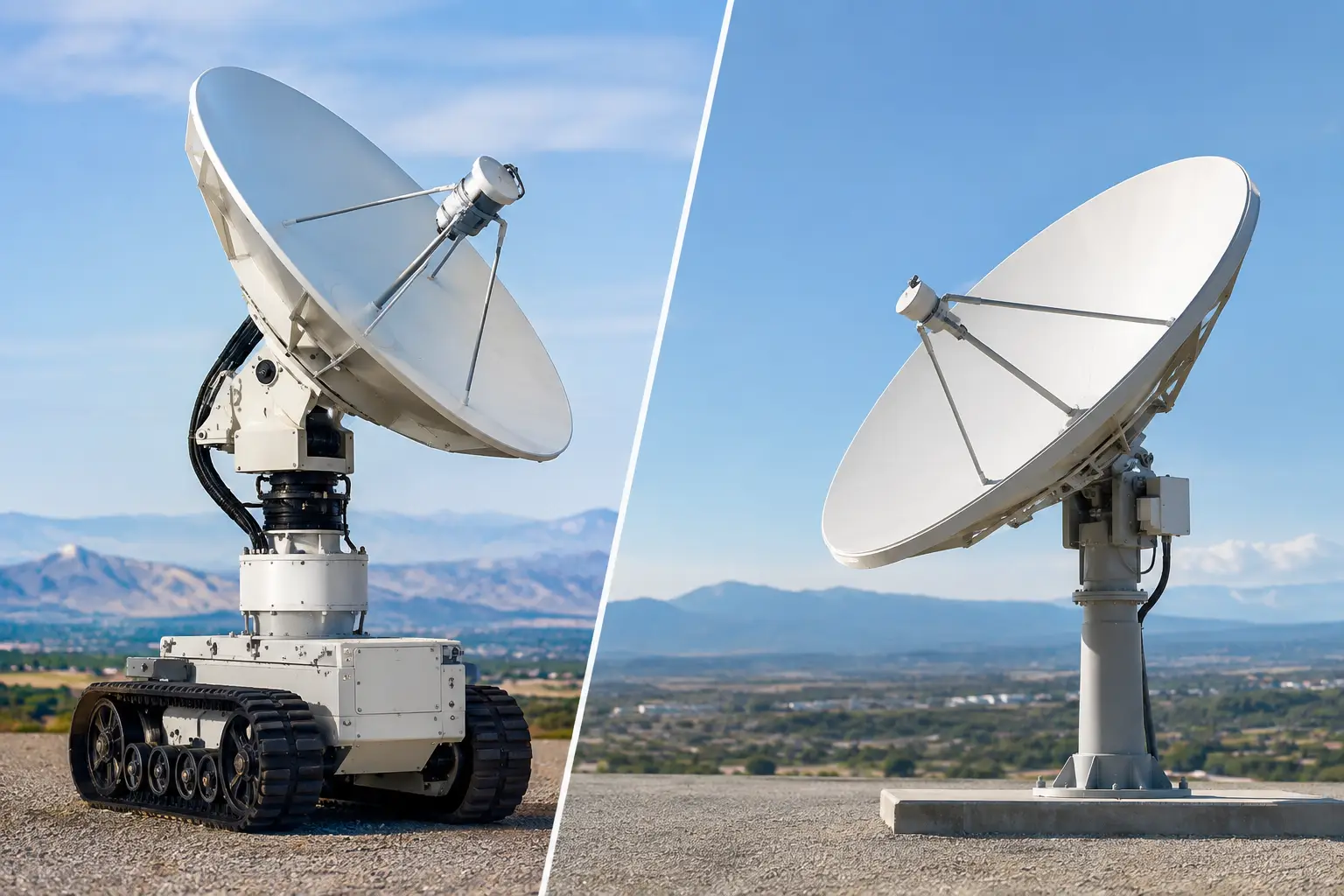
For a remote oil and gas, mining, wind, or utility operation, commercial cellular may not reach the site at all. CBRS can establish the local access network, but the design still needs dependable backhaul. That backhaul may use fiber where available, satellite where geography demands it, or stabilized microwave links where long-range point-to-point capacity is required. The access layer is only as useful as the transport path behind it.
Maritime and mobile deployments add another layer of complexity. A vessel, mobile command unit, or field platform needs more than a radio mounted in a fixed location. Movement, vibration, changing path geometry, weather, and line-of-sight conditions all affect performance. In these environments, antenna selection, stabilization, auto-aiming capability, and network architecture deserve the same attention as the cellular core.
What CBRS adoption requires beyond radios
A CBRS deployment is an engineered communications system, not a collection of small cells. The radio is visible, but the design work determines whether the network produces reliable operational value.
Start with the coverage objective
Coverage planning should identify where devices must work, not merely where a signal can be detected. An acceptable design for intermittent telemetry may not support live video, voice, or remote equipment control. Teams should define the required service area, expected device density, mobility patterns, application throughput, latency tolerance, and availability target before selecting equipment.
Terrain and obstructions must be evaluated early. Buildings, tree cover, metal infrastructure, rock faces, water, and moving equipment can all change the RF environment. At 3.5 GHz, line of sight and antenna height remain significant factors in outdoor performance. A site survey and path analysis can prevent costly assumptions about range.
Design the full network path
Private cellular performance depends on the complete chain: user device, CBRS radio, antenna system, backhaul, core network, application server, and internet or enterprise connection. A high-performing access radio cannot compensate for an undersized backhaul link or an unstable power source.
Network planners should also determine where the private core will reside. Some organizations prefer an on-premises core to keep traffic and control local. Others use a hosted core to reduce site infrastructure. The right choice depends on application criticality, cybersecurity requirements, management resources, and the consequences of a loss of external connectivity.
For distributed operations, local survivability is often a key requirement. If the WAN connection drops, determine which functions must continue at the site. Local voice, video recording, equipment controls, and essential data services may require edge computing or localized network functions rather than reliance on a distant cloud platform.
Plan for SAS coordination and spectrum conditions
CBRS spectrum is shared, which makes SAS integration a central design consideration. General Authorized Access can be an efficient and cost-saving option, but it does not offer the same priority level as a Priority Access License. In locations with higher CBRS activity or where service predictability is especially important, spectrum planning should account for potential channel assignments, power limits, and environmental sensing constraints.
This does not make GAA unsuitable for mission-oriented networks. It means the deployment must be designed with clear expectations. A fixed rural site with limited spectrum contention presents a different risk profile than a dense metro industrial corridor. Experienced planning considers local spectrum conditions before the system is installed, not after performance concerns appear.
Security and device strategy matter
Private LTE and 5G can provide stronger control over authentication and device access than an open or broadly shared Wi-Fi environment. SIM or eSIM-based credentials allow administrators to define which devices belong on the network and to remove access when a device is lost, replaced, or reassigned.
However, private cellular security is not automatic. The network must be integrated with the organization’s segmentation, identity, monitoring, and incident-response practices. Operational technology traffic should not be placed on the same unrestricted segment as contractor devices, office laptops, or guest access. Segmentation policies should reflect operational consequences, not just traditional IT categories.
Device selection is equally important. Not every cellular device supports the necessary CBRS bands, network features, environmental ratings, or management tools. Field tablets, routers, cameras, vehicle gateways, and industrial sensors need to be validated for the specific network design. For demanding environments, power input, connector durability, temperature range, vibration tolerance, and antenna placement can matter as much as modem specifications.
Where CBRS delivers the strongest results
CBRS adoption is gaining traction across sectors where the operating environment makes public connectivity uncertain or Wi-Fi impractical. Construction sites can maintain broadband as trailers, work zones, and site boundaries move. Ports and logistics facilities can support mobile equipment, cameras, and handheld workflows across large outdoor areas. Utilities can connect substations, field crews, and temporary restoration operations.
Public safety and disaster-response organizations can use deployable private cellular systems to restore local communications where commercial infrastructure is damaged or overloaded. Defense and government users can apply the same approach to controlled facilities, training ranges, mobile operations, and temporary command locations, subject to their specific security and spectrum requirements.
The strongest deployments do not force one technology to handle every task. They combine private LTE or 5G access with fiber, microwave, satellite, Wi-Fi, and wired Ethernet where each is most effective. The goal is operational continuity across the entire communications architecture, not loyalty to a single radio technology.
A disciplined path to CBRS adoption
Before committing to hardware, organizations should establish measurable success criteria. Define the service area, supported applications, number and type of endpoints, required uptime, backhaul capacity, cybersecurity controls, and future expansion needs. A pilot can be valuable, provided it reflects real terrain, real devices, and real application traffic rather than a convenient test location.
The next decision is whether the network will be a fixed installation, a rapidly deployable system, or a hybrid of both. Fixed sites may favor permanent towers, sector antennas, and fiber or microwave backhaul. Mobile operations may need compact radios, transportable masts, onboard routing, and auto-aiming stabilized microwave systems that can maintain a long-range connection while the platform moves.
This is where an engineered approach pays off. BATS Wireless designs private connectivity systems around the RF path, mobility profile, backhaul requirements, and operating conditions that define each mission. The right design is not necessarily the one with the most radios. It is the one that maintains useful service when distance, motion, terrain, weather, or infrastructure limitations make ordinary broadband unreliable.
CBRS should be evaluated as an operational tool, not a spectrum trend. Start with the communication failure that costs the most time, money, or safety margin. Then build the private wireless architecture required to remove it.

October 10, 2026

October 10, 2026

October 10, 2026
October 10, 2026
