
Tracked Antennas vs Fixed: Which Fits Your Network?
Compare tracked antennas vs fixed systems for link reliability, mobility, cost, and deployment fit across demanding broadband and microwave networks today.

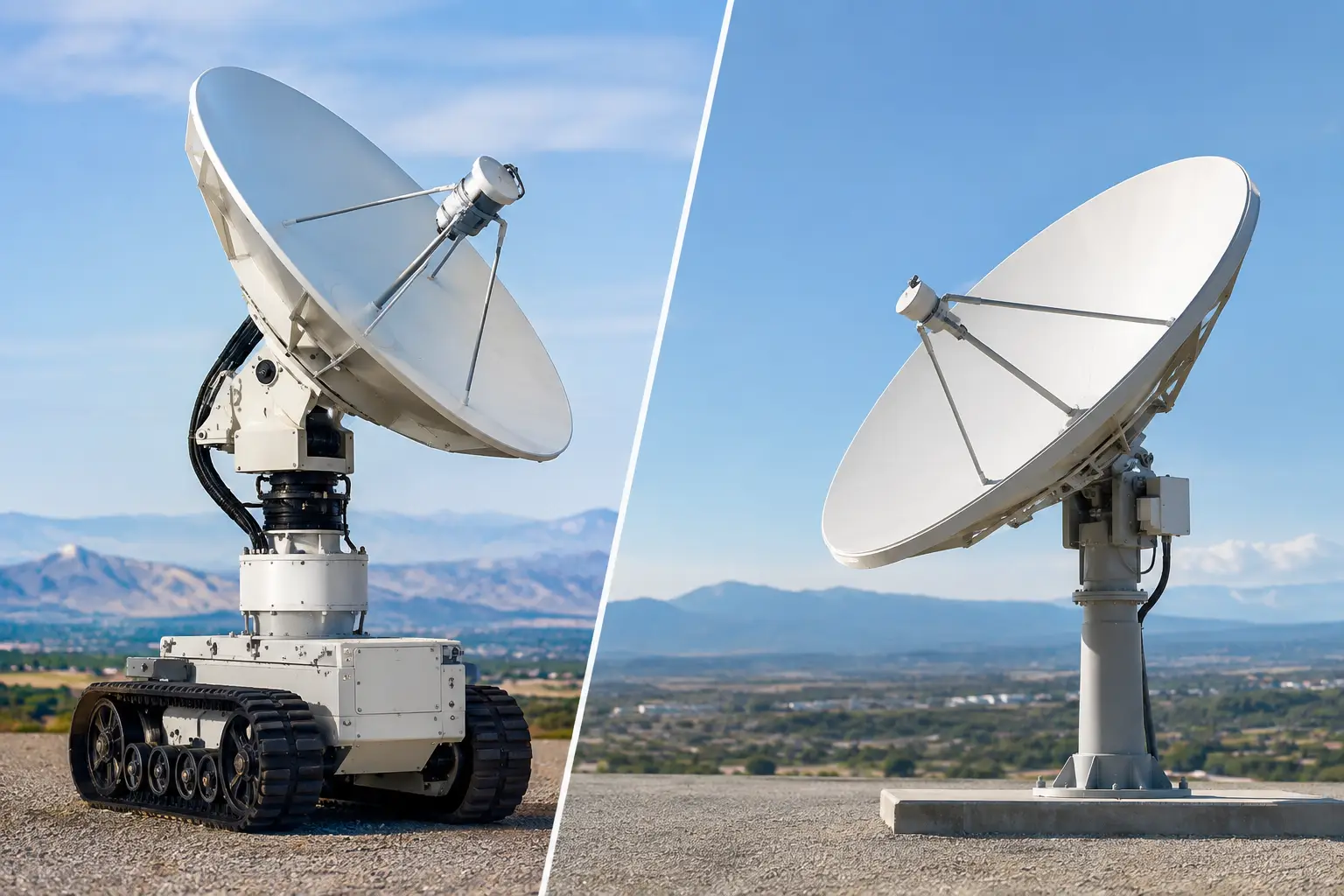
A 40-mile microwave link can look excellent during commissioning and fail the moment the vessel turns, the vehicle changes elevation, or a temporary site shifts its operations. That is the practical decision behind tracked antennas vs fixed systems. The question is not which antenna is more advanced. It is whether the network endpoint, path geometry, and operating environment remain predictable enough for a fixed beam to hold the link.
For mission-critical operations, antenna choice affects more than throughput. It determines how often crews intervene, how much fade margin is truly available, whether a network can support moving assets, and how reliably applications continue to operate beyond conventional broadband coverage.
The Core Difference Between Tracked Antennas and Fixed Systems
A fixed antenna is installed at a known location and aimed toward a known remote endpoint. Once aligned, it remains in that position. This approach is efficient when both sides of the link are stationary and the physical relationship between them is unlikely to change. Point-to-point microwave backhaul between two towers, buildings, or stable industrial sites is a common example.
A tracked antenna continuously or periodically adjusts its pointing direction to maintain alignment with a remote endpoint. Depending on the system and use case, tracking may use GPS position data, heading information, inertial sensors, path calculation, signal-strength feedback, or a combination of these inputs. A stabilized system also compensates for pitch, roll, yaw, vibration, and other motion that would move a narrow beam off target.
That distinction becomes critical as antenna gain increases. Higher-gain directional antennas create narrower beamwidths. A narrow beam can extend range and improve link performance, but it also leaves far less tolerance for movement or pointing error. A few degrees of misalignment may be enough to reduce signal quality, lower modulation rates, or drop the connection entirely.
When a Fixed Antenna Is the Right Engineering Choice
Fixed antennas are not a lesser solution. In the right network architecture, they are often the most cost-effective and dependable option.
A fixed system is well suited to permanent or semi-permanent links where endpoints are stationary, mounting structures are stable, and a clear path can be maintained. Examples include a backhaul connection from a remote facility to a fiber point of presence, connectivity across an industrial campus, a fixed private LTE or 5G backhaul link, or communications between stable offshore and shore-side assets.
The primary advantages are straightforward. Fixed systems generally require fewer moving components, less control hardware, and less installation complexity. They can be easier to commission, maintain, and troubleshoot. When the path is clear and the mounting structure does not move, a correctly engineered fixed link can deliver excellent availability and capacity.
The limitation is equally straightforward: the antenna can only serve the direction in which it is pointed. If the remote endpoint moves, or if the antenna platform moves, the link depends on beamwidth and mechanical tolerance rather than active correction. A wider-beam antenna may tolerate modest motion, but it sacrifices gain and can reduce usable range or data capacity.
Fixed antennas can also become operationally expensive when a “temporary” site moves frequently. Re-aiming a link by sending personnel into the field may be acceptable once or twice. It becomes a recurring cost, delay, and safety consideration when locations change weekly or daily.
Why Tracked Antennas Matter in Mobile Operations
Tracked antenna systems are designed for operations where the endpoint relationship changes by design. They maintain a directional wireless path while a vehicle, vessel, aircraft, or mobile command asset moves relative to the network.
For a maritime operator, the challenge is not simply vessel movement across the water. The antenna platform is also affected by heading changes, wave motion, roll, pitch, and vibration. For ground vehicles, terrain, turns, suspension movement, and changing distance from the base site all affect pointing accuracy. In ground-to-air communications, geometry changes rapidly and demands precise path calculation and responsive control.
An auto-aiming antenna replaces manual alignment with a system that knows where it is, calculates where the remote endpoint should be, and corrects its position as conditions change. This permits the use of high-gain directional antennas in situations where manual aiming would be impractical or impossible.
The business value is operational continuity. A well-designed tracked system can maintain broadband backhaul to mobile assets, support onboard networks, extend private LTE or 5G coverage, and carry voice, video, telemetry, and operational data over long distances. It also reduces the dependence on personnel to restore alignment after every maneuver or relocation.
Tracked Antennas vs Fixed: The Trade-Offs That Matter
The best choice depends on the entire link, not just the antenna. Network planners should evaluate movement, range, required throughput, environmental loading, available mounting points, power, spectrum, and the consequence of an outage.
Tracked systems add mechanical and control complexity. Motors, sensors, controllers, cabling, environmental sealing, and integration with radios must all be engineered for the deployment. The initial investment is typically higher than for a comparable fixed antenna installation. For a static point-to-point path, that extra capability may provide little return.
However, comparing equipment prices alone can produce the wrong result. If a fixed link requires repeated field visits, manual repointing, link recovery after motion, or lower-gain antennas to accommodate path variation, its lifetime cost can exceed the cost of an automated solution. The correct comparison includes truck rolls, vessel crew time, downtime, safety exposure, lost production, and the cost of using alternative connectivity when the primary link is unavailable.
Tracking performance also depends on the quality of the system design. A tracker must respond quickly enough for the platform motion, but it must not hunt or overcorrect. It needs accurate position and heading inputs, calibrated offsets between sensors and antenna boresight, and stable integration with the selected radio. A high-quality antenna positioner cannot compensate for an obstructed Fresnel zone, an undersized radio link budget, or poor spectrum planning.
Stabilization Is Not Optional on Moving Platforms
Tracking and stabilization are related but distinct capabilities. Tracking follows the changing position of the remote endpoint. Stabilization counters the local movement of the antenna platform.
A vessel may remain nearly stationary relative to shore while still experiencing continuous roll and pitch. A tracked-only approach that responds mainly to GPS position may not correct fast enough for those movements. Stabilized microwave systems use motion inputs to keep the antenna pointed where it needs to be as the platform moves beneath it.
This is particularly relevant when operating high-frequency microwave links with narrow beamwidths. The performance benefit of high gain is valuable for long-range connectivity, but high gain requires better pointing accuracy. Stabilization protects that accuracy under real field conditions rather than idealized site assumptions.
Environmental engineering matters as much as control logic. Marine salt exposure, wind loading, shock, temperature swings, dust, and vibration affect mechanical systems over time. For industrial, defense, maritime, and public safety deployments, the tracker and its installation must be specified as a complete operational assembly, including enclosure protection, cable management, grounding, mounting, and power design.
Design the Link Around the Mission
A practical design process starts with the asset and mission profile. Is the endpoint fixed, periodically relocated, or continuously moving? Does movement occur slowly over a known route, or rapidly in three dimensions? What data must remain available during motion? Is a short interruption acceptable, or does the link support safety, command, remote control, or live video?
Next, examine the RF path. Engineers should model range, terrain or sea-state effects, Fresnel clearance, antenna gain, modulation requirements, interference exposure, and rain fade where relevant. The goal is not to achieve a link on a calm test day. The goal is to preserve usable performance under expected operating conditions.
Radio compatibility should be addressed early. The antenna, positioner, modem or radio, network architecture, and control interface must work together. An integrated approach simplifies commissioning and gives operations teams a clearer support path when a link needs adjustment or expansion.
For some deployments, the right answer is a hybrid design. A fixed high-capacity link may serve a primary facility, while tracked terminals maintain connectivity to moving vessels, mobile command posts, construction equipment, or temporary field sites. Private 4G or 5G can provide local access coverage, with microwave or other long-range wireless systems delivering the backhaul. Each layer serves a different part of the operational requirement.
Questions Procurement and Network Teams Should Ask
Before selecting either architecture, teams should establish measurable requirements rather than relying on broad claims about range or mobility. Useful questions include:
- What movement must the system accommodate, including roll, pitch, heading changes, and relocation frequency?
- What minimum throughput, latency, and availability are required during normal and degraded conditions?
- What beamwidth and gain are needed to close the link with adequate fade margin?
- Which radios, frequencies, network interfaces, and security requirements must the system support?
- What field maintenance, remote monitoring, spares, and technical support model will keep the system operational?
These questions move the decision from a product comparison to an engineering decision. They also expose where a lower initial-cost fixed system may introduce recurring operational cost, or where a tracked system may be unnecessary complexity.
For BATS Wireless customers, the objective is not to place a tracker on every link. It is to match auto-aiming, stabilized microwave, integrated radio, and private network capabilities to the conditions the operation will actually face. A fixed antenna remains the right tool for a stable path. When the path moves, an engineered tracked system turns mobility from a recurring connectivity problem into a manageable network design condition.
October 25, 2026

October 25, 2026

October 25, 2026
October 25, 2026
