
5G Backhaul for Remote Sites That Works
5G backhaul for remote sites requires more than signal. Learn what drives uptime, capacity, and range in harsh, mobile, and rural deployments.

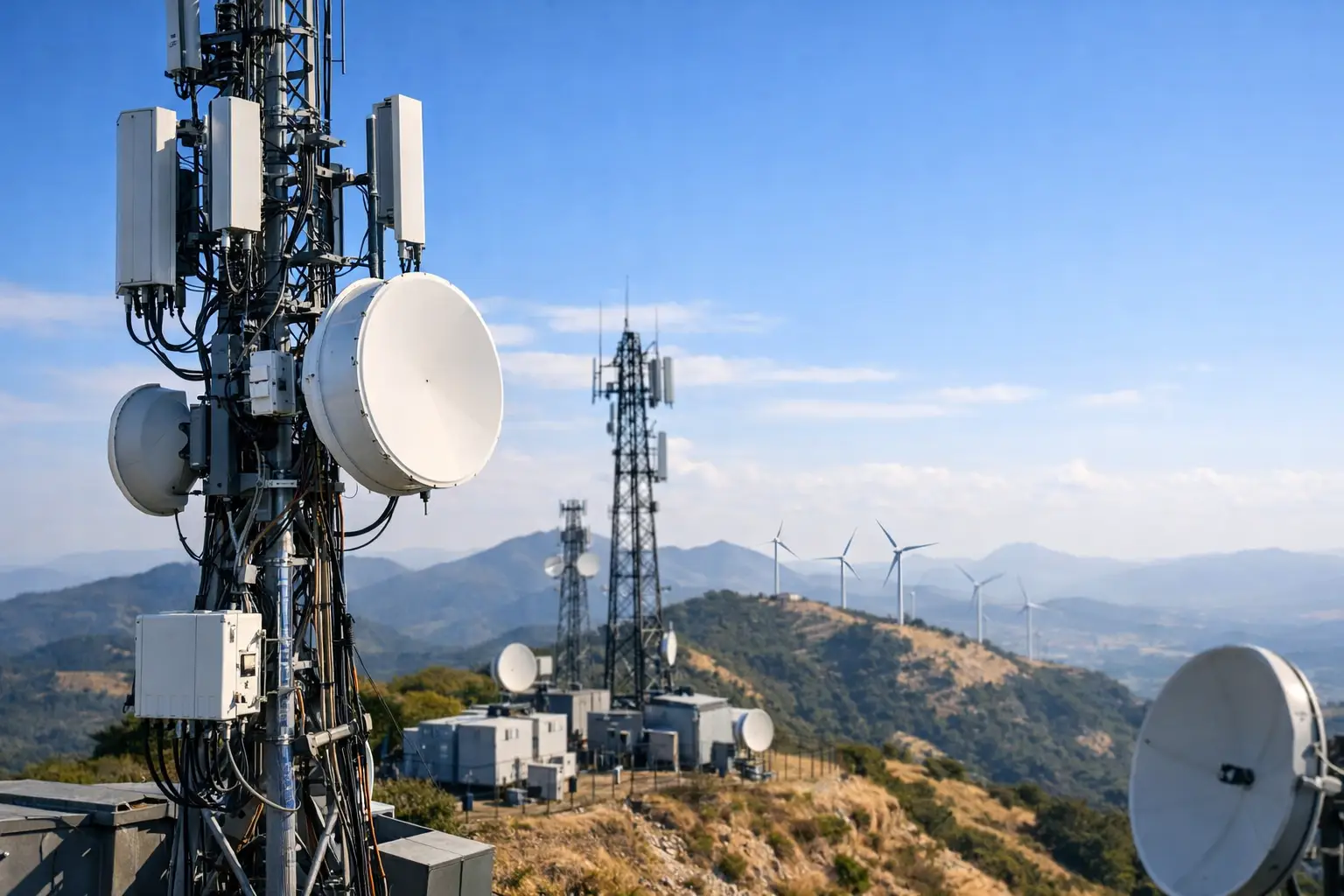
A remote drill pad, forward operating base, wind farm, or temporary command post usually fails at the same point – not the radios at the edge, but the path that carries traffic back to the core. That is why 5g backhaul for remote sites has become a design priority, not a procurement afterthought. When fiber is unavailable, delayed, or too expensive to extend, the backhaul architecture determines whether the site performs like a connected operation or a disconnected outpost.
Why 5G backhaul for remote sites is a different engineering problem
Remote sites are rarely static, forgiving, or bandwidth-light. They sit behind terrain, outside dense carrier footprint, or in sectors where uptime matters more than headline speed. Oil and gas operators need communications that survive weather and distance. Public safety teams need rapidly deployable links that hold under pressure. Defense and maritime environments add movement, vibration, and line-of-sight instability.
That changes the question from Can we get a signal there to What transport method will hold performance over time? In many deployments, 5G at the site edge is the easy part. The hard part is maintaining a predictable path from that edge network back to the data center, cloud gateway, or command infrastructure.
A workable design usually balances four variables: throughput, latency, availability, and deployment practicality. Push too hard on one and another gives way. High-capacity microwave can outperform carrier service in isolated areas, but only if path engineering is done correctly. Satellite can reach almost anywhere, but latency and recurring cost may not fit the application. Commercial cellular backhaul may be fast to activate, yet coverage inconsistency can make it a weak primary option for mission-critical use.
The main backhaul architectures in remote 5G deployments
There is no single best answer for 5G backhaul for remote sites. The right architecture depends on geography, mobility, site life span, traffic profile, and operational risk.
Microwave and millimeter wave
For many fixed and semi-fixed remote locations, licensed or lightly licensed microwave remains one of the strongest options. It offers high capacity, low latency, and control over the transport layer. In places where fiber trenching is unrealistic, a well-engineered microwave link can deliver carrier-grade performance without waiting on local infrastructure development.
The trade-off is path dependency. Microwave needs line of sight, stable mounting, and proper fade margin planning. In mountain regions, coastal environments, and heavy rain zones, path calculations matter. If the site is mobile or subject to constant movement, stabilized microwave systems and auto-aiming capability become central to maintaining link quality.
Millimeter wave can deliver very high throughput, but distance and environmental tolerance are tighter. It is often best where remote does not mean extremely far, but where fast deployment and high capacity are needed between known points.
Commercial cellular as transport
In some cases, the backhaul path for a remote site is another cellular network. This can be practical for temporary sites, early project phases, or failover designs. It reduces time to service and avoids major infrastructure work.
But this approach depends on external network conditions you do not control. Sector congestion, changing radio conditions, and policy limits can affect real-world performance. For lower-priority traffic, that may be acceptable. For private 5G, industrial video, SCADA, or command communications, it often needs to be paired with a more deterministic transport option.
Satellite backhaul
Satellite remains relevant because some sites are beyond practical terrestrial reach. For isolated operations, maritime deployments, and emergency response, it can be the only realistic way to establish wide-area connectivity quickly.
The trade-offs are familiar but still significant. Latency can affect application behavior, especially for real-time control and voice. Capacity pricing can make sustained high-throughput use expensive. Weather and terminal stability also shape performance. Satellite works best when teams design around those constraints rather than treating it as a drop-in replacement for terrestrial backhaul.
Hybrid backhaul
In high-stakes environments, hybrid design is often the right answer. Microwave for primary transport, cellular for rapid backup, or satellite for tertiary continuity can give remote sites a more resilient profile. This is especially useful where downtime costs more than added architecture complexity.
Hybrid systems also let operators match traffic to path quality. Critical operational data can stay on the lowest-latency link, while less sensitive traffic uses secondary transport. That improves service continuity without overbuilding every part of the network.
What actually determines performance in the field
Spec sheets do not explain why one remote deployment stays stable and another spends months in troubleshooting. Field performance comes from system design choices that are easy to underestimate during procurement.
Antenna strategy is one of them. Gain, beamwidth, mounting height, alignment tolerance, and tracking capability all affect usable throughput and uptime. In fixed installations, poor alignment or marginal line of sight can quietly reduce network quality long before the link drops entirely. In mobile or unstable environments, static antennas can become the weak point very quickly.
Power planning matters just as much. Remote sites often run from generators, solar, battery systems, or mixed sources. Backhaul equipment has to fit power budgets and survive fluctuating conditions. A technically strong link that demands unrealistic site power is not a practical design.
Environmental hardening is another dividing line. Wind loading, salt exposure, vibration, dust, and temperature swings all change long-term performance. Ruggedized hardware is not just about surviving the first month. It is about maintaining alignment, protecting connectors, and keeping radios within operating tolerance over years of use.
Then there is interoperability. A remote 5G network may involve private LTE, private 5G, onboard Wi-Fi, video systems, edge compute, and legacy industrial traffic. The backhaul layer needs to support that stack cleanly. Compatibility with integrated radios, routing platforms, and sector-specific systems is often more valuable than raw headline throughput.
Common mistakes in 5G backhaul design for remote sites
The most common mistake is treating backhaul as a commodity transport decision. Remote environments punish generic assumptions. A low-cost radio path that looks viable on paper can fail due to vibration, obstruction growth, or mounting instability. A carrier service with good map coverage can underperform during peak operational windows.
Another mistake is underestimating installation precision. Remote links often work inside narrow engineering margins. Small errors in path assessment, Fresnel clearance, tower rigidity, or antenna selection can have outsized effects. This is why deployment experience matters. The system has to be engineered for the actual site, not a clean lab model.
Short project timelines can also push teams toward temporary solutions that become permanent. That is sometimes necessary, but it should be an explicit decision. If a site will scale from low-bandwidth telemetry to multi-service private 5G, the backhaul plan should account for that from the start. Otherwise, the upgrade path becomes more expensive than doing the architecture correctly the first time.
Where 5G backhaul for remote sites delivers the most value
The value is clearest where connectivity supports operations that cannot pause. Construction and infrastructure projects need broadband before permanent utilities arrive. Wind farms and aquaculture sites need transport that reaches dispersed assets without waiting on rural fiber builds. Public safety teams need deployable communications that can be established quickly and hold under incident conditions.
Maritime and defense use cases add another layer. Here, remote may also mean moving. Stabilized microwave systems, tracking capability, and engineered antenna performance become essential because connectivity has to persist despite motion and changing orientation. That is where a solution-led approach separates itself from commodity networking equipment.
BATS Wireless operates in this part of the market for a reason. In difficult environments, the difference is rarely one component. It is how antenna engineering, auto-aiming, path calculation, radio integration, and field deployment discipline work together as one system.
How buyers should evaluate vendors and designs
Start with the operational requirement, not the transport label. Ask what applications must function during degraded conditions, how much latency they can tolerate, and what outage window is actually acceptable. That usually narrows the backhaul options quickly.
Then look at deployment realism. Can the vendor account for terrain, mast behavior, mobility, power limitations, and environmental exposure? Can they support phased builds, backup paths, and integration with private 4G or 5G infrastructure? These questions are more useful than broad claims about speed.
Finally, examine lifecycle support. Remote networks are not set-and-forget systems. They require monitoring, maintenance planning, and a practical approach to expansion. The best design is the one that continues to perform after the project team leaves the site.
Remote connectivity is often judged by whether users see bars or bandwidth. Operators know better. The real test is whether the backhaul keeps the site usable when conditions turn against it, because that is the moment the network starts proving its value.
September 20, 2026

September 20, 2026

September 20, 2026
September 20, 2026
