
Wireless Backhaul for Construction Sites
Wireless backhaul for construction sites delivers fast, reliable connectivity for cameras, trailers, crews, and private LTE/5G where fiber is too slow.

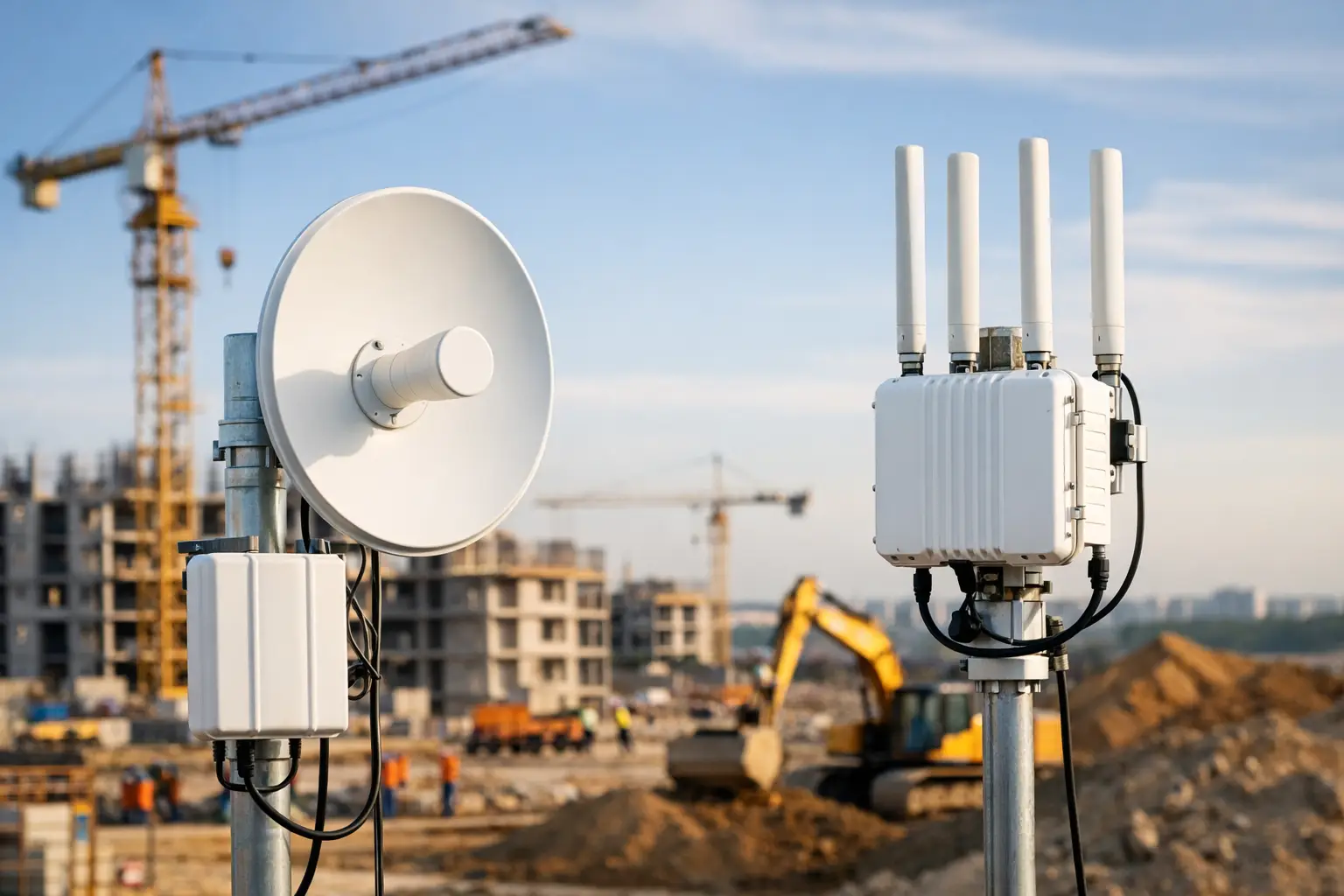
A project trailer with no broadband is more than an inconvenience. It slows document access, weakens camera coverage, disrupts subcontractor coordination, and turns every connected system on site into a workaround. That is why wireless backhaul for construction sites has moved from a temporary fix to a core part of jobsite network design.
Construction teams rarely have the luxury of fixed telecom infrastructure arriving on schedule. Fiber may be months out. Cable may stop at the road. Cellular service may look acceptable in a parking lot and fail once steel, concrete, cranes, and elevation changes shape the RF environment. In that gap, backhaul becomes the difference between a connected site and a blind one.
Why wireless backhaul for construction sites is now a design priority
Modern construction sites depend on far more than email and internet access. Schedules, BIM files, telematics, access control, environmental sensors, safety systems, and surveillance all compete for bandwidth. Many sites also need to support private LTE or private 5G to connect personnel, vehicles, and equipment across a dynamic footprint.
The challenge is not just bandwidth. It is continuity. A construction site changes every week. Structures rise, materials move, and line-of-sight conditions that looked clear during mobilization can degrade quickly. A backhaul design that works on day one but fails after structural steel goes up is not an engineered solution. It is a short-lived installation.
This is where a purpose-built wireless system matters. The backhaul layer must be designed around distance, elevation, obstruction risk, required uptime, and the applications riding over it. For some sites, a short-hop point-to-point link is enough. For others, especially large civil works, industrial projects, ports, or distributed developments, the network may require multiple relay points, sector coverage, and integration with private wireless infrastructure.
What a construction backhaul system actually needs to support
At a minimum, the backhaul connection has to carry predictable business traffic and unpredictable operational demand. Project managers may need cloud applications and VoIP during business hours, while the security team depends on high-bitrate video at all times. If the site is running connected access control, worker welfare systems, fuel monitoring, or autonomous equipment trials, the traffic profile becomes even more demanding.
Latency also matters more than many buyers expect. If the backhaul path is supporting real-time video monitoring, push-to-talk over LTE, equipment control, or edge applications, raw throughput alone is not enough. Jitter and packet loss can turn a technically connected site into an operationally unreliable one.
A strong design also considers how the site will expand. Early-phase construction may only need a trailer, a few cameras, and Wi-Fi coverage. Six months later, the same project may need connectivity for multiple compounds, perimeter monitoring, gatehouses, subcontractor offices, and connected plant. Wireless backhaul should be sized for that evolution, not just the first invoiceable milestone.
The main architectures used for wireless backhaul for construction sites
The right architecture depends on geography, project duration, and application load. There is no single best template.
Point-to-point microwave or millimeter wave links are often the most efficient option when there is clean line of sight to an aggregation point or nearby building with fiber. They can provide high throughput, low latency, and rapid deployment without trenching. They are especially effective for urban projects where an existing rooftop, office, or facility can serve as the network handoff.
Point-to-multipoint designs make sense when one upstream node must serve several site zones or remote compounds. This approach can reduce civil work and speed expansion, but capacity planning becomes more critical. Shared sectors can be highly effective, though they need to be engineered around contention, growth, and RF overlap.
Private LTE and private 5G backhaul models are increasingly relevant on larger sites. In these deployments, the backhaul is not the end service. It is the transport layer feeding the private network core or radio access infrastructure. That changes the design criteria. Uplink resilience, synchronization, traffic prioritization, and interoperability with radios and edge systems become central.
Temporary does not mean simple. A temporary construction deployment may need the same discipline as a fixed industrial network, especially where safety, compliance, and security monitoring are involved.
Site conditions that change the engineering approach
Line of sight is the obvious variable, but it is not the only one. Crane movement, dust, vibration, power instability, and weather exposure all affect equipment performance and mounting strategy. A radio installed on a lightly braced pole at a busy site may pass an initial link test and still underperform once wind load and vibration increase.
Elevation can help or hurt. Higher placements improve path clearance, but they also increase exposure and maintenance complexity. In some cases, mounting to a temporary tower or stable structure is preferable to using the tallest available point.
Spectrum selection is another trade-off. Higher-frequency links can deliver excellent throughput, but they are generally less tolerant of path obstruction and weather than lower-frequency options. Lower bands may offer better resilience over difficult paths, though often with capacity constraints or licensing considerations. The right answer depends on required service levels, path length, and environmental conditions.
Power planning is often overlooked. If the site power source is unstable, a well-designed backhaul link can still fail at the edges. Battery backup, surge protection, and remote monitoring should be treated as part of the network, not accessories.
Where standard broadband solutions fall short
Consumer-grade routers and basic mobile hotspots are common in early project phases because they are easy to procure. They are also common sources of avoidable failure.
Cellular-only approaches can work for light administrative traffic, but they are difficult to scale for camera fleets, private wireless infrastructure, or multi-zone operations. Performance varies by carrier loading, terrain, and local congestion. On a site with steel framing, containerized offices, and moving machinery, indoor signal quality can drop quickly.
Standard fixed wireless products can also disappoint when they are deployed without path analysis, antenna alignment discipline, or a realistic growth model. Construction is a harsh RF environment. Equipment selection, mounting geometry, fade margin, and network management all matter. The lowest-cost hardware rarely delivers the lowest total cost once outages, truck rolls, and rework are factored in.
This is why engineered systems have an advantage. Buyers in construction are not just procuring bandwidth. They are procuring operational continuity.
What to evaluate before selecting a provider
The first question is whether the provider understands dynamic environments. A static office building and an active jobsite are not the same design problem. Buyers should look for experience in mobile, industrial, and obstruction-prone deployments where performance has to be maintained as conditions change.
The second question is compatibility. Construction sites often combine multiple vendors across cameras, routers, LTE or 5G infrastructure, security platforms, and edge devices. The backhaul system should fit into that ecosystem cleanly. Interoperability with existing radios, power systems, and network management tools reduces deployment risk.
The third question is support. Backhaul for a live construction project is not a ship-and-forget purchase. It may need path redesign, relocation, capacity changes, or temporary expansion as the build progresses. Providers that can pair hardware with engineering, commissioning, and ongoing technical support are usually better positioned to keep the site connected over the full project lifecycle.
For buyers operating in difficult terrain or fast-changing layouts, advanced capabilities such as auto-aiming, path calculation, and stabilized microwave systems can materially improve performance and reduce maintenance burden. That is especially true where assets move, where mounting positions are less than ideal, or where rapid redeployment is part of the operating model.
The business case is stronger than trenching in many scenarios
Fiber remains the preferred long-term option where it is available, affordable, and aligned with the construction schedule. But many projects do not have those conditions. Trenching is expensive, permitting can delay activation, and temporary civil work often has poor payback on short or mid-duration jobs.
Wireless backhaul offers a cost-saving solution when time-to-service matters as much as monthly recurring cost. It can be deployed quickly, reconfigured as the site expands, and in many cases relocated to the next project. For contractors managing multiple active builds, that reusability improves the economics.
There are trade-offs. Wireless systems require careful RF planning, proper mounting, and active monitoring. They are not immune to obstruction, interference, or weather effects. But when designed correctly, they provide a practical and high-performance alternative to waiting on wireline infrastructure that may arrive too late to support the job.
BATS Wireless works in exactly these kinds of environments, where connectivity has to perform under changing field conditions rather than ideal assumptions.
The smartest construction networks are built with the jobsite in mind, not copied from office IT standards. If the site is temporary, remote, fast-moving, or expected to support private wireless services, backhaul deserves early engineering attention. Waiting until applications start failing is the most expensive way to discover what the network should have been from the start.

October 10, 2026

October 10, 2026

October 10, 2026

October 10, 2026
