
Private 5G vs LTE: Which Fits Your Site?
Private 5G vs LTE for industrial and mission-critical sites: compare coverage, latency, device support, cost, and deployment trade-offs.

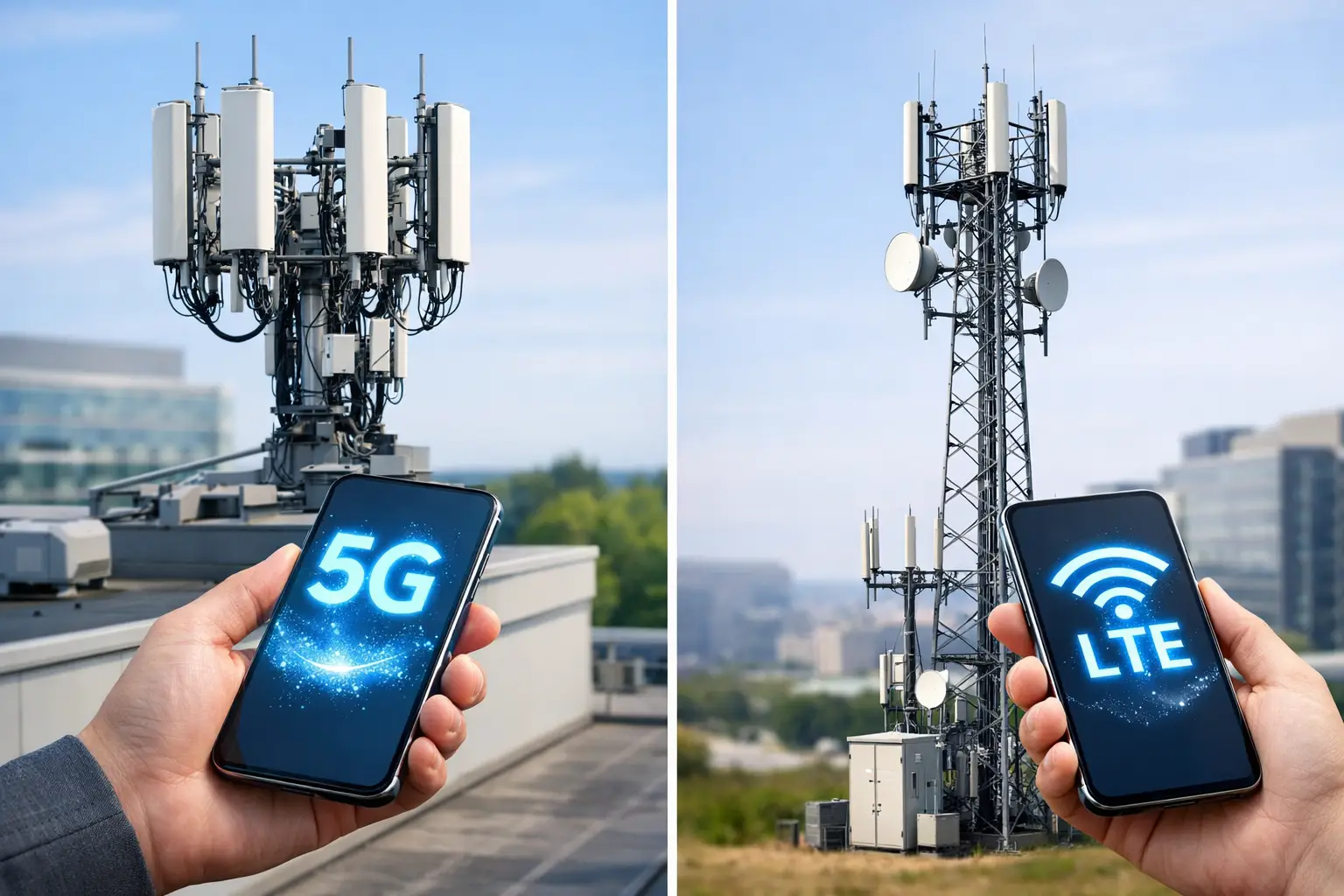
When a remote terminal, vessel, substation, or field operation loses connectivity, the debate over private 5G vs LTE stops being theoretical. It becomes an operational decision with real consequences for uptime, safety, and response time. For most enterprise and mission-critical buyers, the right answer is not the newest standard. It is the network architecture that matches the environment, traffic profile, mobility pattern, and budget.
That is where the conversation needs more precision. Private LTE is proven, widely supported, and often the fastest path to dependable coverage across large industrial footprints. Private 5G brings higher capacity, lower latency potential, and a stronger roadmap for advanced automation, but it also introduces more design complexity and, in some cases, higher cost at the edge. If you are planning connectivity for a port, campus, mine, plant, public safety deployment, or offshore asset, the better question is not which technology sounds more advanced. It is which one will perform under your actual conditions.
Private 5G vs LTE starts with the use case
The most common mistake in private network planning is starting with the radio standard instead of the operational requirement. A utility with dispersed assets and relatively modest data demand has a very different need than a manufacturing site running machine vision and autonomous vehicles. A maritime operator covering moving assets and steel-heavy onboard environments is solving a different RF problem than a warehouse distribution center.
Private LTE remains a strong fit when broad area coverage, device maturity, and predictable economics matter most. It is particularly effective for telemetry, push-to-talk, video backhaul, SCADA support, workforce mobility, and general industrial broadband. LTE also benefits from a mature ecosystem of user equipment, modules, routers, and deployment experience. In many field environments, that maturity reduces integration risk.
Private 5G becomes more compelling when the application genuinely needs higher throughput density, lower latency, stronger traffic segmentation, or future support for advanced edge-driven workloads. That may include real-time analytics, robotics, automated guided vehicles, machine control, or dense sensor environments where LTE starts to show limits. In those scenarios, 5G is not just a faster radio. It is part of a broader architecture decision.
Coverage and propagation: LTE often wins the first phase
Coverage is still where many private LTE deployments make their case. In lower or mid-band spectrum, LTE can deliver efficient wide-area coverage with fewer radios, which matters on large industrial sites, linear corridors, remote facilities, and temporary operations. Fewer infrastructure points can translate into lower power requirements, less civil work, and faster deployment.
That advantage is especially relevant in rugged environments where every mast, enclosure, and backhaul node adds cost and maintenance overhead. If the requirement is reliable connectivity across a refinery perimeter, a port yard, a wildfire response zone, or an oil and gas field, LTE often gives operators more practical reach per node.
Private 5G can also deliver excellent coverage, but the answer depends heavily on spectrum strategy. If you are using higher frequencies to achieve capacity, propagation challenges increase and site density tends to rise. That is manageable in a controlled campus or factory, but harder in distributed outdoor deployments. In other words, 5G can outperform LTE in the right RF plan, but it does not erase basic physics.
Capacity and latency: where private 5G pulls ahead
If your environment supports the design and budget, private 5G has a clear edge in capacity headroom and latency potential. That matters where many devices compete for bandwidth, where uplink performance matters, or where real-time response is tied to production efficiency or safety.
A modern industrial facility may be carrying HD video, autonomous equipment data, voice, environmental sensors, and enterprise traffic at the same time. LTE can support a lot of this mix, but as concurrency and application sensitivity increase, 5G offers more room to engineer predictable performance. It also provides a stronger long-term foundation for network slicing, deterministic service strategies, and edge compute integration.
Still, buyers should be careful with headline claims. The theoretical benefits of 5G do not automatically appear in every deployment. Core design, spectrum availability, backhaul quality, antenna placement, and endpoint capability all shape actual results. A poorly designed private 5G network can underperform a well-engineered LTE system. In mission-critical environments, design discipline matters more than marketing language.
Device ecosystem and interoperability still matter
One reason LTE remains attractive is ecosystem maturity. Industrial routers, gateways, sensors, handhelds, onboard systems, and embedded modules are broadly available and well understood. For organizations with mixed fleets or legacy operational technology, LTE often provides a smoother migration path.
This becomes important in sectors where equipment lifecycles are long. Utilities, transportation operators, government agencies, and offshore operators do not refresh devices on consumer timelines. They need radios and endpoints that work reliably, integrate with existing systems, and remain supportable over time.
Private 5G device support is improving quickly, but buyers should still check interoperability in detail. Not every device supports the needed bands, power profiles, mobility behavior, or software features. If your deployment relies on specialized field equipment, onboard communications, or ruggedized edge hardware, the practical device roadmap may influence the network choice more than raw radio performance.
Cost is not just capex
Budget discussions around private 5G vs LTE often focus too narrowly on initial equipment cost. The real comparison should include radio density, edge compute requirements, core architecture, integration effort, spectrum access, installation conditions, and long-term support.
Private LTE often delivers lower total project friction, particularly for wide-area outdoor sites or operations that need straightforward broadband with solid mobility. The lower complexity can shorten deployment schedules and reduce the operational burden on internal teams.
Private 5G may justify higher investment if it supports measurable gains in automation, production output, safety response, or workforce efficiency. If ultra-low latency enables machine control improvements or if higher capacity eliminates bottlenecks in a critical process, the business case can be strong. But if your traffic profile does not require those gains, 5G can become an expensive answer to the wrong problem.
Mobility, backhaul, and harsh environments
In real-world deployments, the access network is only part of the picture. Mobile assets, vessel movement, terrain changes, obstructed line of sight, and unstable public infrastructure can all affect performance more than the radio standard itself.
That is why engineered private wireless solutions matter. A private network in a fixed warehouse is one design problem. A network supporting maritime operations, temporary command posts, field construction, or remote industrial zones is another. In those environments, antenna engineering, path calculation, adaptive wireless links, and backhaul resilience are often the difference between a working system and a paper design.
This is where experienced providers such as BATS Wireless bring value beyond the core cellular stack. Auto-aiming systems, stabilized microwave systems, integrated radios, and practical field deployment knowledge can determine whether LTE or 5G performs consistently when assets move or weather conditions shift. For many operational buyers, that systems-level view is more valuable than choosing a standard in isolation.
How to choose between private 5G and LTE
The most effective way to decide is to map the network to four realities: coverage area, application sensitivity, device ecosystem, and lifecycle cost. If you need broad reliable coverage, mature hardware support, and a lower-risk rollout, private LTE is often the right first move. If you need higher device density, lower latency targets, and a platform for advanced automation, private 5G deserves serious consideration.
There is also a middle path. Many organizations do not need an all-or-nothing answer. LTE can serve as the dependable coverage layer across the wider site, while 5G is introduced in targeted zones where performance demands justify it. That hybrid model can reduce cost, preserve compatibility, and give operators a clearer upgrade path over time.
For mission-critical operations, the smartest decision is usually the one that fits current conditions without closing off future options. The network should be engineered around operational continuity first, then scaled for growth. If your team starts with that discipline, the private wireless choice becomes much clearer – and much more likely to deliver in the field.

October 11, 2026

October 11, 2026

October 11, 2026

October 11, 2026
