
Designing Antenna Tracking Networks Right
Designing antenna tracking networks for mobile, harsh, and remote operations requires precise RF planning, control logic, and field-ready integration.

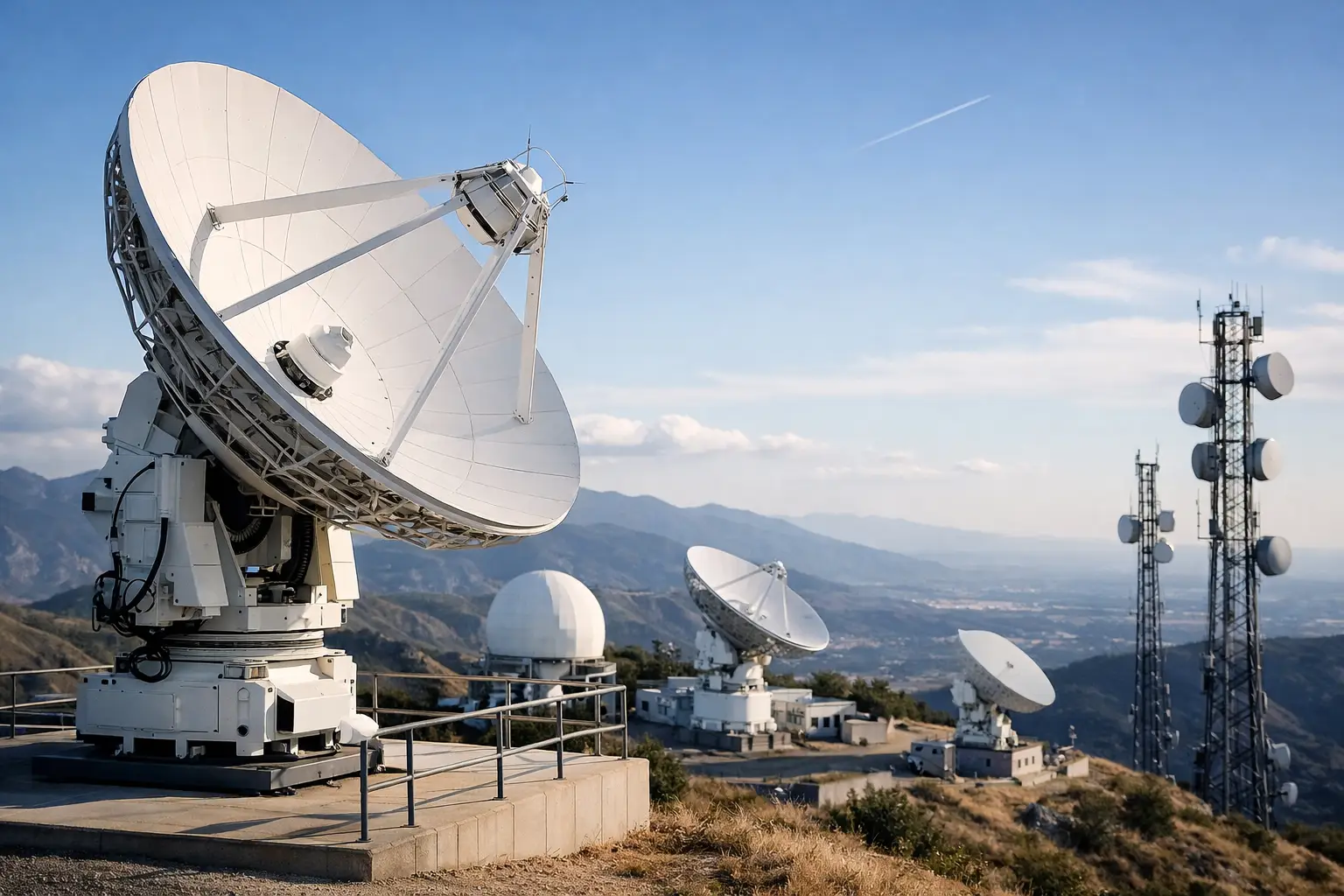
A tracking link that looks perfect on a lab bench can fail fast in the field. The usual cause is not a single bad component. It is a network design that underestimates motion, latency, interference, power constraints, or the simple fact that antennas, radios, and control systems have to perform as one operational system. That is the real challenge in designing antenna tracking networks.
For defense, maritime, public safety, oil and gas, and industrial deployments, the objective is not just signal acquisition. It is maintaining usable throughput, low enough jitter, and predictable link behavior while one or both ends are moving, weather is changing, and terrain or sea state is working against the path. A tracking network has to do more than point accurately. It has to support the mission.
What designing antenna tracking networks really involves
At a high level, antenna tracking is straightforward. A directional antenna follows a moving or repositioning target so the link stays aligned. In practice, the network only works if the mechanics, RF design, tracking logic, and IP architecture are engineered together.
That means starting with the actual operating environment rather than a generic coverage map. A vessel tracking shore, a command vehicle linking to a mobile mast, and an air-to-ground platform all place different demands on update rate, beamwidth, stabilization, and failover behavior. The narrower the beam and the higher the frequency, the tighter the pointing tolerance. That can improve capacity, but it also reduces margin for motion error and installation deviation.
A common mistake is treating the antenna tracker as an accessory attached to the radio. In mission-critical systems, it is part of the network core. Pointing data, GPS input, inertial stabilization, path calculations, radio configuration, and switching logic all affect service continuity. If one layer is loosely integrated, the entire link becomes less predictable.
Start with the motion model, not the equipment list
The first design question is how the endpoint moves. Is movement smooth and mostly linear, or does it involve pitch, roll, yaw, vibration, and abrupt directional changes? A patrol boat in coastal water behaves differently from a survey vessel offshore. A ground vehicle moving through open desert presents a different problem than one operating in urban canyons.
This motion model drives tracker selection and network topology. In low-dynamic environments, GPS-based auto-aiming with periodic correction may be enough. In higher-dynamic scenarios, you may need closed-loop tracking, inertial sensors, faster servo response, and tighter coordination between aiming software and radio status. If the link budget is already tight, tracking delay becomes a network problem, not just a mechanical one.
It also affects handoff design. If the mobile node will cross sector boundaries, pass behind structures, or rotate relative to a mast, the tracking network should anticipate temporary path degradation and provide alternate paths or fast reacquisition. Designing around ideal line of sight is rarely sufficient in field conditions.
RF design sets the boundaries
When designing antenna tracking networks, RF planning is where the system becomes realistic. Beamwidth, gain, frequency band, modulation strategy, and fade margin all have to match the intended range and movement profile.
High-gain antennas extend distance and improve spectral efficiency, but they tighten the pointing window. Wider beam antennas are more forgiving, but they sacrifice range and link performance. There is no universal best choice. It depends on whether the operation values persistent connection at moderate throughput or maximum throughput over a narrower geometry.
Frequency choice matters just as much. Microwave and higher-frequency links can deliver substantial capacity, but they are less forgiving in rain, blockage, and motion. Lower bands may provide better propagation and resilience, but often with less bandwidth and more spectrum coordination constraints. In private LTE and 5G architectures, this trade-off often appears in the backhaul layer, where operators want capacity without creating a fragile path.
Interference should also be modeled early. In ports, industrial facilities, and emergency response zones, the RF environment can change quickly. A tracking network that depends on a clean spectrum assumption may pass acceptance testing and still struggle in live operation. Receiver sensitivity, adjacent-channel performance, filtering, and antenna isolation are not background details in these systems. They are design fundamentals.
Control logic and path calculation are where many systems win or lose
Tracking accuracy is not only about hardware precision. The control layer determines whether the antenna moves intelligently or simply reacts after the link starts to drop.
The best-performing systems use location data, heading, speed, and known path geometry to calculate aim points ahead of time, then correct continuously based on sensor input and link state. That predictive behavior matters in mobile operations because lag compounds quickly. If the platform turns, the tracker hesitates, and the radio waits for signal recovery, the user experiences throughput collapse long before the system reports a complete outage.
Path calculation also has to account for mounting offsets, platform geometry, mast flex, and installation tolerances. A mathematically accurate tracker can still miss the target if the physical reference frame is wrong. That is why commissioning matters. Alignment validation, calibration, and operational testing under motion should be treated as part of network design, not post-install cleanup.
Integration with radios and the broader network
Antenna tracking networks are only as effective as their integration with the radio and IP layers. The tracker should not operate independently from the communication system it supports.
Radio compatibility affects everything from control signaling to recovery behavior. Some deployments require direct coordination between tracking status and modulation changes, failover routing, or secondary link activation. Others need integration into private LTE or 5G transport where latency and backhaul consistency matter as much as raw RSSI. If the tracker keeps the antenna aligned but the network takes too long to reroute traffic during a path event, the operational result is still poor.
This is where engineered systems outperform commodity assemblies. A complete design considers power draw, environmental hardening, cable loss, connector reliability, enclosure ratings, network switching, and remote management from the start. In harsh deployments, maintenance access may be limited and downtime expensive. Designing for operational continuity means reducing single points of failure before installation, not after the first field issue.
BATS Wireless typically approaches these environments as complete systems problems rather than isolated hardware selections, which is the right model for buyers managing mobile and mission-critical infrastructure.
Designing antenna tracking networks for harsh environments
Harsh environments expose weak assumptions quickly. Salt spray, temperature swings, vibration, dust, and unstable power all affect link behavior over time. A tracker that performs well in controlled conditions may drift, slow down, or fail intermittently once exposed to marine or industrial stress.
That is why environmental design has to be tied directly to network requirements. If a link supports vessel operations, remote site automation, or emergency response traffic, the acceptable downtime window is often very small. The design should include not just ruggedized hardware, but also realistic maintenance intervals, fault alerts, local and remote diagnostics, and fallback communications options.
There is also a practical trade-off between system complexity and field survivability. More sensors and tighter control loops can improve performance, but they also create more dependencies. In some deployments, a slightly less aggressive design with better serviceability will deliver higher long-term availability. The right answer depends on who is operating the network, how quickly they can service it, and what happens if the link degrades for five minutes versus fifty.
Capacity planning has to reflect real traffic, not brochure numbers
Tracking networks are often justified by coverage extension or mobility support, but the business case usually depends on application performance. Video, telemetry, VoIP, SCADA traffic, public safety data, and enterprise applications do not behave the same way.
A link that can carry peak throughput during perfect alignment may still be undersized if motion causes regular modulation shifts or packet loss. Capacity planning should account for expected airtime efficiency under movement, weather-related fade, protocol overhead, and the traffic priorities that matter most. For some operations, preserving command-and-control traffic during degradation is more important than maintaining full-rate bulk transfer.
That makes QoS policy and traffic engineering part of antenna tracking design. If the network supports mixed services, application priority should be enforced before the field deployment begins. Otherwise, users will experience random failures that are actually predictable congestion events.
What buyers should expect from an engineered design
A credible design process should produce more than a parts list and a theoretical range estimate. It should define the movement assumptions, path geometry, RF margins, tracking method, radio integration model, environmental protections, and recovery strategy. It should also be clear about limits. Every system has them.
If a vendor cannot explain how the network behaves during temporary obstruction, GPS degradation, vessel roll, power interruption, or interference spikes, the design is not finished. Those are normal operating conditions in many sectors, not edge cases.
The strongest antenna tracking networks are built around operational realities. They are designed to reacquire quickly, tolerate imperfect conditions, and maintain the services that matter most when the environment stops cooperating. That is what separates an impressive demo from a field-ready communications system.
The useful question is not whether a tracking network can hold a link on a clear day. It is whether the design still makes sense when the platform moves harder, the path gets dirtier, and the mission keeps going anyway.
October 10, 2026
October 10, 2026
October 10, 2026

October 10, 2026
