
How to Plan 5G Backhaul for Remote Networks
Learn how to plan 5G backhaul for remote, mobile, and industrial networks with capacity, latency, spectrum, resilience, and field deployment planning.

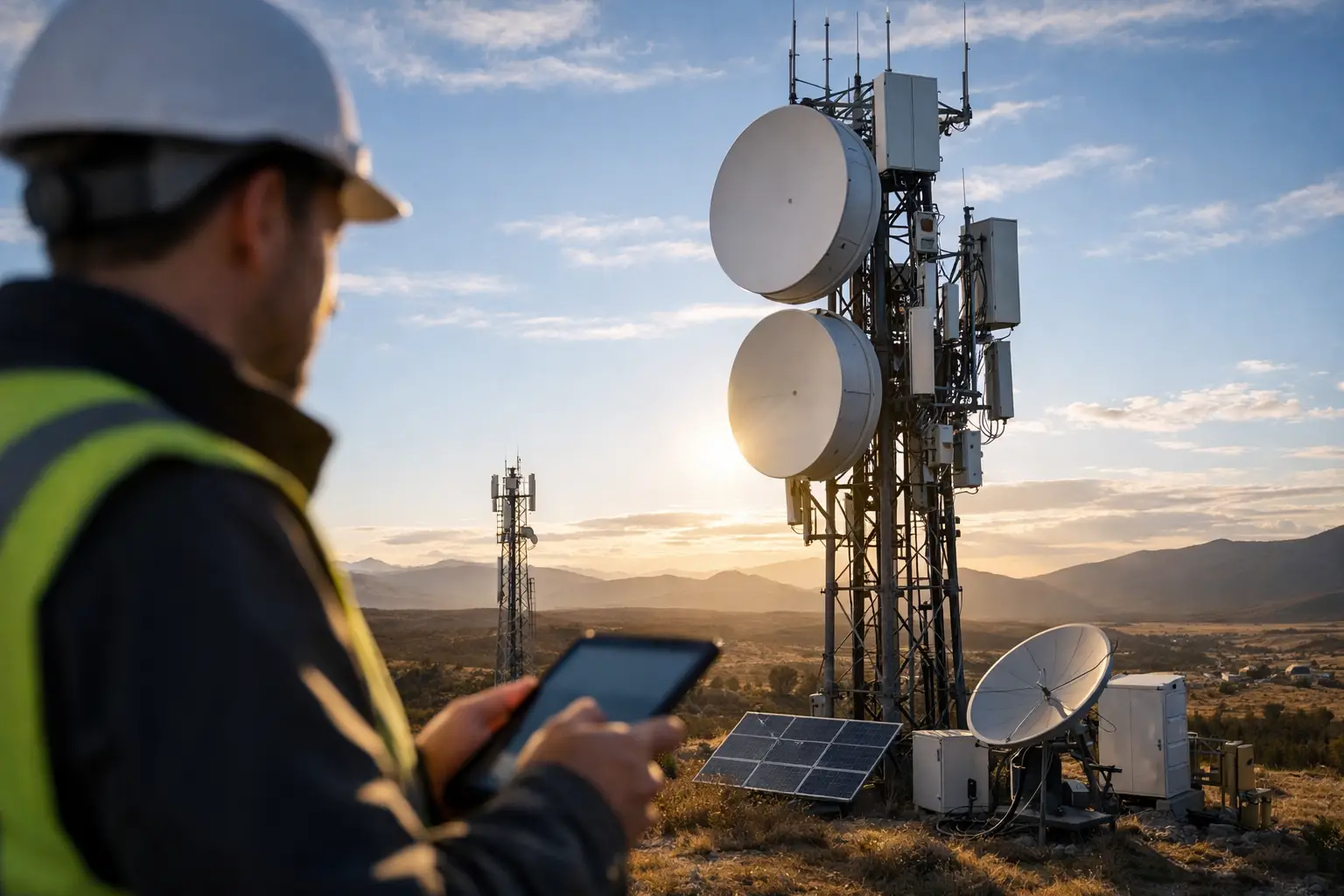
A 5G radio site can deliver excellent local coverage and still fail the mission if its transport path cannot carry the traffic, maintain timing, or stay online through weather and movement. That is the central challenge in how to plan 5G backhaul: the backhaul design must be engineered as part of the radio network, not selected after the access layer is installed. For industrial sites, vessels, disaster-response deployments, and remote field operations, the right architecture is determined by operating conditions as much as by peak throughput.
Start With the Operating Mission
Backhaul planning begins with what the network must support when conditions are least favorable. A fixed private 5G network at a mine has different requirements from a mobile command post, an offshore platform, or a vessel moving beyond terrestrial coverage. Define the coverage area, user count, applications, uptime target, mobility profile, and expansion horizon before choosing a transport medium.
Separate traffic by operational consequence. Real-time voice, video command feeds, safety systems, and control traffic need predictable latency, jitter, and packet delivery. General internet access, file synchronization, and noncritical telemetry can tolerate more variation. This distinction prevents an expensive design from being overbuilt for low-priority traffic while ensuring critical services receive the protection they require.
Also establish the actual demarcation point. The backhaul may terminate at a regional data center, a carrier point of presence, a cloud edge, an enterprise WAN, or a portable network core. Each option affects routing, security, latency, service-level expectations, and who owns fault isolation.
Build a Realistic Capacity Model
Do not size backhaul from a radio’s advertised peak rate. Air-interface capacity varies with spectrum bandwidth, modulation and coding, user distribution, interference, uplink demand, and radio configuration. The transport link must be sized against expected busy-hour traffic, with enough headroom for signaling, retransmissions, software updates, growth, and abnormal operating periods.
A practical capacity model considers three cases: typical traffic, busy-hour traffic, and mission surge traffic. A construction site may have predictable daytime usage, while public safety operations can move from low utilization to video-heavy incident response in minutes. An offshore asset may add temporary personnel, remote inspection systems, or high-definition cameras during maintenance windows.
Uplink demand deserves special attention. Many industrial and mission-critical deployments generate more upstream traffic than conventional consumer networks: body-worn video, drone feeds, security cameras, sensor aggregation, and remote expert support all consume uplink capacity. A symmetric or uplink-optimized backhaul path may be the correct choice even when a standard commercial broadband profile appears less expensive.
Match the Backhaul Medium to the Site
Fiber remains the preferred option where it is available, economically practical, and physically protected. It offers high capacity and low latency, but remote projects often face long construction timelines, permitting constraints, difficult terrain, and exposure to accidental cuts. Fiber can be the primary path without being the only path.
Licensed microwave is often the most efficient alternative for long-distance, high-capacity terrestrial links. With proper path engineering, licensed spectrum, and appropriately sized antennas, microwave can support dependable transport across terrain where trenching is impractical. It is particularly effective for fixed industrial facilities, remote towers, wind farms, and temporary-to-permanent expansion plans.
Millimeter-wave links can provide very high capacity over shorter paths, but they demand careful attention to rain fade, alignment tolerance, and path clearance. They are well suited to short, high-throughput extensions where fiber is unavailable or delayed. They are less forgiving than lower-frequency microwave on long paths or in severe weather environments.
Satellite provides reach where no terrestrial route exists, including maritime operations, isolated energy assets, and emergency deployments. Its trade-off is generally higher latency, variable capacity, and recurring service cost. Low Earth orbit services can improve latency compared with traditional geostationary options, but a design still needs traffic prioritization and realistic assumptions about availability, coverage, and contention.
In many field deployments, the best answer is hybrid. A licensed microwave path may carry primary traffic, while satellite or a second radio path provides continuity. The value is not simply redundancy on paper. The alternate path must have sufficient capacity and correctly configured failover behavior to carry the critical services that remain during an outage.
Engineer the RF Path, Not Just the Link Budget
For wireless backhaul, a clear line of sight is only the starting point. Path calculations must account for Fresnel-zone clearance, terrain, structures, foliage growth, reflection, multipath, atmospheric conditions, and local interference. A link that works during an acceptance test can degrade later because seasonal vegetation or site changes were not included in the design assumptions.
Availability targets should drive fade margin and equipment selection. A link supporting routine administrative traffic may tolerate occasional degradation. A link carrying private 5G core connectivity, emergency communications, or operational control systems requires a far higher availability objective, often with diverse paths rather than one oversized link.
Mobile and maritime environments introduce another layer of complexity. Vessel motion, vibration, wind loading, vehicle movement, and changing geometry can make manually aligned antennas inadequate. Stabilized microwave systems and auto-aiming antenna tracking can maintain the link as the platform moves, while adaptive systems help compensate for changing path conditions. The antenna, mount, inertial inputs, radio, and control software need to work as one system.
Plan Latency, Synchronization, and QoS Together
Capacity alone does not make a backhaul path suitable for 5G. The network must preserve latency and jitter within the needs of the applications and the selected 5G architecture. Centralized radio functions, edge computing, and cloud-hosted cores each place different demands on transport. Moving compute closer to the radio site can reduce latency, but it adds operational responsibility at the edge.
Timing and synchronization are equally critical. Depending on the radio design and spectrum use, the site may require reliable frequency and phase synchronization through GNSS, IEEE 1588 Precision Time Protocol, SyncE, or a combination of methods. GNSS is useful but can be obstructed, jammed, or unavailable in certain operating environments. A resilient design identifies the timing source, holdover behavior, monitoring method, and response if timing quality declines.
Quality of service must be enforced end to end. Classify traffic at the correct boundary, preserve markings through the transport network, and verify that queues behave as intended under congestion. If satellite serves as backup, define which services continue, which are rate-limited, and which are blocked. Trying to run every application unchanged over a degraded backup path usually causes all services to perform poorly.
Design Resilience Around Credible Failures
A resilient backhaul plan starts with a failure analysis, not a generic requirement for redundancy. Ask what can realistically fail at the site: a tower power system, fiber route, microwave radio, antenna controller, GNSS receiver, network core connection, or satellite terminal. Then determine whether two paths share the same tower, power source, cable route, carrier facility, or weather exposure. Shared dependencies can defeat an apparently redundant design.
Power is often the first limiting factor in remote deployments. Size backup power for the radios, switches, security appliances, antenna systems, environmental controls, and local compute that must remain active. Consider generator run time, fuel logistics, battery performance at temperature extremes, surge protection, grounding, and remote power telemetry.
Cybersecurity belongs in the transport plan as well. Segment management traffic, encrypt traffic where appropriate, control administrative access, and maintain configuration backups. Remote systems should provide secure out-of-band management whenever possible, because the most difficult time to troubleshoot a backhaul link is after the primary network path is already unavailable.
Validate in the Field and Operate What You Build
A design package should include more than a topology diagram. It should document path profiles, link budgets, antenna heights and azimuths, spectrum coordination, IP addressing, VLAN and QoS policies, synchronization design, power calculations, grounding requirements, failover logic, and acceptance criteria. That documentation allows teams to commission the system consistently and diagnose issues without relying on individual memory.
Field acceptance should test the conditions that matter. Measure throughput in both directions, latency and jitter under load, packet loss, timing quality, failover time, and service behavior on the backup path. For tracking systems, test movement through the expected operating envelope rather than confirming alignment only while the platform is stationary.
After commissioning, monitor transport performance continuously. Link margin, modulation changes, receive levels, packet errors, queue utilization, timing alarms, power status, and antenna position can reveal a developing failure before users report an outage. BATS Wireless designs these systems around that operational reality: backhaul performance depends on engineered paths, compatible radios, stabilized or auto-aiming antennas where required, and supportable field procedures.
The most effective 5G backhaul plan is one your team can operate under pressure. Build for the traffic you expect, the failures you can credibly anticipate, and the physical conditions your site will impose. That is how transport becomes a dependable extension of the 5G network rather than its weakest point.

October 10, 2026

October 10, 2026

October 10, 2026

October 10, 2026
