
Secure Backhaul for Critical Operations in the Field
Secure backhaul for critical operations protects mobile and remote networks with transport security, resilient paths, and field-ready design for harsh sites.

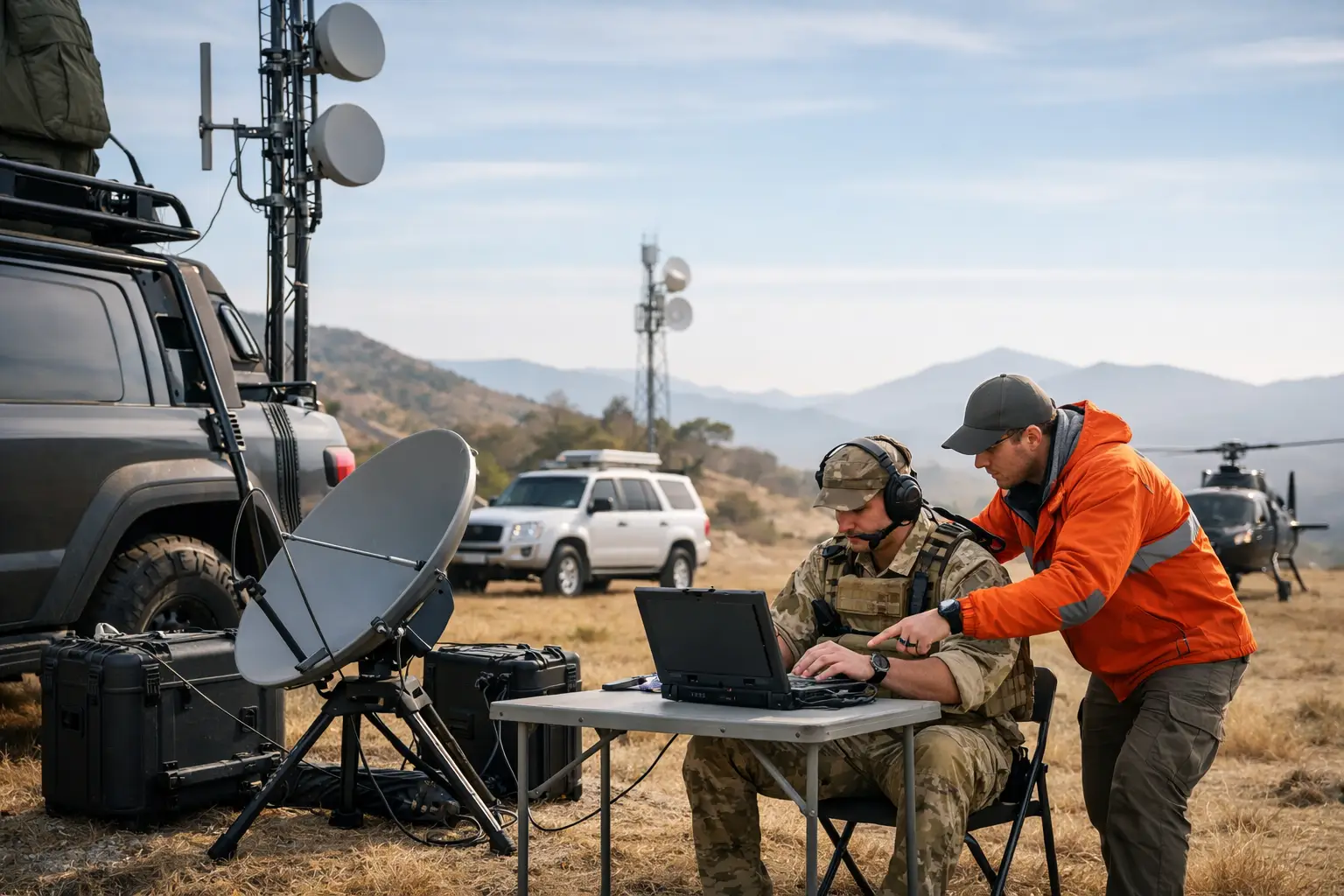
A command vehicle arrives at a disaster zone. A vessel clears the harbor. A drilling operation moves beyond terrestrial coverage. In each case, the local network may be well designed, but its value depends on one question: can traffic reach the command center, cloud resources, public networks, and other operational sites without interruption or exposure? Secure backhaul for critical operations is the transport layer that answers that question.
For mission-critical teams, backhaul is not simply an uplink with more bandwidth. It is a designed communications path that must maintain availability, protect sensitive traffic, support changing operational demand, and recover predictably when conditions deteriorate. That calls for an architecture built around the environment, mission priorities, and the consequences of a lost connection.
Why Secure Backhaul for Critical Operations Is Different
Enterprise networks often operate from fixed facilities with established fiber service, managed power, and predictable RF conditions. Critical operations rarely offer those advantages. Backhaul may need to span water, uneven terrain, restricted airspace, industrial structures, moving platforms, or an active incident scene. It may also carry traffic that cannot be delayed, intercepted, or rerouted through an untrusted network.
The risk profile is therefore broader than bandwidth. A microwave link can deliver high throughput and still fail the mission if its antenna loses alignment during vessel movement, if routing converges too slowly after a path failure, or if a remote radio is accessible through an unsecured management interface. Likewise, encryption alone does not create a secure system if the transport path is intermittently unavailable when dispatch, telemetry, video, or command traffic is needed.
A properly engineered design treats availability, confidentiality, integrity, and operational control as connected requirements. The backhaul must move the right traffic at the right priority while giving authorized teams visibility into link health, security events, and failover status.
Start With the Operational Requirement, Not the Transport Medium
The best backhaul technology depends on distance, mobility, spectrum, terrain, traffic type, regulatory constraints, and how long the network must remain in service. Fiber may be the preferred option at a permanent industrial site, while a stabilized microwave system is often a better fit for high-capacity maritime connectivity. A private LTE or 5G network may provide the access layer across a large work area, with point-to-point microwave transporting that traffic to the core.
The operational requirement should define the design. Network planners need to establish what traffic is mission-essential, the acceptable latency and packet loss for each application, and the real consequences of a service interruption. Push-to-talk voice, SCADA alarms, aircraft telemetry, body-worn video, high-resolution surveillance feeds, and crew welfare internet access do not require identical treatment.
This analysis drives capacity planning and quality-of-service policy. It also prevents a common deployment error: allowing high-volume, lower-priority traffic to consume the same limited transport capacity needed by command and control systems.
Mobility changes the RF design
Static point-to-point links can use fixed alignment and a carefully calculated path. Mobile operations require more. Vehicle-mounted, vessel-mounted, and airborne platforms introduce movement, vibration, roll, pitch, and changing line-of-sight conditions. In these environments, antenna tracking and stabilization are not optional enhancements. They are central to maintaining the link budget.
Auto-aiming antennas and stabilized microwave systems continuously correct alignment as platforms move. When paired with path calculation and compatible integrated radios, they provide a practical way to extend high-capacity connectivity across water, open terrain, or remote corridors where wired infrastructure is unavailable or uneconomical.
That capability must still be assessed against range, frequency band, weather exposure, and obstruction risk. Higher-frequency links can offer substantial capacity but may require more careful fade-margin planning. Lower-frequency solutions may offer better propagation in certain conditions but with different spectrum and capacity trade-offs.
Build Security Into Every Backhaul Layer
Security controls should be selected for the actual architecture rather than added as a generic checklist. The objective is to limit access, protect traffic in transit, reduce the blast radius of a compromised device, and maintain control when operations are distributed.
At the transport layer, strong encryption protects data moving across microwave, cellular, satellite, or other wireless paths. Encryption should be accompanied by authenticated endpoints and sound key-management practices. A link is not adequately protected if unauthorized equipment can impersonate a known endpoint or if credentials remain unchanged across deployments.
Network segmentation is equally important. The backhaul should separate operational technology, command systems, administration, video, guest access, and third-party connectivity according to risk and mission need. Segmentation limits lateral movement if a connected device is compromised and prevents routine user traffic from affecting critical services.
Management traffic deserves the same attention as user traffic. Engineers should use controlled administrative access, role-based permissions, multi-factor authentication where supported, encrypted management protocols, and centralized logging. Remote sites are often difficult to reach physically, which makes disciplined remote management essential. Default credentials, exposed web interfaces, and undocumented changes create unacceptable risk in systems that support safety, response, or production.
Design for degraded conditions and failed paths
Security cannot come at the expense of recoverability. Critical backhaul should have defined behavior when a primary path drops, capacity falls, or a site loses power. Redundancy may involve diverse microwave paths, a cellular or satellite secondary link, alternate aggregation points, or local survivability for essential applications.
The right approach depends on the mission. A temporary incident command post may need rapid deployment and a satellite fallback. A maritime network may use stabilized microwave as its primary high-throughput transport while maintaining cellular or satellite connectivity for continuity outside microwave coverage. An industrial site may justify physically diverse paths and redundant power because downtime directly affects production and safety.
Failover must be tested under load. A secondary link that works during a commissioning demonstration may not sustain prioritized voice, telemetry, and essential video traffic once the primary path fails. Define what remains available during degraded operation, apply traffic policies accordingly, and validate the result in conditions that resemble the field.
Secure Backhaul Design for Common Critical Environments
For public safety and disaster response, deployment speed matters as much as hardening. Communications teams need transport that can be established quickly, support private LTE or 5G coverage at the incident area, and connect reliably to dispatch and command systems. Portable, vehicle-mounted, and rapidly deployable systems should be designed with clear RF planning, protected management access, and a known fallback path before arriving on scene.
Maritime operations face a different set of conditions. Ship movement, salt exposure, changing distances, and limited access to shore infrastructure make antenna stabilization, weather-ready hardware, and proactive monitoring central design requirements. The backhaul must support onboard operational systems without allowing passenger or crew internet traffic to interfere with vessel communications.
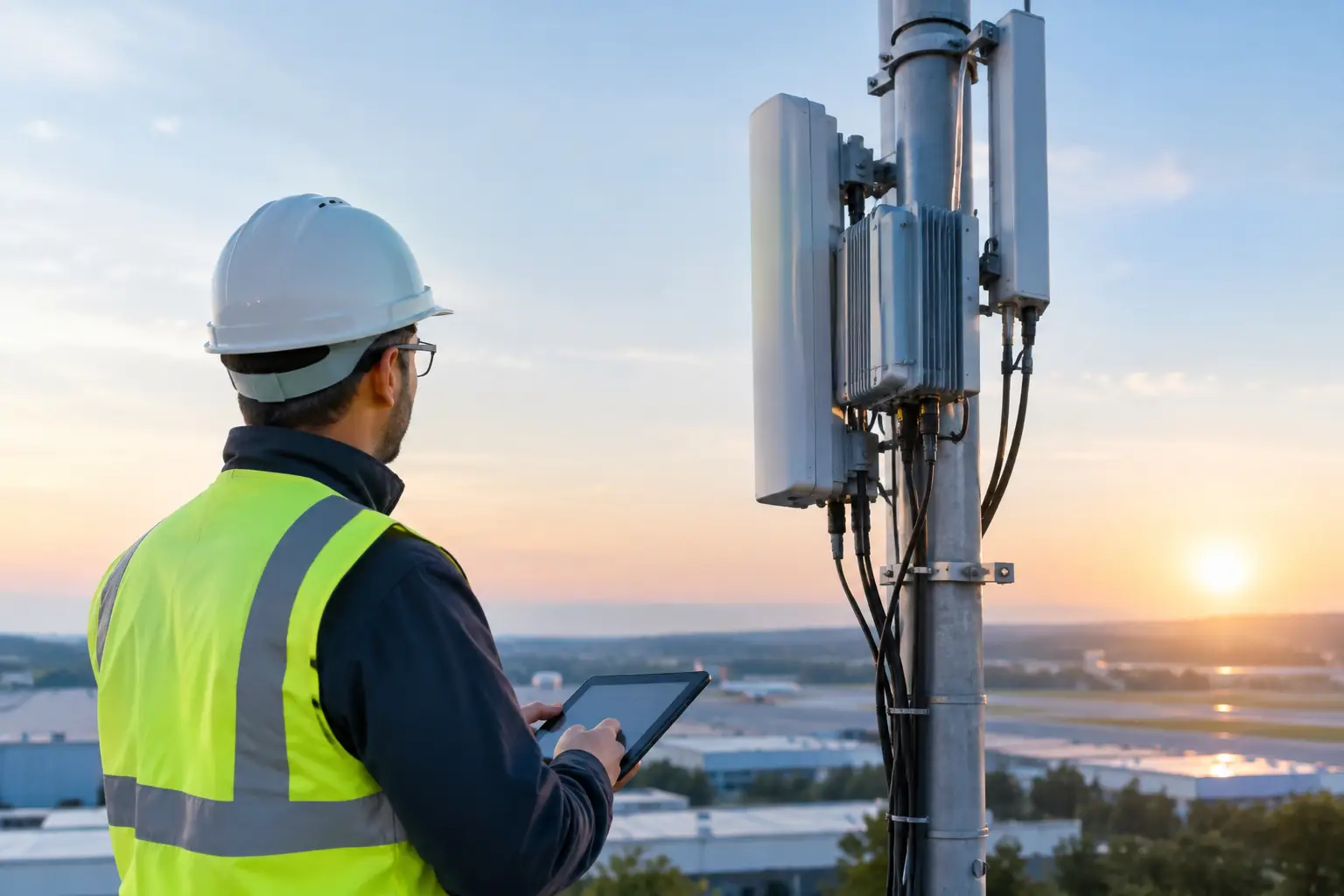
Oil and gas, wind, aquaculture, and remote industrial sites often require connectivity over large areas where trenching fiber is expensive or impractical. Point-to-point and point-to-multipoint wireless systems can extend broadband efficiently, but installation quality matters. Path surveys, mounting design, power protection, grounding, enclosure selection, and radio compatibility determine whether a system performs reliably after the commissioning team leaves.
Defense and government deployments may add requirements for interoperability, controlled access, frequency coordination, and operation in contested or restricted environments. In these cases, security architecture must align with organizational policy while retaining the flexibility to integrate radios, network cores, and field equipment already in use.
Operate the Backhaul as a Mission System
A secure design loses value if it cannot be monitored and maintained. Operations teams need visibility into throughput, latency, packet loss, RF signal levels, antenna alignment, power state, device health, and authentication events. These metrics help distinguish a capacity issue from an RF obstruction, an alignment problem, a failed power supply, or a security event.
Establish clear thresholds and escalation procedures before a deployment becomes urgent. A gradual decline in received signal level may indicate obstruction growth, hardware degradation, or mounting movement. Repeated authentication failures may indicate a configuration issue or attempted unauthorized access. Both are easier to resolve when the system provides useful telemetry and the response process is defined.
Configuration control is also a security control. Maintain current records of network topology, addressing, radio settings, software versions, encryption parameters, and approved changes. In remote operations, undocumented field modifications can turn a recoverable fault into a prolonged outage.
BATS Wireless approaches backhaul as an engineered operational system, combining antenna tracking, stabilized microwave, integrated radios, private cellular connectivity, and technical services around the deployment requirement. That matters when a standard broadband connection cannot account for movement, range, terrain, or the cost of communications failure.
The practical next step is to define the mission traffic, physical operating conditions, threat model, and recovery expectations together. When those requirements shape the RF path, transport security, and failover plan from the beginning, the backhaul becomes a dependable part of the operation rather than its most uncertain dependency.

October 10, 2026
October 10, 2026

October 10, 2026

October 10, 2026
