
Fixed Wireless Versus Private LTE for Field Networks
Compare fixed wireless versus private LTE for remote and mobile operations. See where each architecture delivers capacity, coverage, control, and uptime.

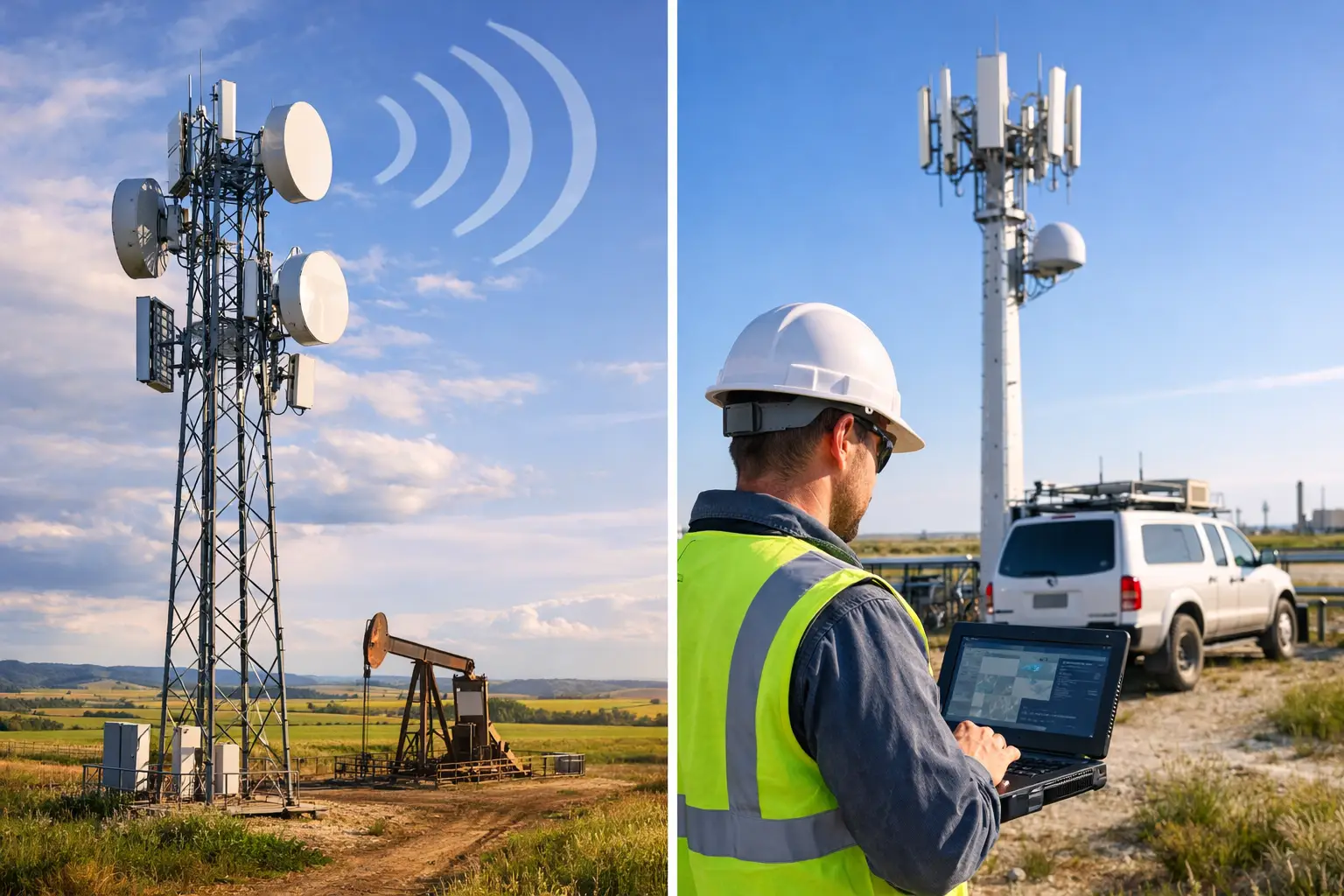
A remote operation loses its primary terrestrial circuit. A vessel moves beyond the shore network. A mine expands past the edge of carrier coverage. In these situations, the fixed wireless versus private LTE decision is not a simple choice between two radio technologies. It determines how traffic moves, which devices connect, how quickly the network can be restored, and whether communications remain usable when operating conditions change.
For many mission-critical deployments, the right answer is a layered architecture. Fixed wireless often delivers the high-capacity transport path that reaches a hard-to-serve location. Private LTE provides managed, wide-area access for users, vehicles, sensors, cameras, and operational equipment within that location. The distinction matters because each technology solves a different network problem.
Fixed Wireless Versus Private LTE: Start With the Job
Fixed wireless uses radio links to extend a network connection between defined locations. Those links may be point-to-point for a dedicated path, point-to-multipoint for several endpoints, or stabilized and auto-aiming for applications where one endpoint is moving. In practical terms, fixed wireless is commonly used for backhaul, site-to-site connectivity, temporary broadband extension, and high-throughput transport.
Private LTE is a dedicated cellular network operated for a specific organization, facility, fleet, or operational area. It uses LTE radios, a cellular core, SIM or eSIM-based identity, and licensed, shared, or locally coordinated spectrum. In the United States, CBRS is a common path for private LTE deployments, although spectrum strategy must be assessed for each project. Private LTE is designed to connect many mobile endpoints across a coverage area while giving the operator control over policy, quality of service, and device access.
The practical question is therefore not, “Which is better?” It is whether the immediate requirement is to move large amounts of data between locations or to provide dependable mobile coverage across an operational footprint.
Where Fixed Wireless Has the Advantage
Fixed wireless is often the most direct option when a network needs a high-capacity path faster or farther than fiber can be installed. A properly engineered microwave link can carry substantial traffic between a command post and a remote site, across a port, between offshore and shore facilities, or from a carrier point of presence to a temporary industrial operation.
Its strongest use case is a known path. When the endpoints can maintain a clear or engineered radio path, fixed wireless can provide predictable capacity and low latency without trenching, leasing new circuits, or waiting for a carrier construction schedule. It is particularly effective when the primary traffic consists of backhaul, video transport, data replication, voice, or internet service for a remote network.
Fixed wireless also has a role in mobility, but that role requires more than a standard directional radio. Ground vehicles, vessels, aircraft, and other moving platforms need antenna systems that maintain alignment while the platform changes heading, pitch, roll, or position. Auto-aiming and stabilized microwave systems address that challenge by continuously maintaining the path to the far-end connection.
The trade-off is that fixed wireless does not inherently provide cellular-style mobility for hundreds or thousands of endpoints. A point-to-point link may keep a site online, but it does not by itself manage handoffs, device authentication, traffic classes, or broad-area user access. It is transport infrastructure, not a complete mobile access network.
Fixed wireless is a strong fit when:
A deployment needs dedicated backhaul between defined points, high throughput for cameras or operations data, rapid connectivity at a site beyond fiber reach, or a stabilized long-range link to a moving asset. It is also a cost-saving solution where the expense and delay of civil construction outweigh the cost of engineered radio infrastructure.
Where Private LTE Has the Advantage
Private LTE is built for controlled mobility. A field technician can move between work zones, a vehicle can cross a large facility, and a handheld device can stay connected without repeatedly joining different Wi-Fi access points. The network recognizes the subscriber device and applies the defined access, security, and quality-of-service rules.
That control is valuable in industrial, public safety, defense, maritime, oil and gas, and logistics environments. Private LTE can separate operational traffic from guest or administrative traffic, prioritize push-to-talk and command applications, support video, and connect a broad mix of purpose-built devices. Its coverage footprint can also be designed around the actual work area rather than the economics of a public carrier network.
Private LTE is especially useful where Wi-Fi coverage becomes difficult to operate at scale. Wi-Fi remains valuable for localized, high-density indoor use, but large outdoor spaces, mobile equipment, and variable terrain can introduce roaming and coverage-management challenges. LTE was designed around mobility, controlled handoff, and scheduled radio access.
The trade-off is deployment complexity. Private LTE requires radio access network planning, spectrum coordination, a core network, SIM management, device certification, security design, and operational support. Coverage is not guaranteed simply because a radio has been installed. Terrain, antenna height, clutter, sector design, uplink requirements, capacity demand, and interference all affect the final result.
Private LTE is a strong fit when:
The network must serve mobile workers, vehicles, sensors, tablets, cameras, or autonomous equipment across a defined area; when the organization needs its own subscriber and policy controls; or when public cellular service is absent, congested, or unsuitable for the operating requirement.
Capacity, Coverage, and Mobility Are Different Measures
A frequent planning mistake is to compare a fixed microwave link’s headline throughput directly with the bandwidth of a private LTE sector. These figures answer different questions.
A fixed wireless backhaul link can be engineered for a dedicated high-capacity path. Its capacity is shared by the networks and services behind it, but it is not typically competing with a large number of directly attached field devices. A private LTE sector shares radio resources among active users. Its usable performance depends on radio conditions, spectrum bandwidth, application behavior, user density, and uplink demand.
Coverage also differs from capacity. Private LTE may cover a large acreage with relatively few sites, but edge-of-cell performance will not match performance near the radio. Fixed wireless may provide exceptional performance across a long path, yet it serves only the endpoints designed into that path. Mobility is different again: private LTE supports device movement within its coverage area, while moving fixed wireless requires tracking, stabilization, and a carefully engineered transport design.
For procurement and engineering teams, the result is clear: define the operational service first. Identify the number and type of endpoints, traffic flows, critical applications, tolerated interruption time, physical environment, and expected growth. Then size the access and transport layers separately.
The Combined Architecture Often Produces the Better Result
In demanding deployments, private LTE and fixed wireless commonly work together. The private LTE network provides the local access layer. Fixed wireless carries that traffic to a network operations center, cloud edge, carrier interconnect, or other remote location.
Consider a construction project operating beyond practical fiber reach. A fixed wireless path can bring broadband from the nearest available connection to the project perimeter. Private LTE can then distribute controlled coverage across equipment staging areas, work zones, offices, cameras, and mobile crews. As the project moves, the access network can be adjusted while the backhaul design remains aligned with the available transport path.
A maritime operation follows a similar pattern. Onboard private LTE can extend managed cellular service through the vessel for crew, operational devices, and onboard systems. Stabilized microwave or other long-range backhaul can provide the off-vessel connection when the route, distance, and shore infrastructure support it. The architecture must account for motion, sea state, antenna placement, regulatory requirements, and fallback communications.
This layered approach also improves resilience. A network can use multiple backhaul options, local traffic handling, and defined priority policies so that critical services retain a path when capacity becomes constrained. Resilience is not a single radio feature. It is the result of path diversity, power design, equipment hardening, monitoring, and a realistic failure plan.
Design Questions That Change the Recommendation
The choice changes quickly when deployment realities are examined. A flat, open industrial site with a nearby fiber handoff may be an excellent fixed wireless and private LTE combination. A densely obstructed facility may need more LTE radios, alternate backhaul placement, or fiber for part of the route. A remote operation with only a few fixed endpoints may need no private cellular layer at all.
Ask whether endpoints are fixed or mobile, whether traffic is predominantly uplink or downlink, whether coverage must extend indoors and outdoors, and whether the site can support towers, masts, power, grounding, and protected equipment enclosures. Evaluate the required availability, the impact of a link interruption, and the operational team that will manage the network after commissioning.
Security should be designed into both models. Fixed wireless links require secure management, segmented traffic, protected credentials, and physical safeguards at endpoints. Private LTE adds subscriber identity, core-network security, and policy control, but it still needs segmentation, monitoring, and an architecture that limits the effect of a compromised device.
BATS Wireless approaches these projects as complete communications systems, pairing industry-leading antenna tracking and stabilized microwave capabilities with private 4G/5G network design where the mission requires both transport and controlled access. The goal is not to force a single technology into every environment. It is to build a field-proven path that matches the asset, terrain, traffic, and continuity requirement.
The best next step is to map the operation as a set of connectivity paths: where data originates, where it must go, which users move, and what must continue working when the preferred path is unavailable. That map will show whether fixed wireless, private LTE, or an engineered combination is the network that can carry the mission.

October 25, 2026

October 25, 2026

October 25, 2026
October 25, 2026
