
Best Maritime Broadband Alternatives for Working Vessels
Assess the best maritime broadband alternatives for offshore vessels, from private LTE and stabilized microwave to satellite, with deployment trade-offs.

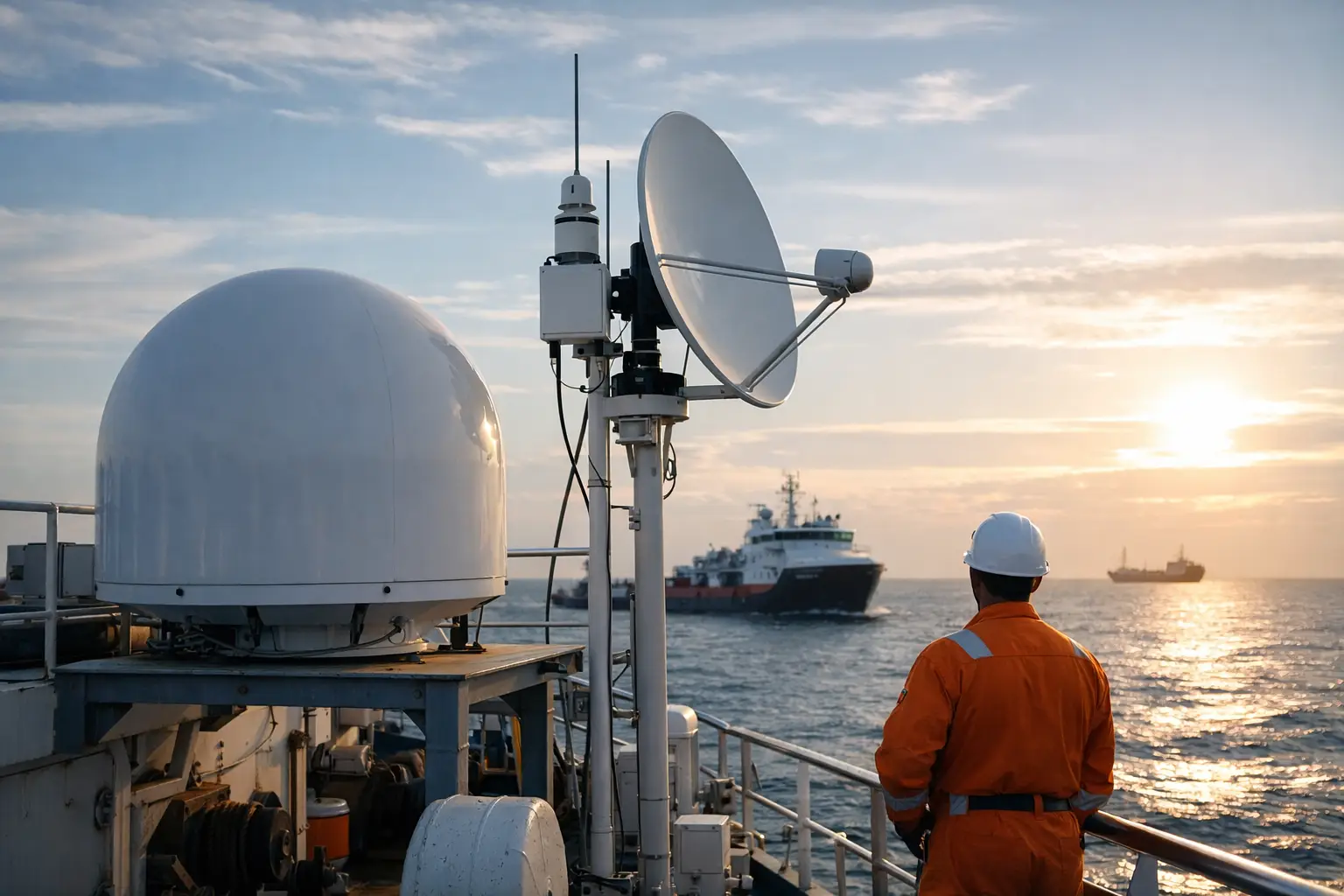
A vessel may be only a few miles from shore yet operate as if it were hundreds of miles offshore. Terrain, port infrastructure, sea state, antenna height, and network congestion can all turn a nominal coverage map into an operational failure. The best maritime broadband alternatives are not simply replacements for satellite service. They are engineered connectivity paths selected around where a vessel travels, what applications it supports, and how much interruption the operation can tolerate.
For commercial fleets, workboats, offshore support vessels, defense platforms, and aquaculture operations, broadband is now part of the operating system. It carries operational telemetry, navigation data, video, crew communications, maintenance access, enterprise applications, and sometimes private network traffic. Choosing the right architecture requires more than comparing advertised download speeds.
Start With the Operating Area, Not the Service Plan
Maritime connectivity decisions should begin with vessel routes and mission profiles. A harbor tug operating inside a defined coastal corridor has fundamentally different options than a survey vessel moving between shore, offshore platforms, and remote work sites. A fishing fleet may need wide-area coverage and basic crew access, while a windfarm service operator may require high-capacity video transfer and low-latency access to shore-based systems.
The practical question is not whether one technology is better in every setting. It is which network path delivers the required performance across the vessel’s actual operating envelope. That includes distance from shore, coverage overlap, expected motion, antenna clearance, application latency requirements, security policy, and the consequences of an outage.
A well-designed system also separates critical traffic from noncritical use. Vessel control, safety communications, operational data, and corporate access should not compete uncontrolled with crew streaming traffic or large software updates. This is where onboard network design, policy controls, and multiple backhaul options matter as much as the external connection itself.
Best Maritime Broadband Alternatives by Network Type
Private LTE and Private 5G for Defined Coastal Operations
Private LTE and 5G are strong alternatives where an operator controls, or can extend, shore-side coverage. They are particularly effective for ports, shipyards, inland waterways, offshore energy assets, windfarms, aquaculture sites, and recurring coastal routes. A private cellular network can provide predictable coverage, dedicated capacity, security controls, and direct integration with an organization’s existing network.
For maritime use, the network design must account for propagation over water. Radio signals can travel farther than expected across open water, but reflections, antenna placement, changing vessel height, and shoreline obstructions create coverage conditions that differ from a standard land deployment. Base-station location, sector design, spectrum planning, and vessel-mounted antennas should be engineered together.
Private LTE is often the practical starting point for operational mobility because device ecosystems are mature and coverage can be extended across large working areas. Private 5G may be appropriate where the operation needs higher capacity, additional device density, or specific latency and performance characteristics. Neither technology is a shortcut. Both depend on a properly planned radio access network and a backhaul design that remains available when conditions deteriorate.
Stabilized Microwave for High-Capacity Shore Connections
Stabilized microwave is one of the most capable maritime broadband alternatives for vessels that operate within line of sight of shore infrastructure, platforms, or designated relay points. It can deliver high-capacity, low-latency connectivity without relying on recurring satellite capacity for every operating hour.
The key requirement is maintaining the radio path while the vessel moves. Conventional fixed antennas are poorly suited to pitch, roll, yaw, and course changes. Auto-aiming antenna tracking systems continuously calculate and maintain alignment to the shore endpoint or relay node, allowing the vessel to sustain a microwave connection in dynamic conditions.
This approach is especially relevant for offshore construction, windfarm maintenance, port operations, marine research, and energy-sector vessels that follow known routes or remain within a defined operating area. It can support bandwidth-intensive applications such as live video, remote inspection, operational data transfer, private network backhaul, and onboard enterprise services.
Microwave does involve trade-offs. It requires shore-side infrastructure, path engineering, and careful treatment of antenna elevation, obstructions, link budget, fade margin, and handoff between endpoints. It is not the answer for unrestricted blue-water transit. Within its designed coverage area, however, stabilized microwave can be a cost-saving solution with performance that is difficult for shared public services to match.
Public Cellular With Marine-Grade Signal Management
Commercial 4G and 5G networks can provide useful capacity near coastlines, ports, and populated waterways. For many fleets, public cellular is an economical secondary path and, in some regions, a primary connection for routine operations. The difference between a workable installation and a frustrating one usually comes down to antenna quality, placement, carrier strategy, and traffic management.
A marine-grade cellular deployment should use external antennas positioned to reduce blockage from masts, cranes, containers, or superstructure. Multi-carrier capability can improve availability where one operator’s coverage fades before another’s. Dual-SIM or multi-WAN routing can then prioritize the best available path based on signal quality, cost, application type, and policy.
Public cellular should not be treated as guaranteed service. Shore networks can be congested, offshore coverage boundaries can shift, and roaming terms may create unexpected cost exposure. It works best as part of a layered architecture with automatic failover, rather than as the sole connection for mission-critical communications.
Satellite as a Layer, Not Always the Entire Architecture
Satellite remains necessary for ocean-going vessels and routes beyond terrestrial network reach. The choice is rarely satellite versus everything else. More often, satellite provides geographic continuity while private cellular, public cellular, or microwave handles higher-capacity and lower-cost traffic when the vessel enters coverage.
Different satellite services also have different operational characteristics. Some favor broad availability and mobility, while others offer higher throughput, lower latency, or more controlled service commitments. Antenna size, power draw, obstruction tolerance, weather performance, installation constraints, and service economics all affect the selection.
The operational advantage of a hybrid design is control. A vessel can use the most efficient available connection without losing access to critical applications when a preferred path disappears. Satellite then becomes the dependable fallback and offshore layer rather than the only broadband strategy.
Build a Maritime Network That Can Make Decisions
Multiple connections do not create resilience on their own. The onboard network must recognize path quality and apply rules that reflect operational priorities. A properly configured router or network controller can steer voice, video, vessel data, maintenance traffic, and crew internet access over different links. It can also fail over automatically when latency rises, packet loss increases, or a connection drops.
For example, a workboat approaching shore may shift routine traffic from satellite to LTE while preserving a critical operational session on the path that offers the most stable performance. A windfarm service vessel may use stabilized microwave for high-volume inspection video, private LTE for operational devices, and satellite for continuity outside the coverage zone. These decisions should happen through policy, not manual intervention by the crew.
Security belongs in the architecture from the beginning. Segmented onboard networks, encrypted tunnels, controlled remote access, identity management, and logging help protect vessel operations from both accidental exposure and deliberate intrusion. This is particularly important where a maritime network connects industrial systems, government assets, or critical infrastructure.
Deployment Questions That Determine Results
Before selecting equipment or service providers, technical teams should document the route map, anticipated dwell areas, vessel geometry, mast locations, power availability, and onboard application requirements. They should also establish measurable performance targets for uptime, bandwidth, latency, handoff time, and recovery after a link failure.
Field validation matters. A coverage design that looks acceptable on paper should be tested under actual vessel movement, expected weather conditions, and representative application loads. Network teams should test failover, confirm that antennas retain alignment, measure throughput at the edges of the coverage area, and verify that operational traffic remains prioritized during congestion.
BATS Wireless approaches these projects as integrated systems, combining stabilized microwave, auto-aiming antenna tracking, onboard networks, radios, and private LTE or 5G design around the mission rather than around a single product category.
The right maritime broadband alternative is the one that gives crews dependable access without forcing every application through the most expensive or least predictable path. Start with the vessel’s operating reality, engineer the coverage around it, and give the onboard network clear rules for what must stay connected first.

October 25, 2026

October 25, 2026

October 25, 2026
October 25, 2026
