
How to Secure Private Wireless in the Field
Learn how to secure private wireless networks at remote, mobile, and industrial sites through layered architecture, access control, telemetry, and tests.

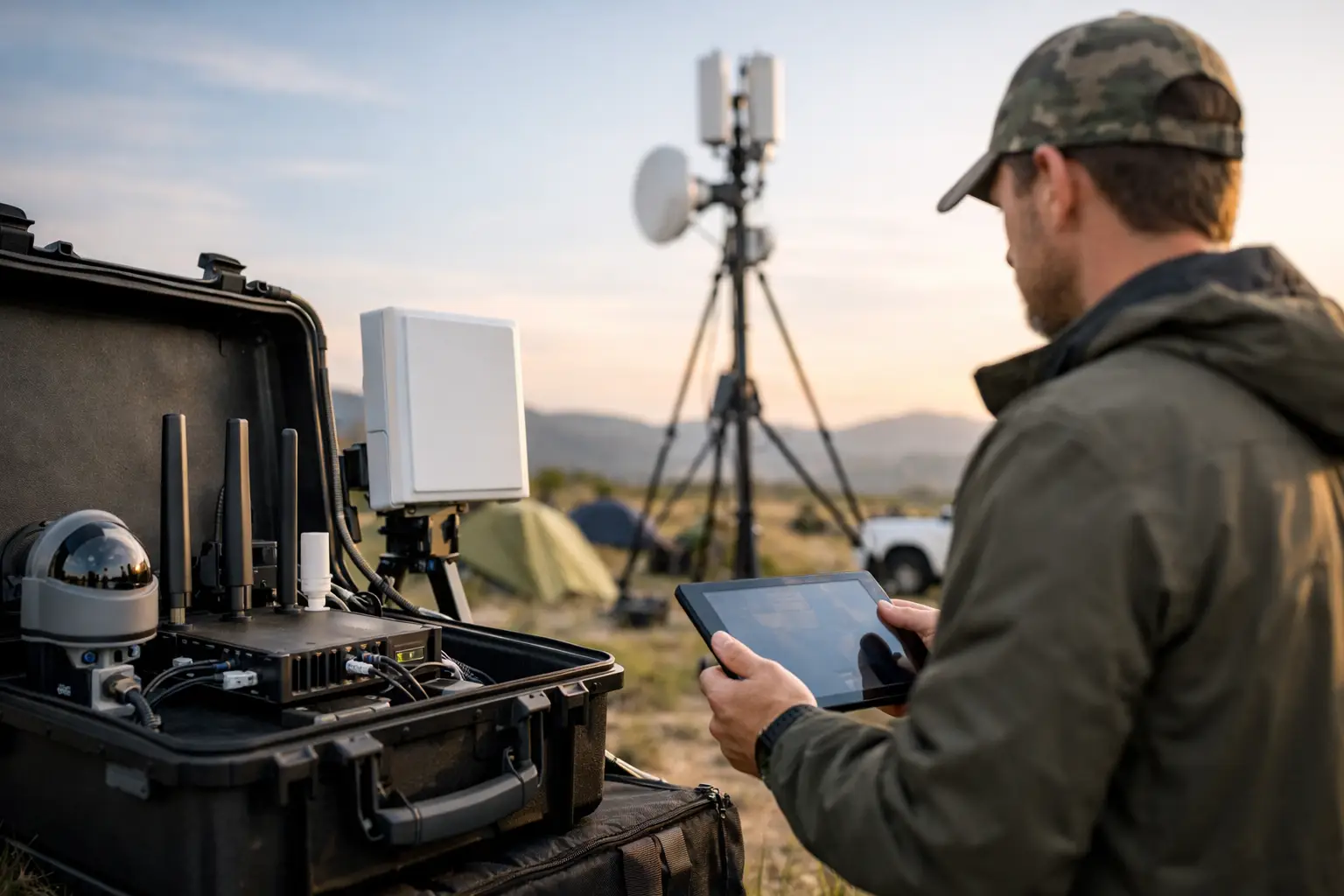
A private LTE or 5G network can extend operational broadband where commercial coverage is inconsistent, unavailable, or unsuitable for mission traffic. But understanding how to secure private wireless means looking beyond radio encryption. A network at a port, mine, wind farm, construction site, offshore vessel, or emergency scene is an end-to-end system. Its radios, SIMs, transport paths, core, management interfaces, and field equipment all require deliberate protection.
For operational teams, the objective is straightforward: allow authorized users and devices to communicate reliably while making unauthorized access, interference, lateral movement, and service disruption difficult to achieve and quick to detect. The architecture must support that objective even when assets are moving, backhaul is constrained, and technicians are working far from a data center.
Start With the Actual Risk and Operating Model
Private wireless security begins with a site-specific threat model, not a generic checklist. A fixed industrial campus has different exposure than a vessel using stabilized microwave backhaul, a public safety deployment that must be established quickly, or a defense operation with mobile command assets. Define which data, applications, users, and control systems the network carries, then identify what a loss of confidentiality, integrity, or availability would mean operationally.
The highest-priority risks commonly include compromised user equipment, stolen or improperly provisioned SIMs, exposed network-management services, weak administrator credentials, insecure remote support access, and attacks against the backhaul path. Radio jamming and spoofing also deserve attention in high-consequence environments. Encryption protects traffic content, but it does not guarantee that a radio channel will remain available.
This assessment should establish security requirements for each layer of the design: the radio access network, cellular core, IP transport, edge compute environment, enterprise connections, and operations tooling. It should also set practical recovery targets. If a field router, small cell, or antenna controller fails or is tampered with, who receives the alert, who can isolate it, and how quickly can service be restored?
Design Private Wireless Security in Layers
A private network should not rely on any single control. Cellular authentication is valuable, but it cannot compensate for a flat IP network or an exposed management port. A layered design limits the impact when one safeguard fails.
At minimum, the architecture should separate four functions:
- User and device access, including SIM or eSIM identity, device enrollment, and application authorization.
- Radio and core services, including the RAN, subscriber database, packet core, and signaling interfaces.
- Transport and backhaul, including microwave, fiber, satellite, or carrier connections between remote locations and the core.
- Management and support access, including orchestration platforms, radio configuration, monitoring systems, and vendor maintenance workflows.
Segment these functions using dedicated VLANs, virtual routing and forwarding instances, firewalls, and tightly defined policy rules. A camera, crew tablet, autonomous vehicle, and industrial controller should not receive the same network reachability simply because they use the same private wireless infrastructure. Segment by role, mission, sensitivity, and traffic destination.
For example, onboard operational technology may need access only to a local control application and a specific shore-side service. Crew welfare traffic can use a separate policy and internet breakout. This approach reduces congestion and prevents a compromised lower-priority device from becoming a path toward critical systems.
Establish Strong Device Identity and Access Control
The SIM or eSIM is a core security control in private LTE and 5G. Every subscriber should have a documented owner, purpose, device identifier, service profile, and approval path. Treat subscriber provisioning as an operational change, not an informal administrative task.
Use modern authentication methods supported by the selected core and devices, and avoid shared credentials for network administration. Privileged accounts should require multifactor authentication and role-based access. A technician who needs to commission a remote radio does not need the ability to modify subscriber policy, export logs, or change core routing.
Pair SIM identity with device identity wherever possible. An authorized SIM inserted into an unknown device should trigger a review or be rejected based on policy. Likewise, establish a process for lost devices, returned contractor equipment, failed field hardware, and emergency deactivation. In a mobile deployment, the time between a reported loss and subscriber suspension matters.
Access control also applies to applications. Private wireless can provide excellent coverage and low-latency connectivity, but the network should not become a broad trust zone. Require application-level authentication and encrypt sensitive traffic from endpoint to service, especially when data crosses shared transport or connects to enterprise systems.
Protect the Backhaul and Management Plane
In demanding environments, the backhaul is often the difference between a usable private network and an isolated radio island. Stabilized microwave systems, point-to-point links, satellite paths, and terrestrial circuits each introduce distinct operational and security considerations.
Encrypt traffic across untrusted or shared transport using appropriately designed VPN tunnels or encrypted carrier services. Authenticate both ends of the connection, control routing advertisements, and restrict traffic to necessary destinations. Avoid assuming that a directional microwave link is private simply because it is difficult to intercept. Physical location, antenna alignment, and spectrum use can add protection, but they are not substitutes for cryptographic controls.
The management plane deserves stricter treatment than ordinary user traffic. Do not expose radio, core, router, or antenna-management interfaces directly to the public internet. Use a controlled access path with multifactor authentication, least-privilege permissions, logging, and time-limited access for vendors and field personnel.
For remote support, a jump host or dedicated secure access service is generally preferable to persistent inbound rules. Record administrative actions where feasible. Configuration backups should be encrypted, access-controlled, and tested for restoration, because a backup that cannot be applied in the field is not a recovery plan.
Harden Field Equipment and Site Infrastructure
Private wireless deployments live in physical environments that can be difficult to control. Cabinets on a remote pad, radio equipment on a tower, onboard networking racks, and portable incident-command systems may face weather, vibration, limited power, theft, and unauthorized local access.
Use locked enclosures, tamper evidence where appropriate, controlled console access, and secure mounting for radios and networking equipment. Disable unused interfaces and services. Change default credentials before equipment enters service, maintain an approved firmware baseline, and verify the integrity of software images and configuration files.
Power resilience is a security consideration as well as an availability requirement. An abrupt power interruption can corrupt storage, interrupt monitoring, or force equipment into an unsafe recovery state. Design for clean shutdown behavior, battery backup where justified, and alerting on power anomalies. For mobile platforms, verify that network and antenna systems maintain their intended behavior through vibration, motion, and changing environmental conditions.
Monitor What the Network Is Actually Doing
Security monitoring must extend beyond whether a site is online. Collect logs from the cellular core, RAN, firewalls, routers, identity systems, and critical edge applications. Establish a baseline for normal subscriber activity, traffic flows, signaling behavior, radio performance, and administrative changes. Without a baseline, a compromised device or misconfigured policy often looks like routine field noise.
Useful alerts include failed authentication spikes, unexpected SIM activations, new devices using existing subscriber profiles, unusual traffic volumes, repeated administrative login failures, policy changes, and management access outside approved windows. On mobile and remote networks, monitor link quality and route changes alongside security events. A sudden performance shift can indicate interference, misalignment, a transport issue, or an attempted attack.
Centralized monitoring is valuable, but remote sites must continue operating safely when the monitoring connection is interrupted. Retain essential local logs, synchronize them when connectivity returns, and give field teams a clear escalation procedure. BATS Wireless designs connectivity systems around real transport conditions, where an adaptive link and well-defined fallback path can preserve operations while the root issue is investigated.
Test Security Before the Incident Tests It
Security controls should be validated during commissioning and at planned intervals afterward. Test the removal of a SIM, the loss of a backhaul link, failed administrator authentication, restoration from configuration backup, firewall policy enforcement, and device replacement procedures. Validate that segmented devices cannot reach systems outside their authorized role.
Penetration testing and vulnerability scanning are useful, but timing matters. Scanning a production industrial environment without coordination can disrupt sensitive equipment. Define safe testing windows, scope, rollback procedures, and responsible contacts. For high-availability operations, use a representative staging environment to test firmware, core updates, and policy changes before field deployment.
Document the network as it is built, including IP plans, radio inventory, subscriber profiles, software versions, antenna locations, transport dependencies, and emergency contacts. Accurate documentation shortens outage response and makes it possible to distinguish an intentional configuration from an unauthorized one.
A secure private wireless network is not the one with the longest security policy. It is the one whose access, transport, equipment, and operating procedures still hold up when crews are offshore, vehicles are in motion, weather is deteriorating, and the communications path becomes critical to the mission.

October 10, 2026

October 10, 2026

October 10, 2026

October 10, 2026
